
Leg 3: Decision Revisited

I read Of Mice and Men as a high school freshman. Despite going on to be a Literature major, reading several more Steinbeck novels (some more than once), that first book remains the only Steinbeck I’ve enjoyed. Perhaps it’s the length of it, or the ubiquity of the references to Lennie and his strength, or just Lennie himself. I’m drawn to his innocence, his good intentions, and the complexity that with his sweetness and innocence, he’s often a threat. He embodies the notion that what we don’t know can hurt us.

Photo by Yaroslav Shuraev on Pexels.com

We rejected the Zurich offer because Zurich had become a threat to us. To the education and the future of our children on the one hand, and to the death of a shared dream on the other. It looked to be a dead end.

Only this was a dream that wouldn’t quite die off. Through holiday travel and the ringing in of 2024, my husband continually brought up feelings of lament around the Zurich position.

“It’s really too bad…” he’d say.
“I wish they’d been able to offer…” he’d say.
“If only there were some other way,” he’d say.

And I’d sit torn between reflecting his lament back to him and encouraging him to move forward with his job search. Until he said, “I found another education consultant in Zurich.”

With intrigue and doubt, I responded, “Yes?”

“I want to have a consultation with her. The consultation is free. So, really, there’s no risk. We can see if she agrees with the other consultant, and, if she does, done deal. So long Zurich.”

“And if she doesn’t?” I asked, anxious about where the answer could lead.

“Well, if she thinks the kids could go to public school and still end up being able to attend university, I think I will contact HR at the company and see if I can have more time to think about it.”

I sat silently. Thinking. If several consultants note the impossibility, it could help him move on….

“What do you think?” Husband asked.

I shrugged my shoulders and raised my eyebrows in tandem with them, letting them all fall in unison. “Why not? The worst that can happen is they say no.” But, I thought to myself, I bet they wouldn’t. Not after all they’d invested in him.

Another 6:00 AM meeting with an education consultant later, Husband and I were convinced.

“It would not be easy,” said this second consultant. “You must have children who are really very unusual. They must work very hard. Even the Swiss children must work very hard. But to catch up and do gymnasium, this would be so difficult. I think, if you are very supportive of them, and you think they can do it, perhaps maybe they can.”

“Our kids are rather atypical,” we said. “They are bright and motivated, well-rounded and kind.”

“I want you to know,” I told her, “that when I say my children are unusual, I mean that in a very good way. And I do not say that just because I am their mother. I am a teacher. I see hundreds of students their age every year. I have taught my oldest son in my classroom, and teachers go out of their way to comment on how wonderful my youngest son is. But what is more, I did not give birth to them. They are not genetically mine. I do not see my children with the rose-colored glasses many mothers see their own children. Still, I can say they are exceptional.”

“If you are willing, then we will have to do some work. I will speak with the Zurich schools and see when it would be possible for them to take the gymnasium test. It will all be in German. So, in the meantime, you get a tutor for them. They must learn German. And some French, too, but German is the most important. I will also ask about them being given a trial year, so they can catch up their German even more — and maybe, by the end of that one year, they have to take a test again or something to prove they are in the right placement.”

“Intellectually,” we told her, “there’s no question. The challenge will be language acquisition.”

“Yes. Okay then,” she told us.

Photo by Skylar Kang on Pexels.com

Yes. Okay then. Time to contact the company to request an extension, allowing us to consider more options. Since it was January by this time, schools in Zurich were back in session, and we could contact them directly, making the whole process a bit easier.

After Husband got a green-light on the extension to consider the job offer, he spoke with friends who had once lived in Zurich to get information about the education system, the culture, the workforce etc.. I spoke with my teacher-neighbor, who was raised in Switzerland. Everyone said, “My goodness! Even if they do not get into gymnasium, they can still be very well educated in the apprenticeship system and go to university if that’s the path they choose. It might take them longer, though.”

“Oh, really?”

“Yes, they can even intern in a programming position or something that would be very useful that they may not learn at gymnasium anyway.”

“Hmmmm….”

Husband, now done with his job from 2023, put extra time into figuring out more about the Swiss/Zurich education system. Then, when I got home from school, he and I went for a daily walk around the block to discuss the current status of what was or was not possible, what was discovered, and what tossed out — as well as draw some conclusions together. We called it the Zurich Tete-a-Tete on our shared calendar, or, more informally, our Zurich Talk Walk.

We hired the consultant, the second one. She requested I send her transcripts and information about what levels of math my sons had taken before we met with her again so that she could pass it onto those in charge in the city of Zurich, to show them how wonderful our children were.

I gathered the information and sent the document that day so that we could meet again as soon as possible.

When we did meet again, the consultant informed us, “Yes, it is good with Mrs. S. She will let the children have a trial year if they pass the test. But, she said they must be able to do B1 German.”
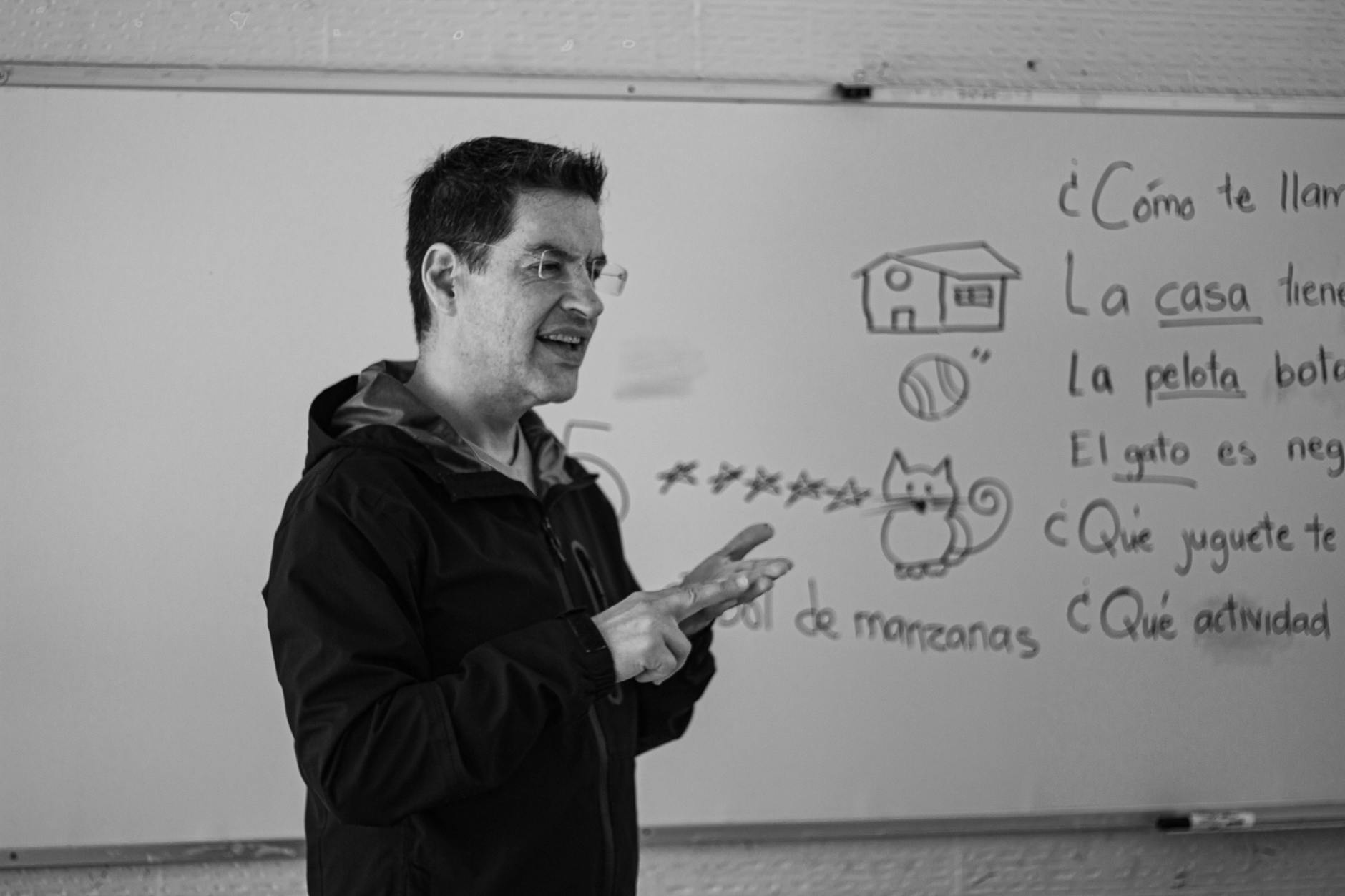
Photo by Fco Javier Carriola on Pexels.com

[Okay, time out. More about language. I took Spanish through 11th grade, opting out of AP Spanish my 12th grade year. I can get by in Spanish, and so I tell people I speak a little bit of Spanish. Which is true. But what does that mean when you hear it? Does it mean I can say hello, goodbye, thank you, and where is the bathroom? or does it mean I can write a letter and read a children’s book?or does it simply mean I’m not a native speaker but I am fluent? It depends entirely on the speaker because that person is calibrating their language ability for you. Then you have the same opportunity to interpret the phrase, regardless of how the speaker meant it. Did they mean they can say hello, goodbye, thank you, and where is the bathroom? or does it mean they can write a letter and read a children’s book? You see the problem.
Being a teacher, seeing a large swath of society, I can tell you with confidence, those who are perfectionists will undermine their abilities, and those who are trying to impress will exaggerate them.

[It is not this way in Europe. There, they use the Common European Framework of Reference (CEFR), which offers actual tests and certification, to declare someone’s language level. There are beginner levels, A1-A2, intermediate levels, B1-B2, and advanced levels, C1-C2. Instead of telling you I speak a little Spanish, I can tell you, I test at the B1 and B2 depending on the test and the day. For the boys to attend gymnasium for a trial year, they were to go from no German in December to B1 German in spring. That’s rough. It’s the equivalent of being a bit behind where I am in my Spanish despite their having a few months whereas I had a few years — admittedly with many years of forgetting since.]

Husband and I discussed it in our Zurich Talk Walk. If the boys don’t meet the language requirement, they go to secondary school and get to try to get into gymnasium at the end of the year anyway. That’s fine. BUT — for Older Son, that may well mean repeating a grade. If we could get him on board with that, we could say yes.

As further proof of my atypical children, not only did Older Son say he’d be willing to repeat a grade, so did Younger Son!

Husband and I took our Zurich Talk Walk around the block and decided. Let’s do this. It’s too big. Too possible. Even with things that could go wrong, we could come back if necessary. It would be one heck of an adventure, no matter what. Otherwise, we would be left forever wondering what may have happened, what we may have achieved or experienced. And that was a regret we weren’t willing to live with.

The threat of Zurich had faded, and everything around it turned into potential and possibility. Even if it was a terrifying possibility, it was also a thrilling possibility. Any threats we’d seen before transfigured into pathways, different journeys, none of which lead to despair, darkness, or death.

If you know Of Mice and Men by Steinbeck, you know it’s filled with death. Lennie often kills beings unintentionally. What you may not know is that the title wasn’t created by Steinbeck himself, nor was he the last to use it. The title comes from an 18th century poem by Robert Burns called “To a Mouse.” (You may read it if you have an affinity for Scottish poetry.) You are likely more familiar with Kurt Vonnegut, whether or not you’ve read his work, who, twenty or thirty years after Steinbeck’s novel, wrote, ” Of all the words of mice and men, the saddest are, ‘It might have been.'”

The narrative of George and Lennie is one of might-have-beens. The story of my family as ex-pats in Europe will transform from potential to actual. This blog invites you to witness the actualities with us.

What do you say? Are you ready to travel with us?

Photo by Element5 Digital on Pexels.com

We had a LOT to do before traveling — find out about the next steps before departure in the next leg!


Next

How Many Legs Can One Move Have? Leg 1: The Lead, which may be buried

Everything our family of four (and two dogs) possesses is now in my parents’ house — including us. Granted our belongings are no longer massive: approximately 25 small shipping boxes, 3 guitars, a typewriter, and 2 large suitcases per person. No furniture.

We are moving to Switzerland with stops along the way.

Stop 1: Still in Southern California, hours from the our home, I’m sitting in the house I grew up in. And now seems as good a time as any to look back on the last few months, breaking down how we ended up here. And how we will end up there. To do that, I’ll have to venture back in time a bit, and start somewhere near the trailhead for this journey.

My husband and I have talked about him leaving his job for years. He is a much nicer, much gentler, much more optimistic person than I am, so whenever I said, “It’s not gonna get better,” he’d say, “Well, they just said they would do…” (He’s a big believer in people — one of the reasons I love him — and also one of the reasons it took a while for him to leave his job.) And he’d go on working there for months and months, and we’d go through this cycle of discussion regularly.

Until he couldn’t take the stress or the angst anymore. Around the start of the school year, he told the company he was leaving at the end of the calendar year, 2023. The discussions between the two of us regarding his job shifted, necessarily, from the usual cycle we’d grown accustomed to to the unknown of the job market.

With a stable job as a teacher and a good school district for our sons, I wasn’t particularly keen to move. Still, I knew it was a real possibility that, as my husband applied to or networked for jobs that fit his particular set of (esteemed) skills, it may not be in the San Diego area. He’s a physicist. A chemical physicist. A physical chemist. It all means the same thing to me; which is to say, I don’t know what it means. (And, yes, I have no idea what he’s talking about when he tells me his tasks and shows me his graphs of what he’s working on; I just read his intonation to figure out if he’s excited or disappointed about what he’s discovering.)

“Maybe I can do something else,” he’d say, “in order to keep us here for sure. Then the boys could graduate here, at least.”

See? Sweet, gentle, giving man. Looking to make it easier for others.

“Like what?” I’d ask — though I don’t know why, because, no matter what he might be doing for a living, I’m not likely to understand a lick of it.

“I basically do a lot of data analysis now, I could probably do something in that field. I know…” or “I know a lot about ____,” and he’d continue with his list of people he knows in all sorts of fields who could help him find a job locally.

So he did everything: worked at the job he was leaving, looked for local jobs, and looked for jobs that could take us to, well, anywhere. He was speaking with companies in Paris, London, one somewhere in New Zealand, San Diego, Boston, Los Angeles, San Jose, and, of course, Zurich. It felt as though there were leads everywhere. So many, to me, that I set it on the shelf in my mind until something was more tangible. Meanwhile, he had to consider everything as imminent.

“There’s a company in Zurich,” he told me one morning, “doing direct air capture.”

This was before my morning coffee, so I did not know if Zurich was the neighboring town in San Diego or a Hawaiian island. Direct air capture sounded like logical words; I’d have to translate them later, after caffeine.

“Cool,” I said, probably with little enthusiasm.

“They have a few job openings I’m interested in. What do you think about Switzerland?”

Okay. Time to wake up, I thought. “Switzerland would be cool.”

“You know my family is Swiss? We’re from Bern.”

“Yeah, cool,” I said.

He applied to several positions at this company in Switzerland, and soon they requested an interview.

I confess, as long as I was going to a full-time job myself, working with the lovely young generation of middle schoolers I found myself with each morning, I didn’t have much headspace for his job hunt. I was excited and proud for all his leads and phone calls and even interviews, but I’d drop those thoughts for most of the day to be Teacher and then Mom. He could give you the more gripping version of this — alas, he’s busy doing consulting work these days, but we will get to that — much later.

For both of us, this job hunt felt long. Leads, leads, then nothing. Phone calls, phone calls, then quiet. It was early November when this company in Zurich, having already conducted several interviews online, told him they’d like to fly him out to have an onsite interview.

Now, if my husband is the big believer in the ability for everyone to change and things to go well, I am the bare-bones, just-the-facts, pragmatic bottom liner. So my train of thought was, “They’re willing to fly him from San Diego to Zurich? They’ll have to put him up in a hotel. That’s thousands of dollars. They are offering him the job.”

Time to learn German.

In fact, I was sitting in a traffic jam outside Lahaina on a family vacation when I figured, might as well capture this time for tutelage.

[Okay, my American friends. I know you speak English and, I don’t know, maybe a little Spanish or French you learned in high school, but you probably haven’t used it much since. So now I’m talking about European languages, yes, but I’m talking specifically about the tiny country of Switzerland, best known, I’d say, for their chocolate and their tennis star, Roger Federer. If you aren’t a tennis fan, that’s okay, and if you aren’t a Roger Federer fan, that’s really not okay, but I’m going to give you a chance to change that. Either way, you need to know that one of the most impressive things about elite tennis players in general is that they play in hours-long matches, sprinting from side to side, playing mind games with their opponents, for sometimes three or four hours before a winner is declared, and then, after all they’ve done, someone shoves a microphone in their face for an on-court interview in the language of the location. At the French Open? Speaking French. Wimbledon? That’s English. And most of these athletes are neither French, British, or American. So, take Roger Federer, an all-time great who has won every grand slam tournament there is. And, of course, he’s Swiss, but he’s gliding through these interviews in English just as he glides on the court. Same thing in French. And he’s also spoken in Italian and Mandarin in the post-match interviews, depending on where the match itself is located. Anyway, I digress. The point is I know English. I’m great at English. I know a little Spanish. I can get by with my high school Spanish. I do not know any other languages anywhere near proficient enough to survive a basic conversation, and we are talking about moving to Switzerland where the spoken language, Roger Federer’s first language, is Swiss German.]

Switzerland has four official languages, and none of them are the language Swiss children learn first. Although Swiss German is spoken, it has no grammar. It’s not really a written language. I like to think of it as the opposite of a language like Latin. In English, we call languages like Latin that are no longer spoken, a “dead language.” Swiss German isn’t dead; it’s spoken, but only spoken. I wouldn’t call it a “live language.” That seems like it would be a written and spoken language. So, not being a linguist as previously proven, I’m going to call Swiss German a “spirit language.” I think it fits. It’s not confined by grammar (aka structure, like a skeleton) so it can’t have a body. It’s not dead, it has no body, it must be spirit.

Again, I digress.

In Switzerland, the four official languages are German (thus where I began), French, Italian, and Romansh (which I’d never heard of in forty years of living). Swiss German is not an official language. Hmmm….

If my husband is going to be offered a job in Switzerland, I need to get on my language game to consider the offer seriously.

Why did I pick German to begin with? I don’t recall, though I can substantiate it with logic. I’m sure you can, too. Say “Zurich.” Really. Say it. Out loud. Whisper if you must. If you hadn’t any idea where this place was but knew it was a place where they were likely to speak German, French, Italian, or Romansh, which would you go with? German, of course. The “ch” at the end of the word chokes of guttural phlegm production. Must be German.

I open my language app I use for Spanish — since I am a teacher in the San Diego area. “Which one of these is coffee?” it asks. My choices: Milch, Kaffee, Brot.

I’m going to rock German, I think.

“Which one of these is milk?”

I’m already fluent.

“Du bist ein Dummkopf.”

Strange. I don’t know how to translate that.

So I’m sitting in a rental car in a Hawaiian traffic jam caused by I-don’t-know-what, learning German.

“I want to learn German!” I hear from the back seat. “Can I do that, too?” asks the younger of my two sons.

“Sure,” I say, thinking only about the fact that he seems exhilarated by the idea and that would make for a good distraction as we move the width of three palm trees per minute.

Then I realize I’m about as exhilarated internally as he is externally about the idea of learning another language and about the notion that we could be living abroad. I’ve always wanted to live abroad. I spent a summer in Hungary teaching English in preparation for a year in Budapest, which fell through at the last minute. And no, I don’t speak Hungarian. I am even, somewhere, on tape — yes, tape — as an eighteen-year-old at my high school Grad Night being asked about the Twenty Year Reunion twenty years in the future. (Now, when I hear this question being posed to a graduate of a few hours, my left eyebrow raises, but at the time, I took it in stride and said) “I won’t be at the reunion. I’ll be living in London.”

Which, of course, did not happen.

But my motivation for saying that was partly about living abroad — and partly about being a book editor, which, also, didn’t happen.

Arranging for an on-site interview in a country nine hours ahead of you is a bit challenging. 9:00 AM in Switzerland is midnight on the California coast. 5:00 PM there is 8:00 AM in San Diego. So, their work day overlaps with our early morning sleep schedule. Since our household gets up between 6am and 7am, we have about an hour or two each day to contact Switzerland live. Otherwise, all communication must be conducted at a snail’s pace via email, waiting through the night to receive a response — if they get to it in fewer than 24 hours.

Eventually, the interview was set for Monday November 20th. Thanksgiving week here in the States. Just another work week there in Zurich.

KZ sitting on the Hawaiian coast, not too far from Lahaina, Maui

No, of course, that’s not all! That’s the first leg. You thought I could tell this whole thing in one post??!

Don’t worry, Leg 2 is coming. We’re going to need at least a second leg so that I don’t fall over.