Mount Rigi, Switzerland

All photographs in this post are unedited and accredited to KZRochelle

This post includes: The Story, Travel by Train, The Bookish Connection, Scenes from Above, and Return Home.

The Story

One month in Switzerland, and we had already arrived at the first family birthday. The honors of the first Swiss celebration fell to my youngest son, so Younger chose the event of the day — sort of.

“I want to go to the Alps,” he declared without hesitation. The hesitation belonged to Husband and to me.

It’s late May; down in the city of Zurich, most days all you need is a light sweater. The Alps are still covered in snow — and, as a result of our minimization of material goods in our move, we have a small selection of clothing to don. As Southern California beach-dwellers, our winter attire leaves something quite a lot to be desired.

In addition, we have our two dogs to think about; we can’t leave them home all day, and they haven’t been on a long journey since the flight from Los Angeles to Zurich. (Should I tell you about the flight in the Leaving San Diego chapter? Leave a comment.)

We had to tell Younger about the problems his birthday wish posed on a practical level.

“If we can’t do that,” Younger said with poorly hidden discouragement, “maybe we can watch Friends all day.”

Husband and I retreated behind closed doors to discuss without an audience.

“We’ve got to make this happen for him.”

“But a trip to the Alps is hours and hours away, right? We can’t get into the Alps.”

As Zurich-region residents, we live in the Northern part of Switzerland, close to Germany. The Alps are in the Southern half, closer to Italy, though they do take up a gigantic portion of Switzerland. That’s the technical term recorded in all topographical literature.

While Switzerland is not a large country (especially to those of us who are accustomed to the size of the United States), it takes close to two hours to travel the nearly 150km from Zurich to the Alps. To be at the base. If we were to do that, we would not have time to get into the mountains themselves before needing to return for evening festivities.

We’d already booked the evening, having promised Younger a Thai dinner for his birthday that night. That promise had hung in the air for over a week. It wasn’t getting changed.

Husband worked his magic and found we could split the difference if we traveled to Mt. Origi, originally called Mt. Rigi, but renamed after footballer (soccer player) Divock Origi after he scored a brace (two goals) in Liverpool FC’s iconic comeback over Barcelona in May of 2019, including the sneak-attack corner kick from Alexander-Arnold.

With a peak at 1800 meters (or 5900 feet — over a mile for those of you who didn’t grow up with mathematicians for parents), Rigi would allow us to look out on the surrounding land which included three lakes, and, of course, the Swiss Alps to the South. We wouldn’t even have to hike up to the peak, though we could some other time — when we had the time — we could take the cogwheel train to the highest point. [Check out this map of routes which is also available in brochure form, in several languages, at the base.]

“Let’s do it,” I said. “And that Divock Origi thing? He’s Belgian! Why would a Swiss mountain be named after a Belgian playing for an English club?”

“Yeah, I know. Of course it’s not really called Divock Origi Mountain or Mt. Origi — except, perhaps, to Liverpool fans.”

“So, just us?”

“Yeah, just us.”

Actually, according to JungFrau Tours, Mt. Rigi’s name origin is disputed — though only Husband has placed a Belgian athlete in the mix. While some say Albrecht von Bonstetten, a Swiss humanist, named the mountain in the late 1400s, calling the mountain Regina, others say it’s more likely derived from local phrases for the grass and rocks that band around the mountain. Either way, Mt. Rigi is also referred to as Queen of the Mountains.

arrow pointing to location of Mt Rigi on map of Switzerland
Map of Swtizerland featuring Rigi courtesy of SwissFamilyFun.com

RETURN TO TOP

Travel by Train

Our family of six was able to get tickets on the train from Zurich HB (the main train station) to the Arth-Goldau station. We decided we would take the dogs instead of leaving them home for a bit more time than we were comfortable only to come home, shower, and leave again for dinner.
Duration: 45 minutes
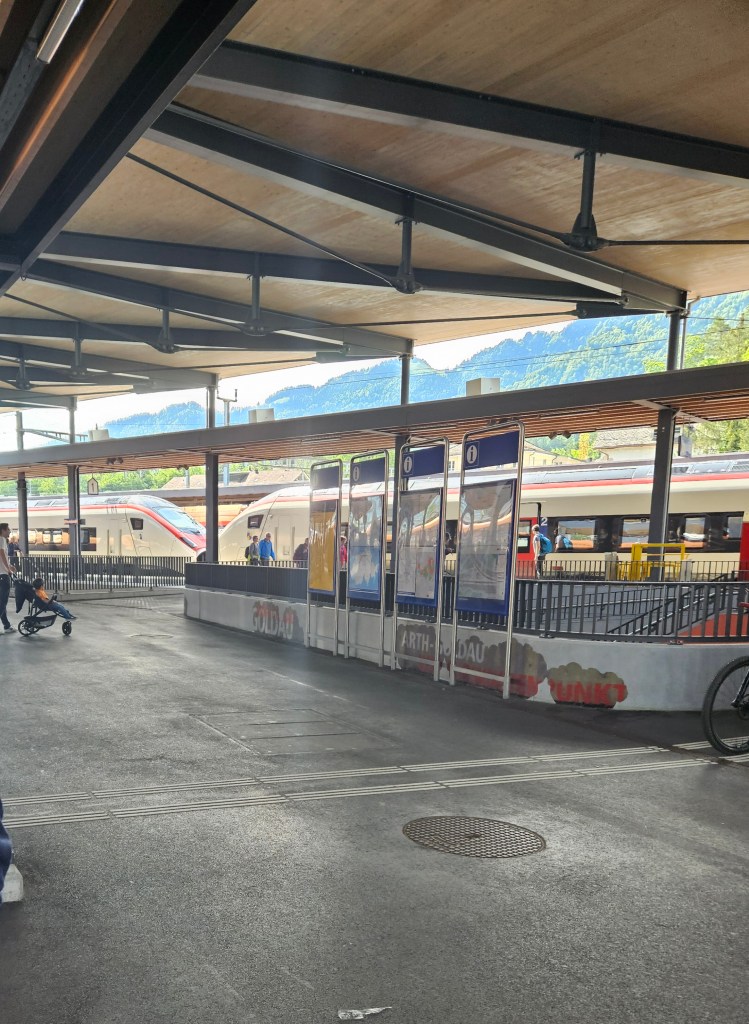
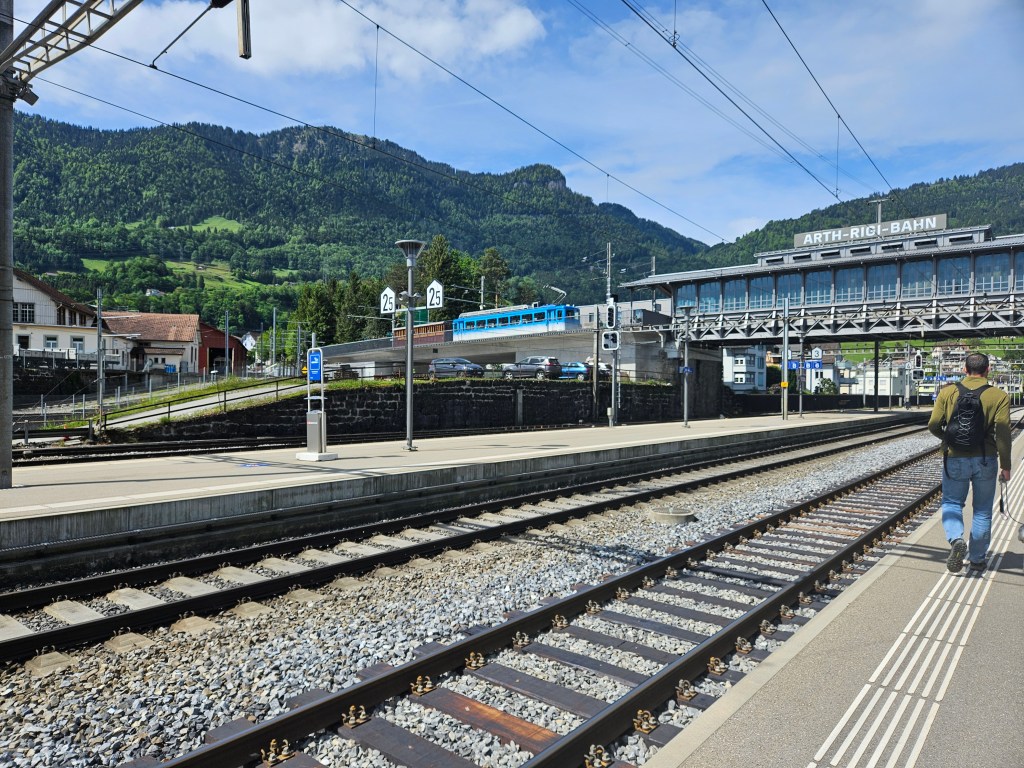
Arth-Goldau Station
Mt. Rigi in the distance straight ahead; train platform and cog train visible approximate 50 yards ahead.

Once we arrived in Arth-Goldau, we walked about 5 minutes to the cogwheel train station. We boarded to go all the way to the peak, Rigi Kulm, though many passengers got off at the several stops along the way — presumably for excursions on foot. [Check out this map of routes which is also available in brochure form, in several languages, at the base.]
Duration: 45 minutes
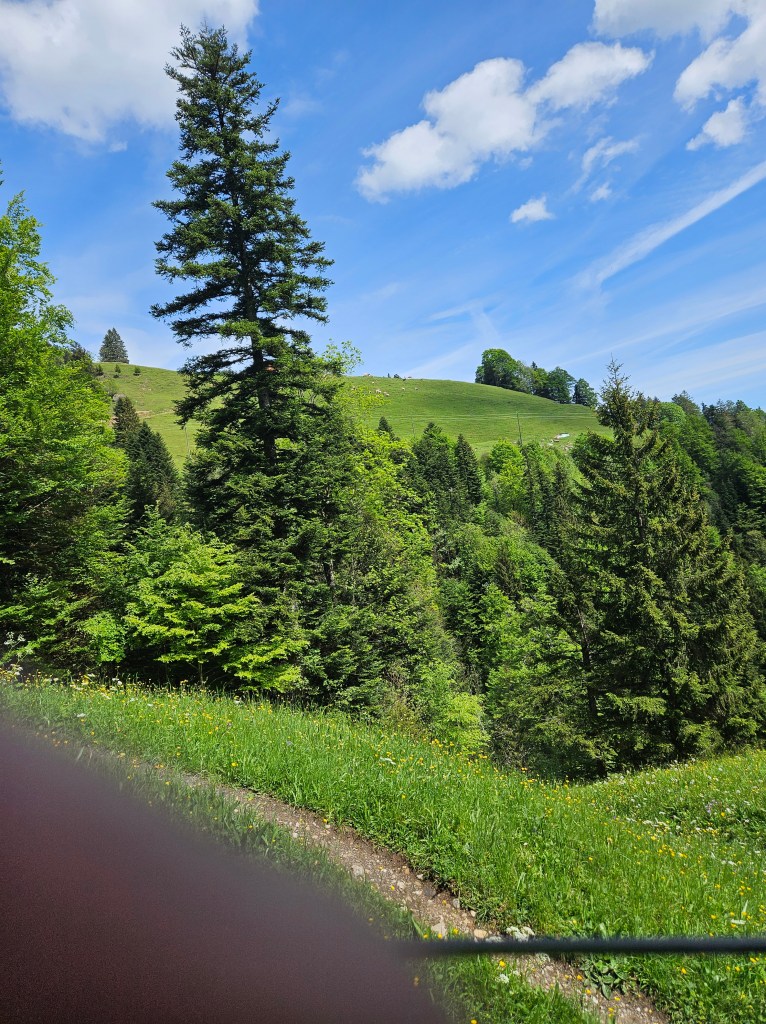
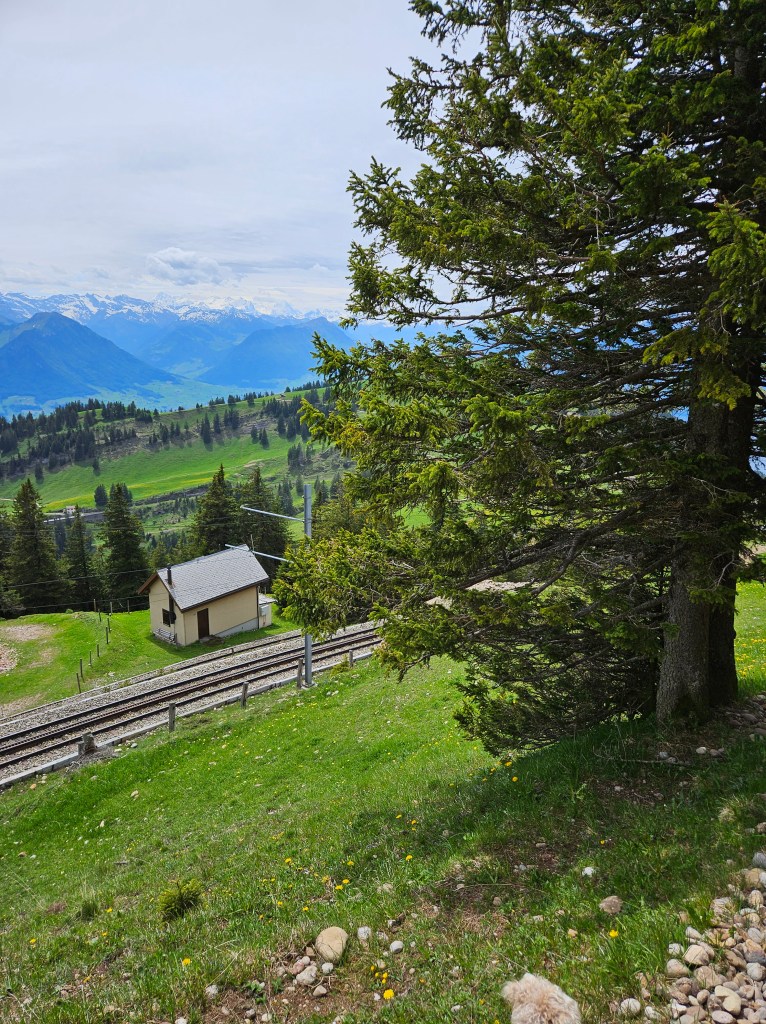
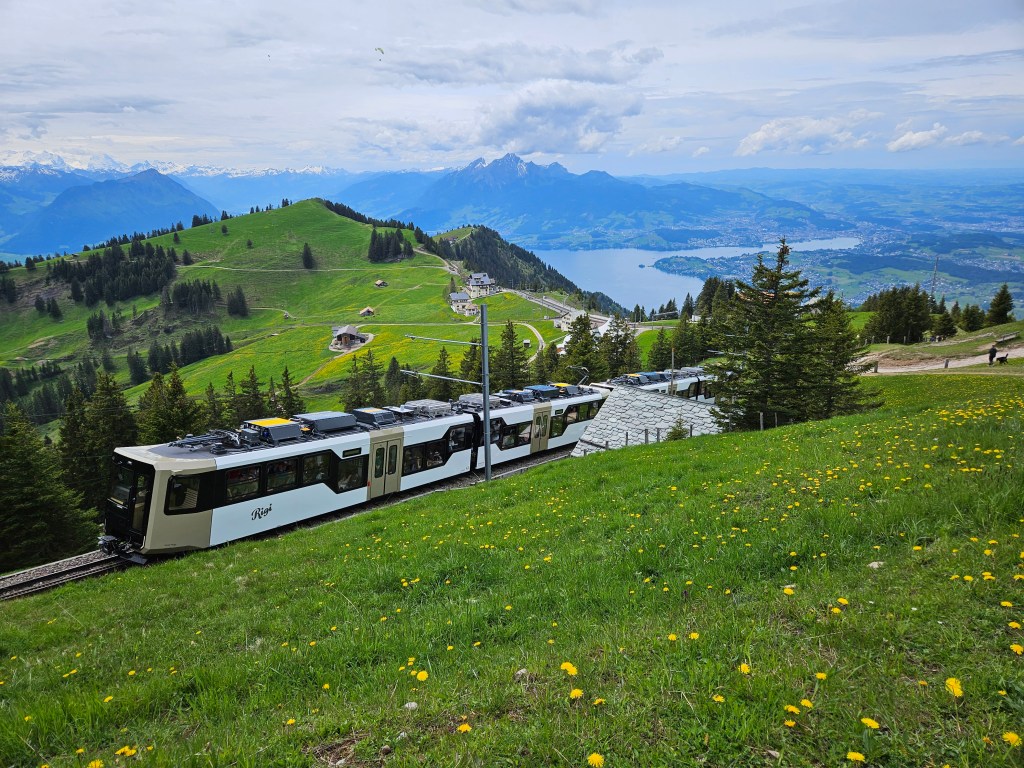
We boarded what was originally Europe’s first cog railway which fascinated Husband more than anyone else. We were almost all mesmerized by what appeared out the window on the ascent though. Only Older had his nose in a book and missed that opportunity. Out the window, we saw numerous hikers, plenty of cows (Younger and I won the Cow Game), and several hotels in which to stay.
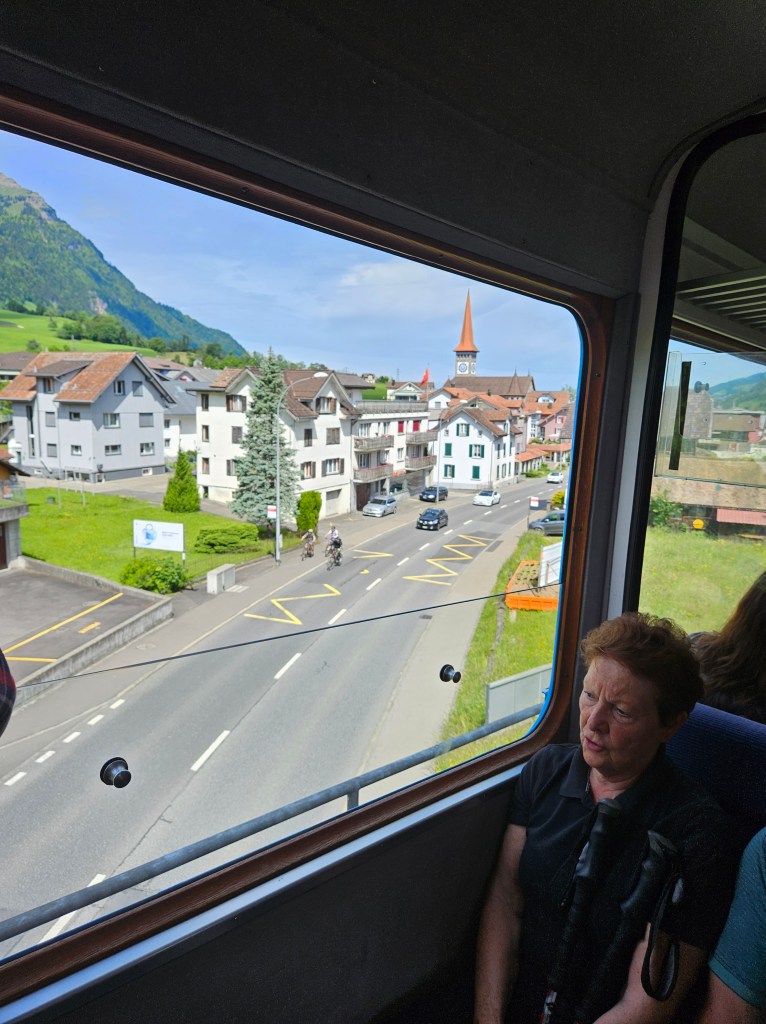
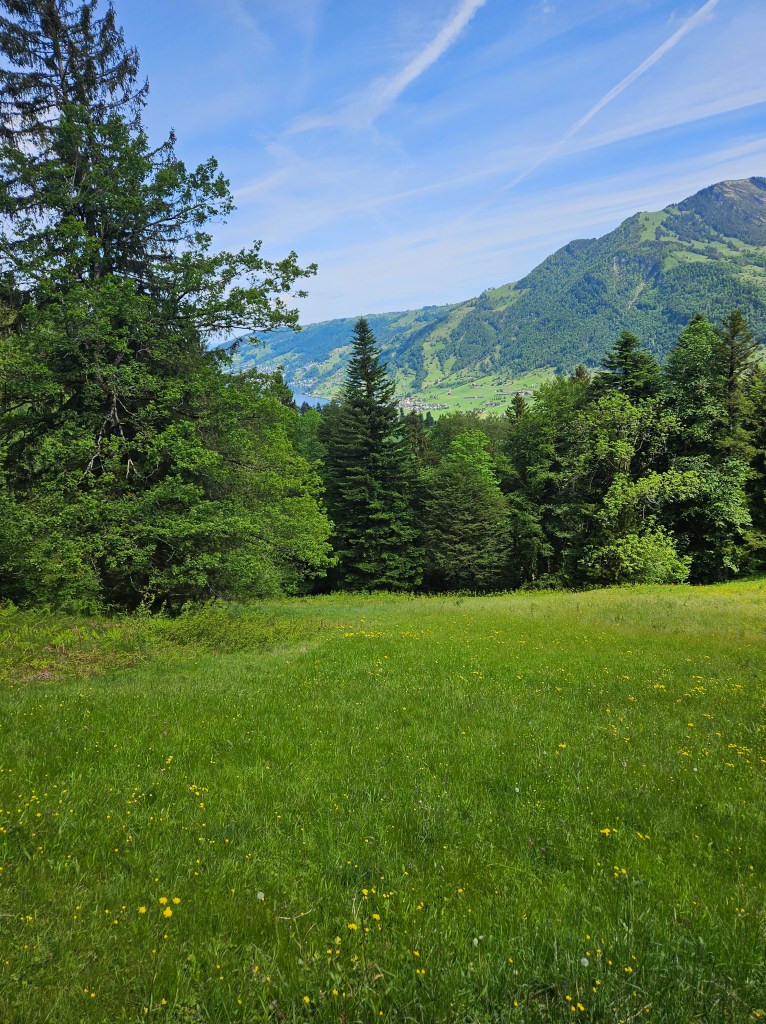
Leaving town, heading for Mt. Rigi on the cog railway. Notice the open window, from which we would soon snap scenic shots.

After a total of 90 minutes of travel from Zurich, even the dogs were amazed and we arrived just below the peak.
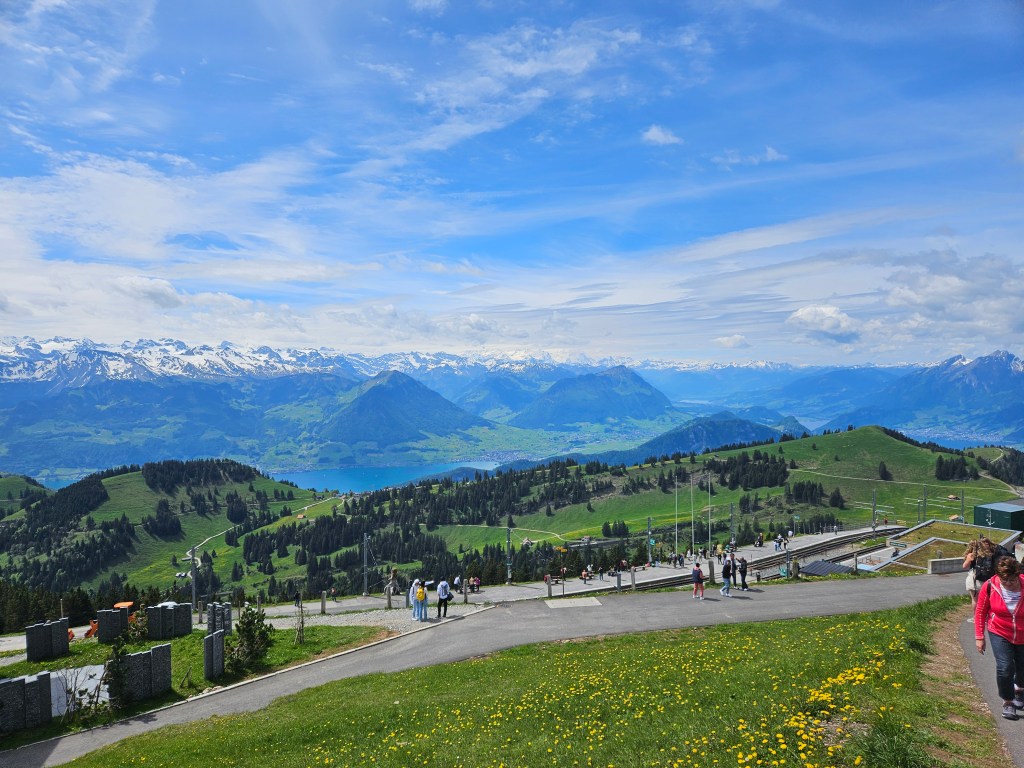
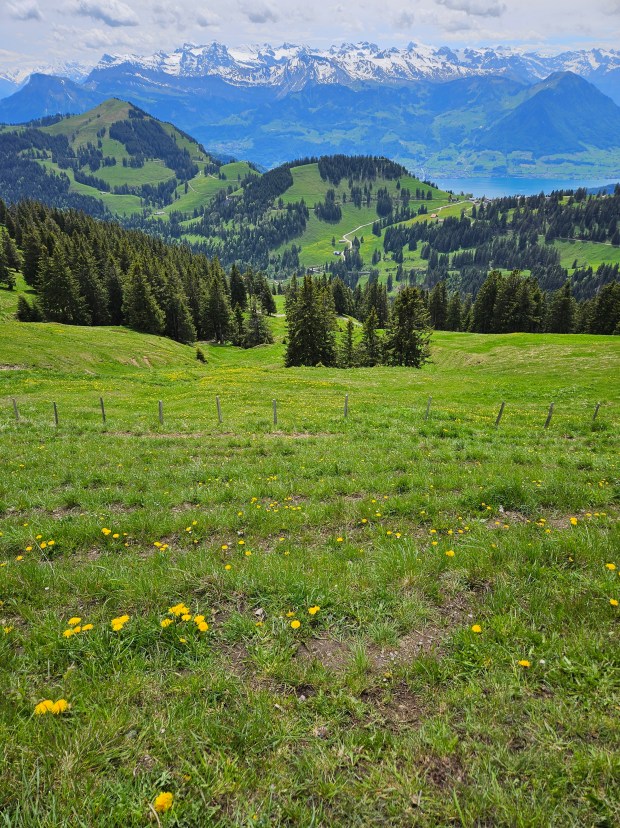
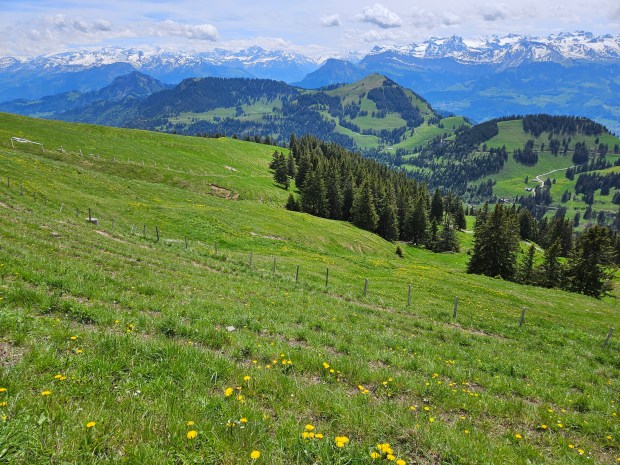
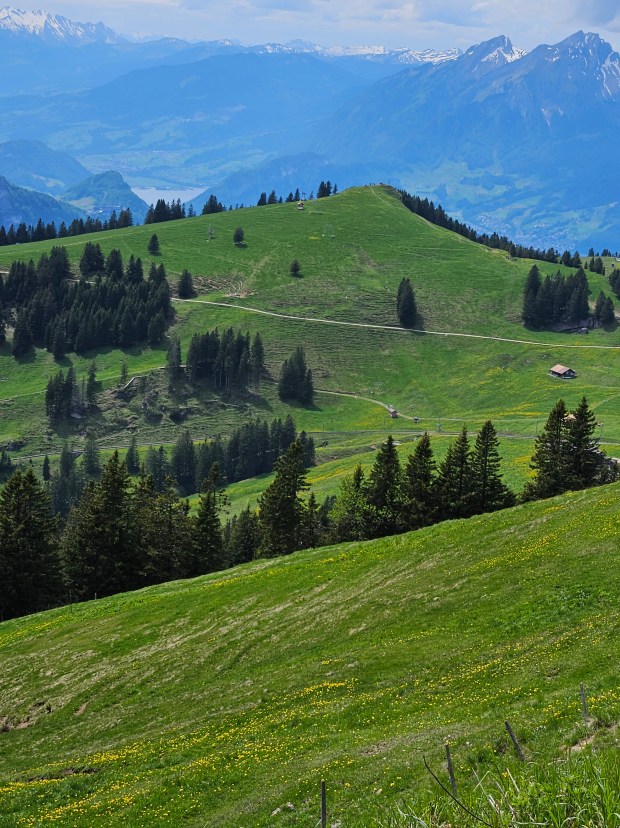
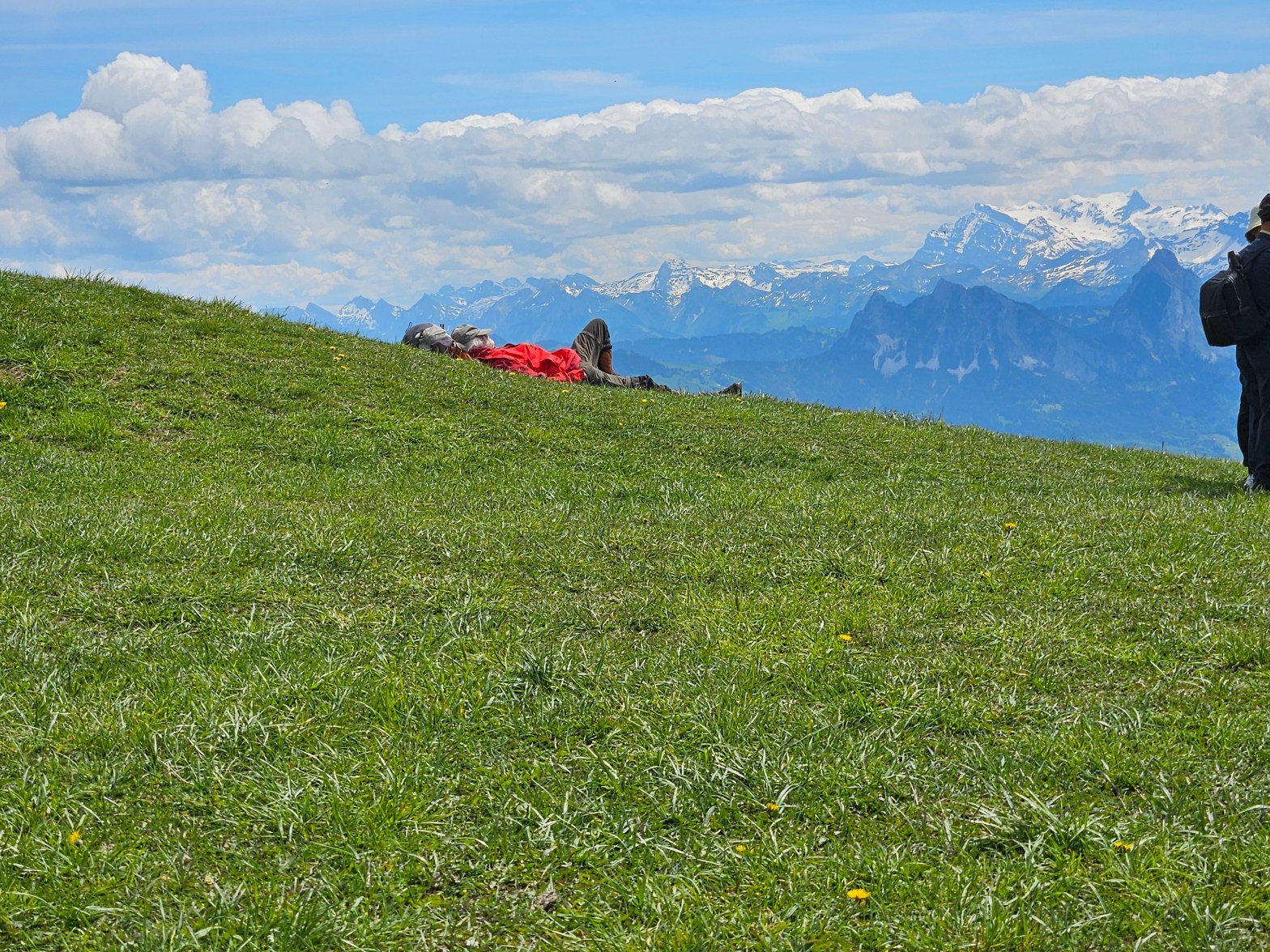
The view on arrival of the Alps, Zugersee, and some of Rigi’s paths & visitors.

RETURN TO TOP

The Bookish Connection

I am a collector of old books. Our move has rampaged my former library and even my antiquarian library was not left unscathed, but I could not give up a poor condition copy of a narrative by Samuel Clemens. Yes, Samuel Clemens. That is what the book declares. (I could prove this to you if the book were not, still, in my parents’ home inside a box until we are able to ship it.)

If you haven’t recognized that author, perhaps you’ll recognize the work. It’s a short book called The Adventures of Tom Sawyer. Ever heard of it? Ever heard of him, Samuel Clemens? Give yourself a bit of wiggle there, most people know Clemens by his pen name, Mark Twain. That same author penned these words.

“THE Rigi-Kulm is an imposing Alpine mass, 6,000 feet high, which stands by itself, and commands a mighty prospect of blue lakes, green valleys, and snowy mountains a compact and magnificent picture three hundred miles in circumference. The ascent is made by rail, or horseback, or on foot, as one may prefer.” Thus begins chapter 28 of a book mentioned momentarily.
Mark Twain, American writer, essayist, humorist (are these necessarily distinct categories?) rather famously visited Rigi and wrote about it in his A Tramp Abroad, published in 1880. Twain speaks of steamboats and “locomotives” leaving smoke tracks. He notes fog and jodlers (yodelers) in his quest to see the sunrise from the summit of Rigi. We witnessed none of these, nor any of Twain’s foolish moments in ascent — neither did we experience them. Of course, we took the direct route to the top 150 years later.

Twain reports staying in the hotel at Rigi Kulm, which I was unaware of when I suggested to Husband that perhaps we return some year on an anniversary or some such celebration and stay atop the Rigi. Heck! Apparently, you can even travel in his footsteps if you are as big a nerd as I am.
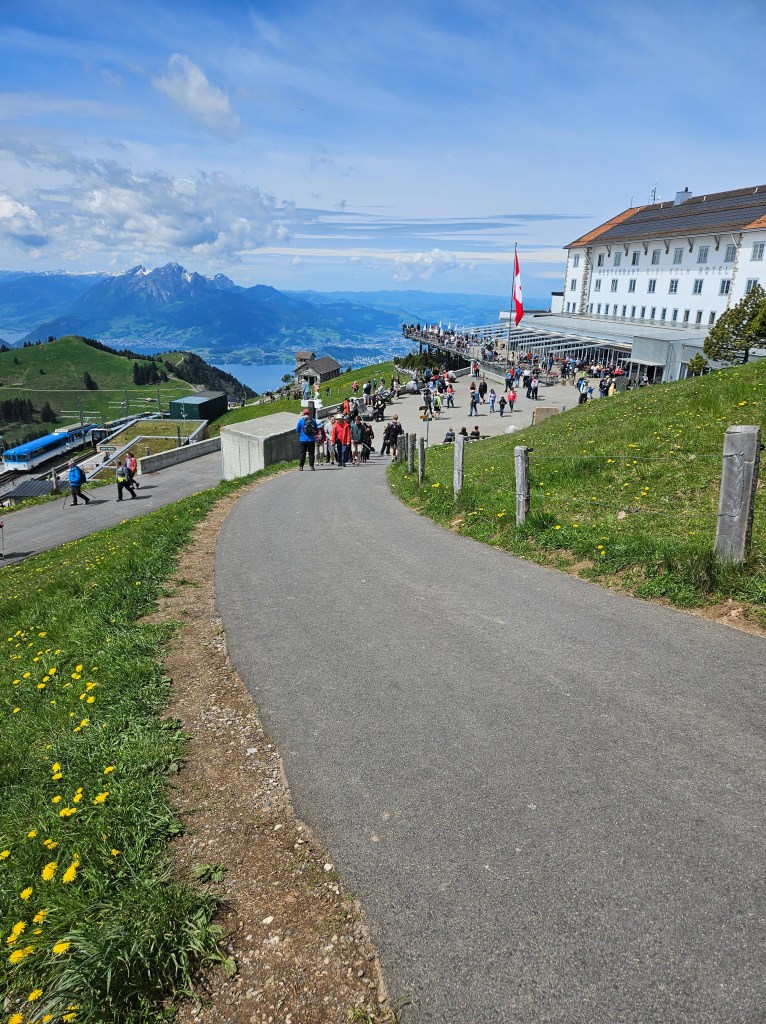
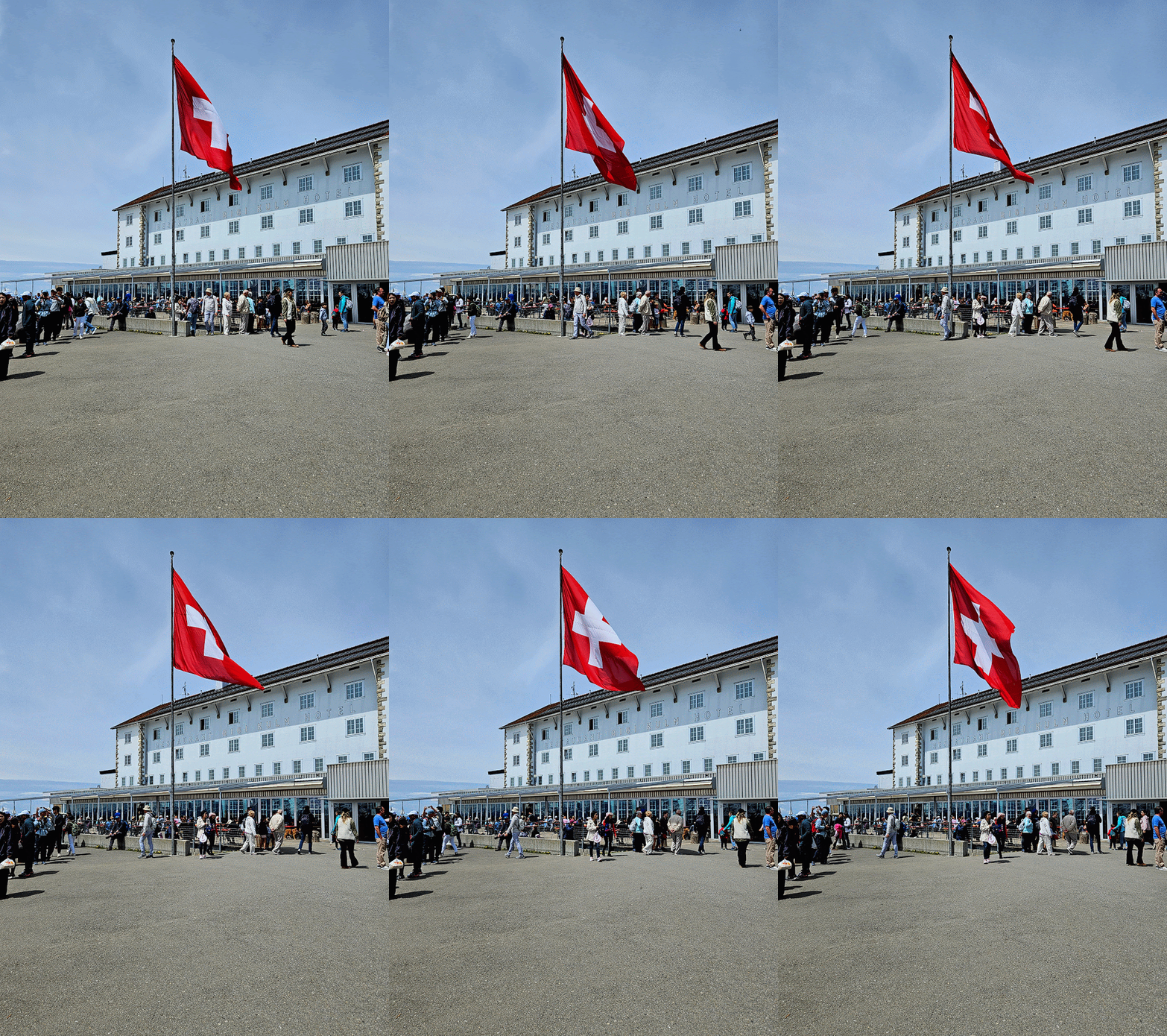
The Rigi Kulm Hotel and view

RETURN TO TOP

Scenes from Above

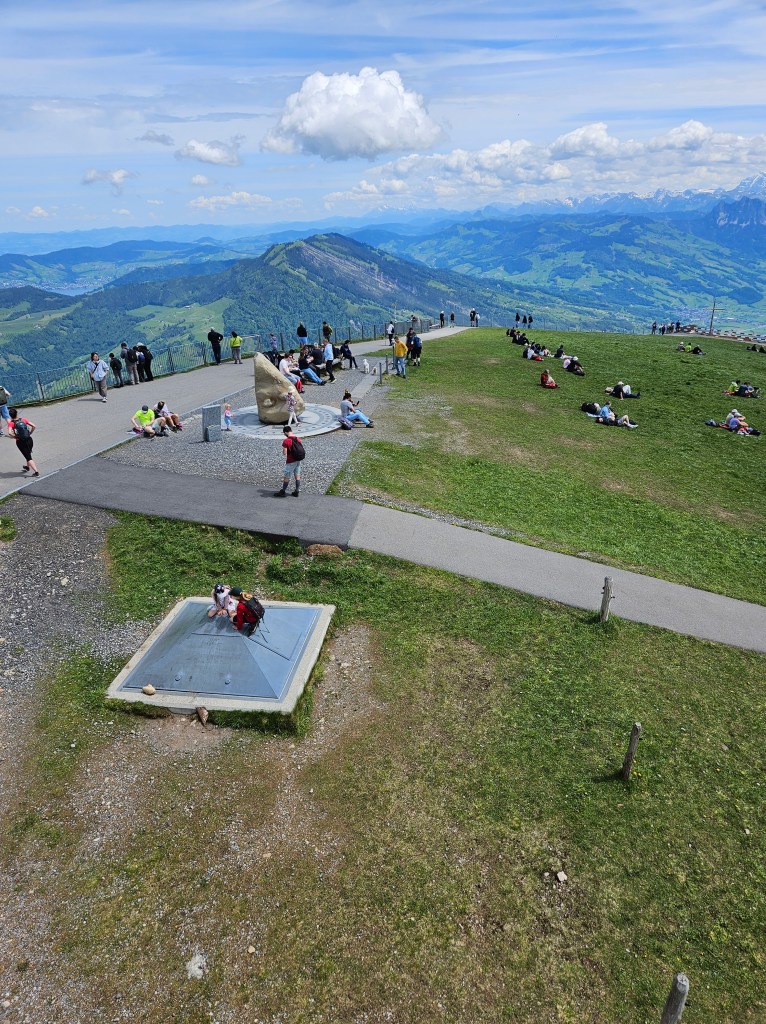
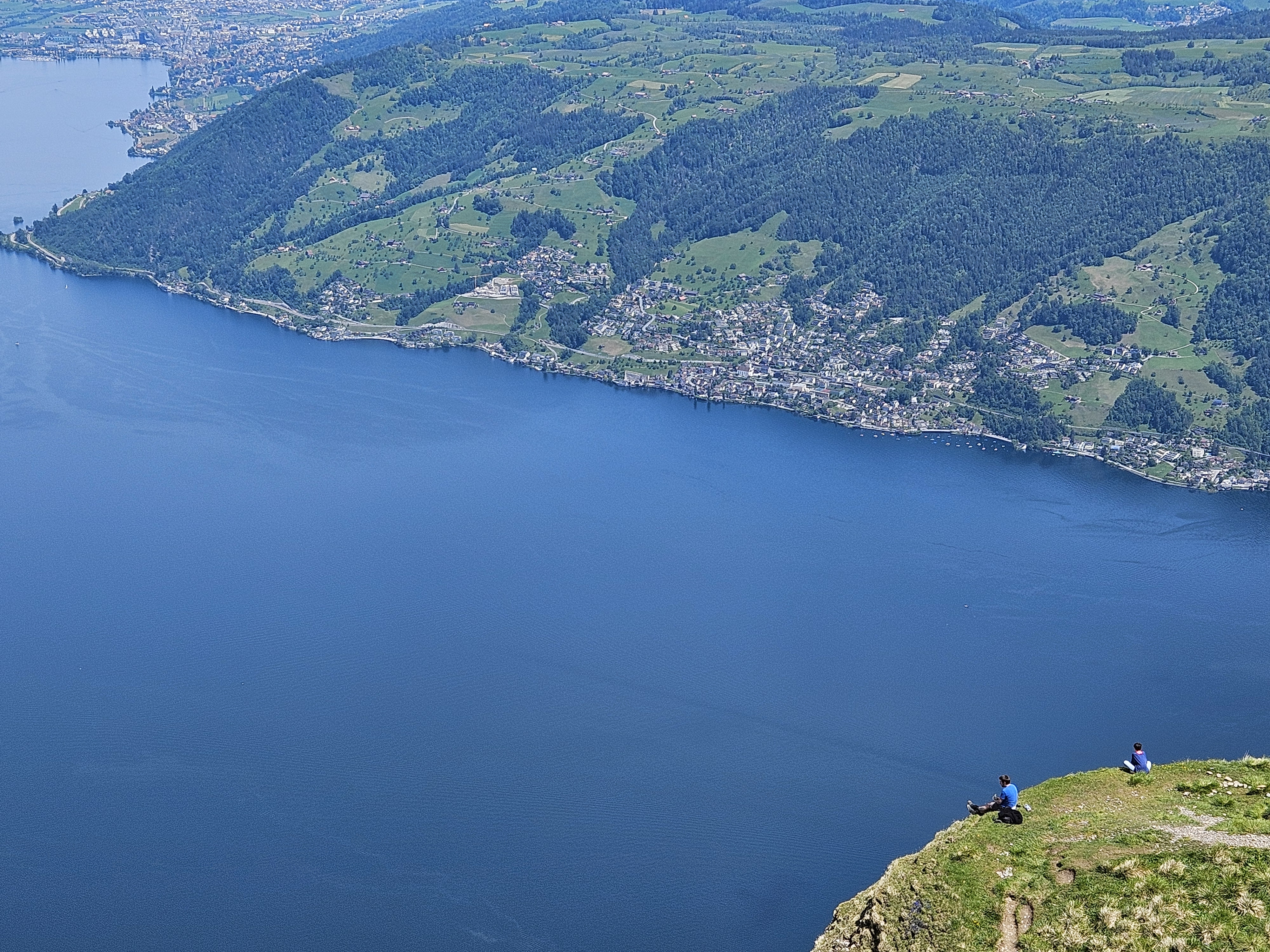
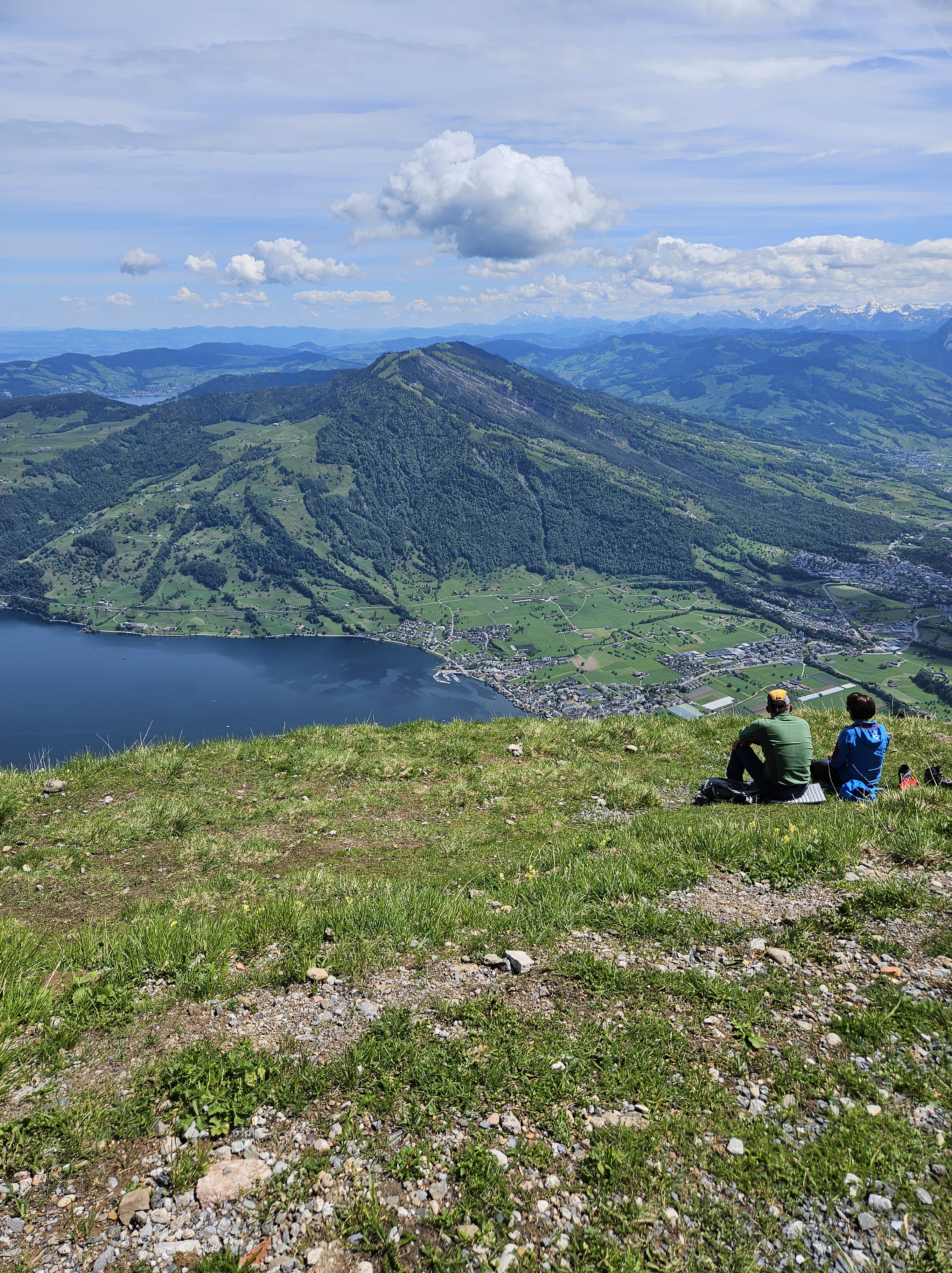
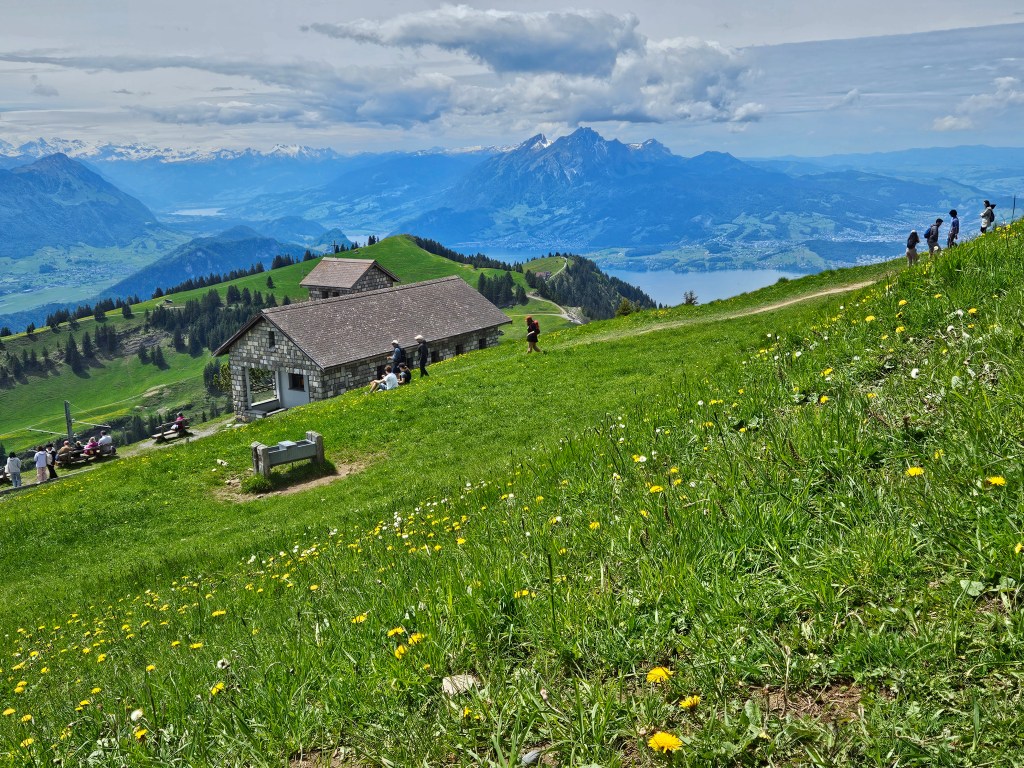
Mt. Rigi Kulm is a popular place in Switzerland, and there were plenty of people there on a beautiful and relatively sunny Sunday in May. Sometimes, the people made the shot better, some times they did not — but there weren’t so many that a few shots couldn’t be found without any people at all.
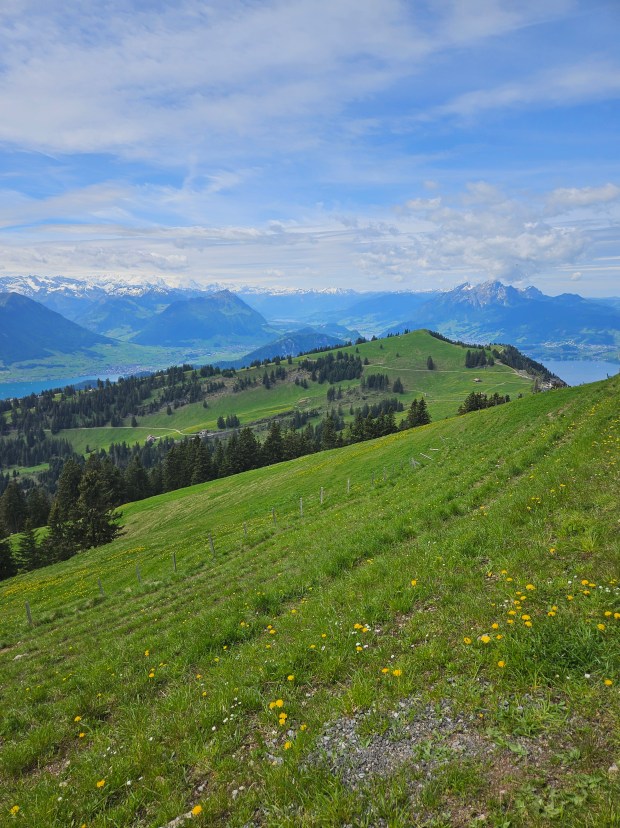
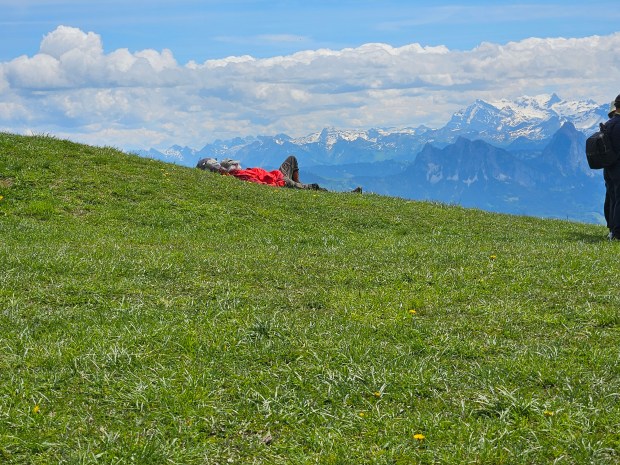
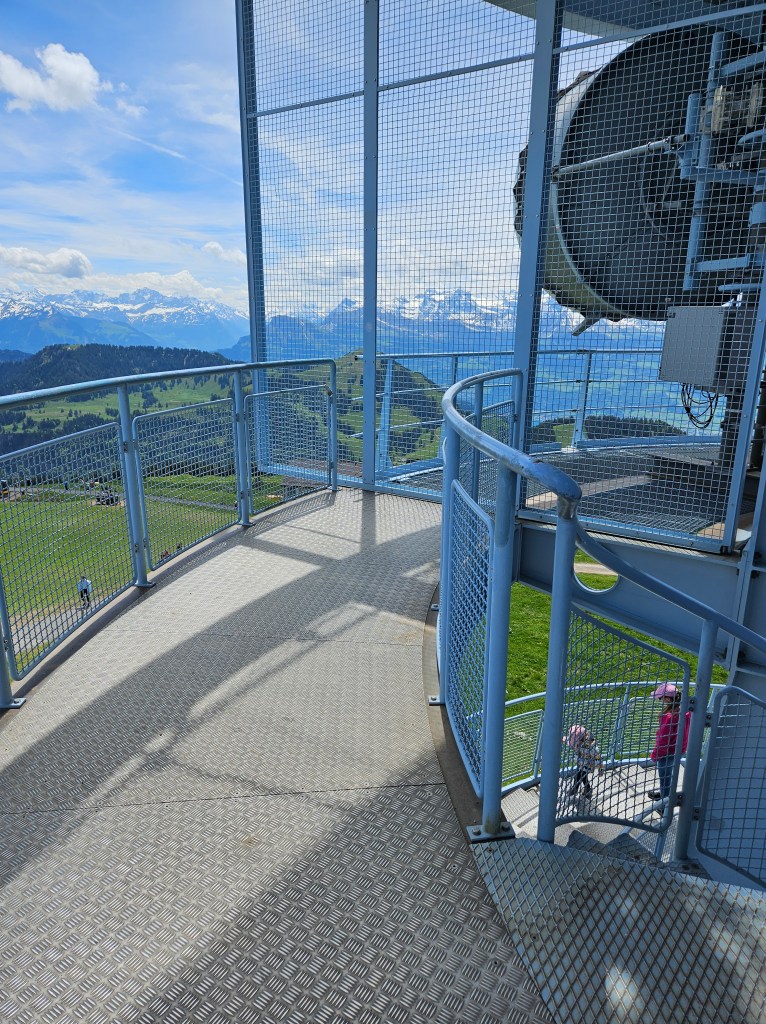
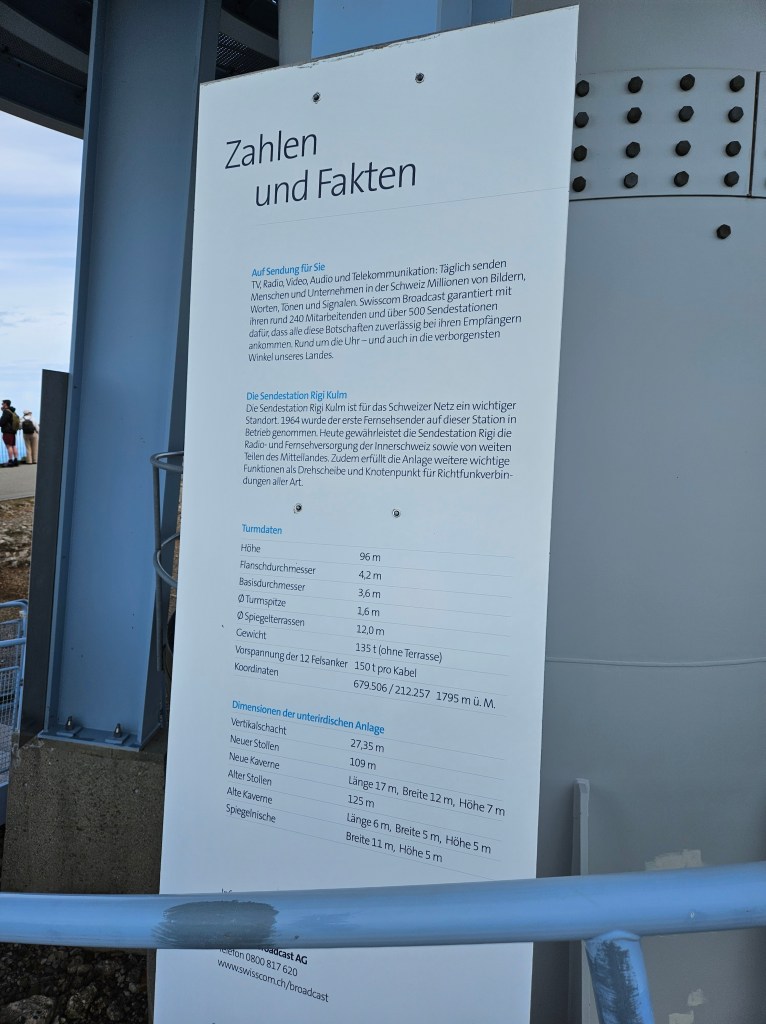
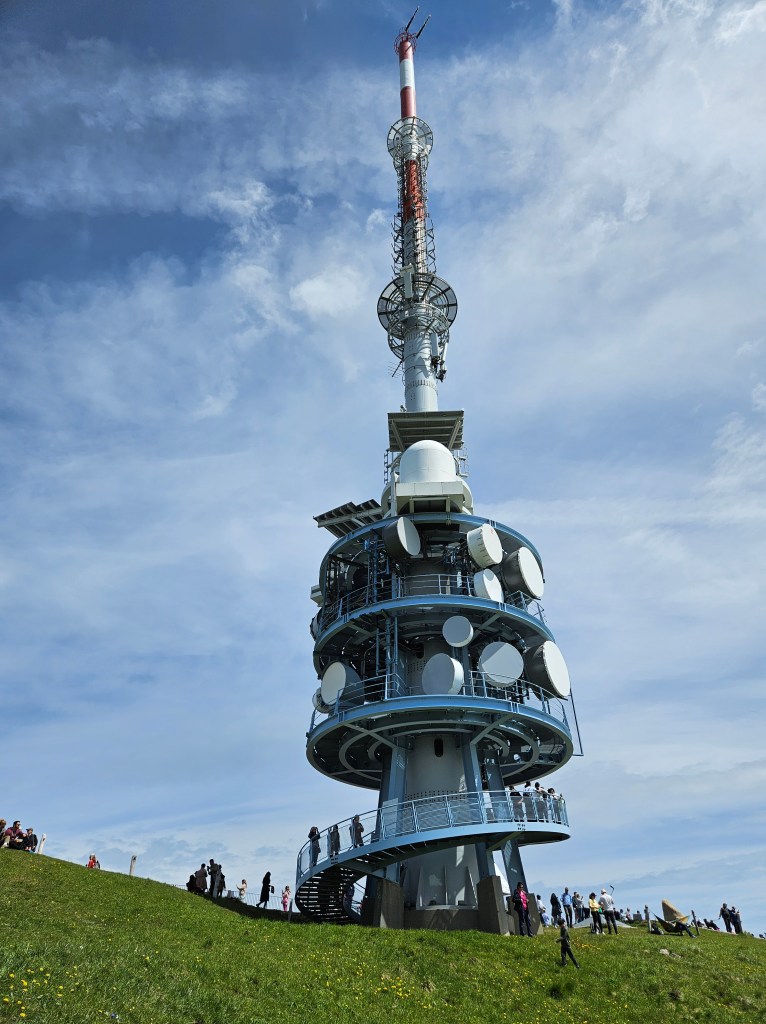
I presume Twain saw something of this view, if somewhat colder and less verdant. In the years that have passed since his visit, there have been a few technological changes in the world. As a result, there is a communications station at Rigi Klum, visible from below.
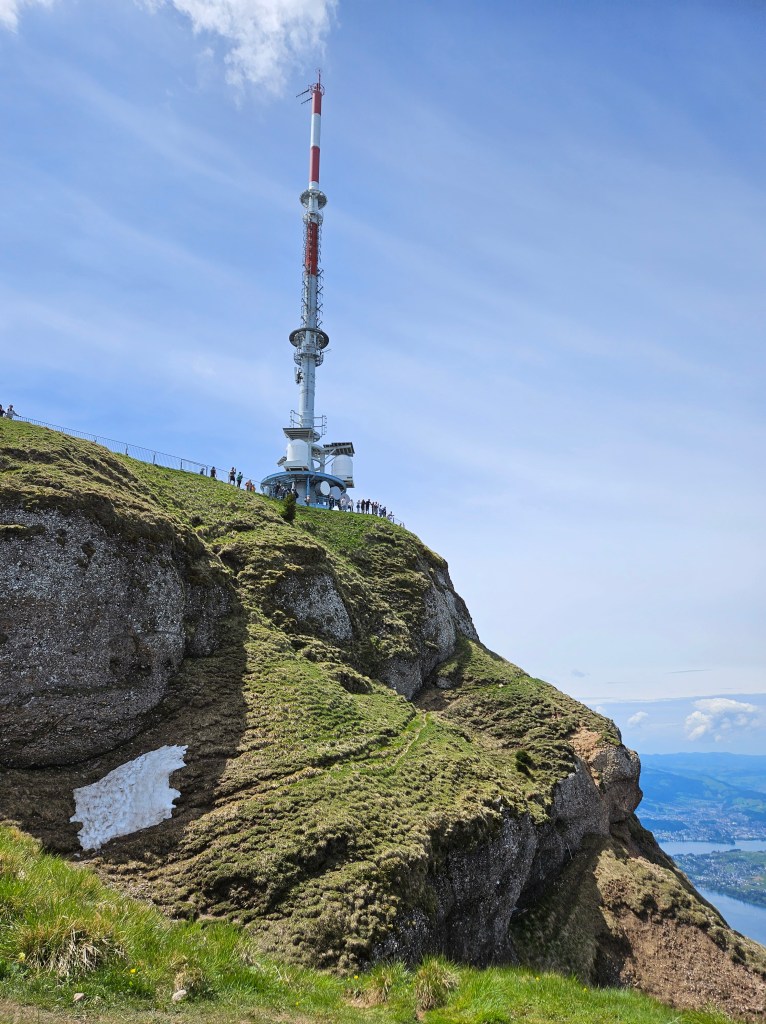
RigiComms, as I’ve coined it, from the side of the mountain. And snow.

As the tower includes stairs, I hoped to climb to a lookout several stories above the mountain’s actual peak. I brought Younger along to make sure to catch this Birthday View. However, upon ascent, it became clear that fences limited the public to a rather low one story gain above the terrain, and the view there, not markedly different but for the addition of a huge block of metal.
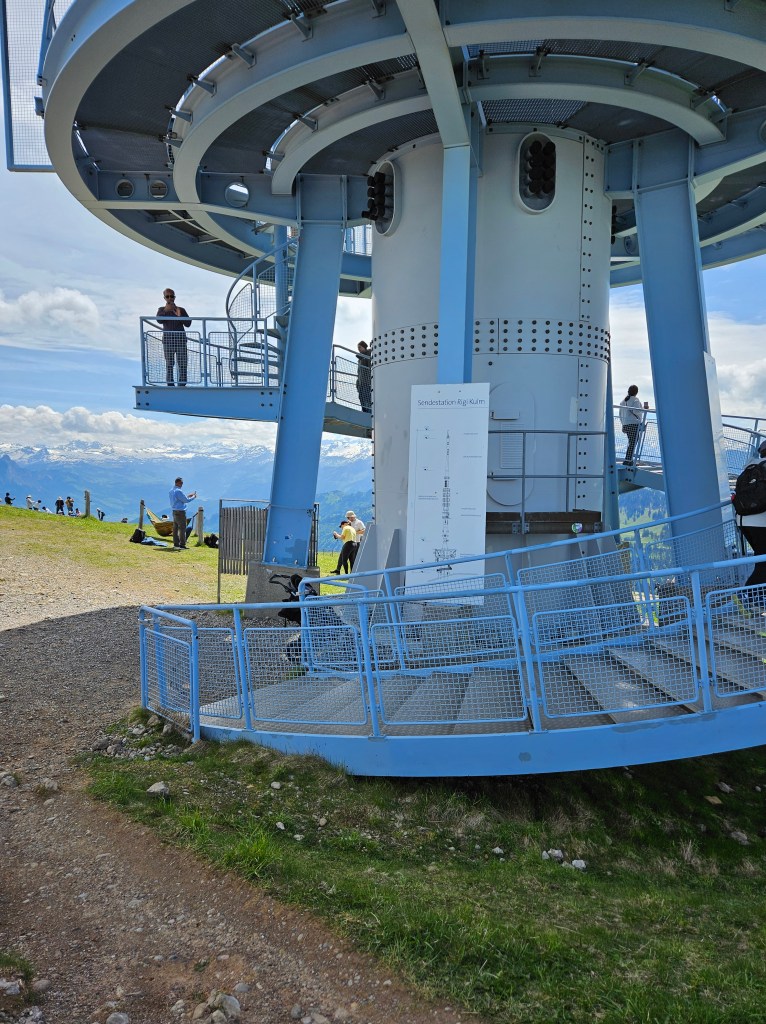
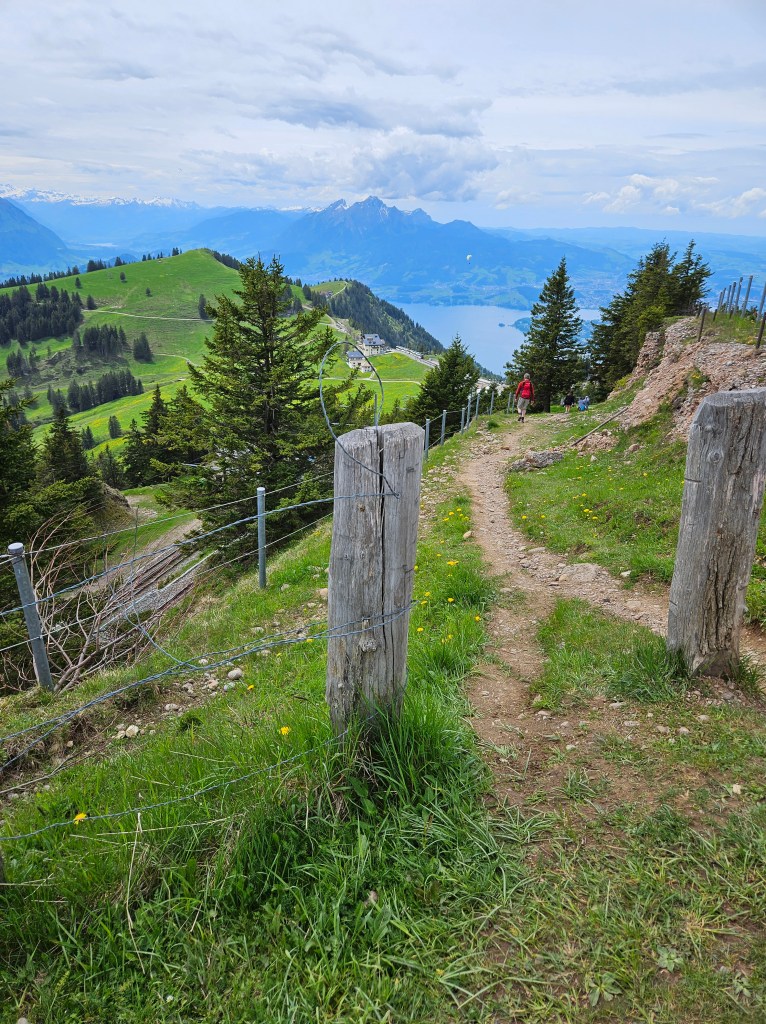
A fence keeps the crowds safe(r) from the sharp decline down the mountain, and, in one spot on the northwest perimeter, a gate hides itself in the fence. We, of course went through this gate — and trekked a short ways to a drop-off, which could have been navigated around if we’d wanted. I suspect some people ascend/descend on this route.
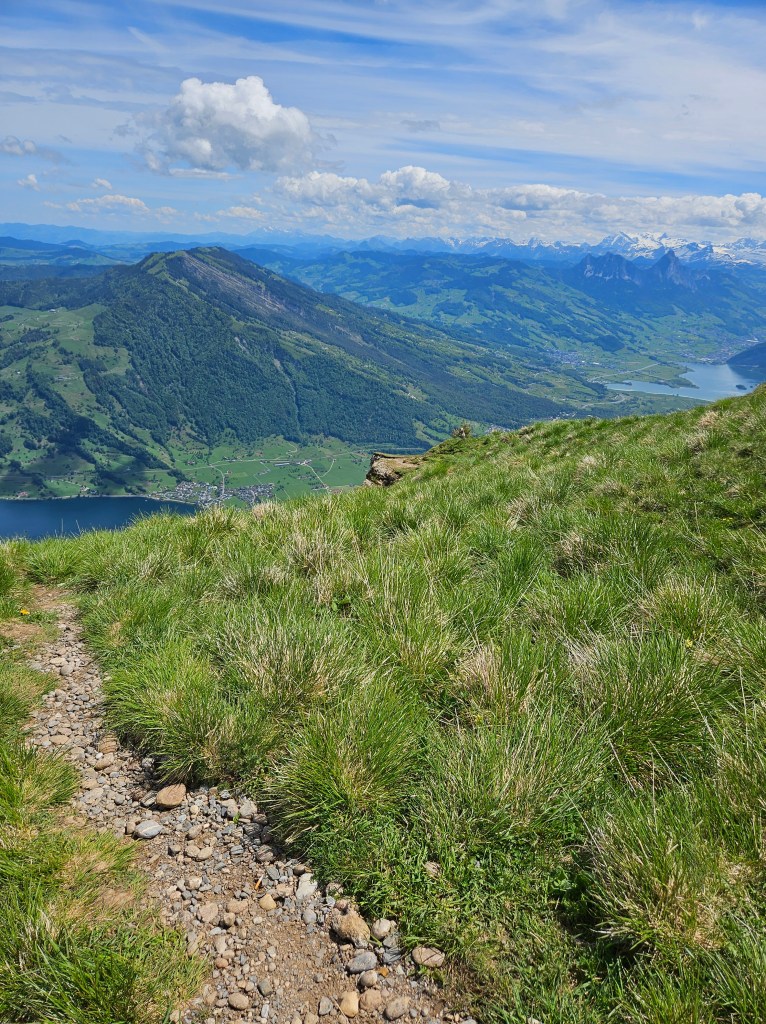
The narrow path beyond the gate.

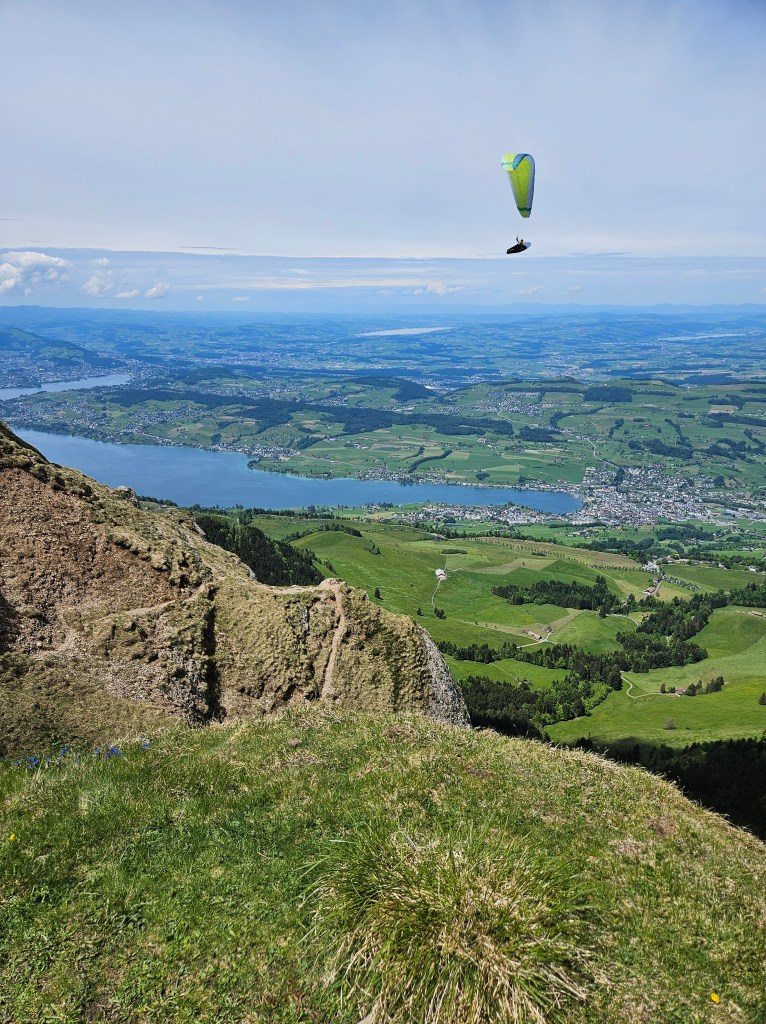
While we explored the mountain’s face, we were surprised to see quite a few hang gliders. Younger spoke repeatedly about wanting to participate in this, as though the repetition of his desire would convince his parents that, it being his birthday, they ought to put him in a sack in the sky and let him go. — They didn’t.
RETURN TO TOP

Return Home

We sat down on a bench, ate our lunch, bought a bar of chocolate, and came down the same way we went up.
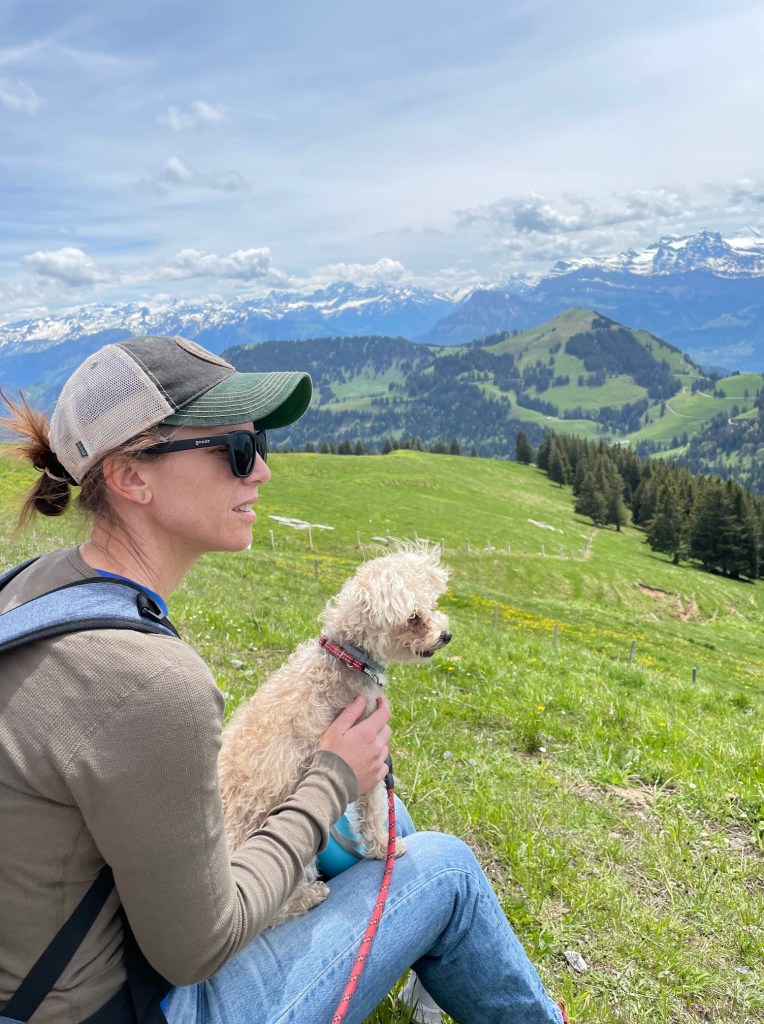
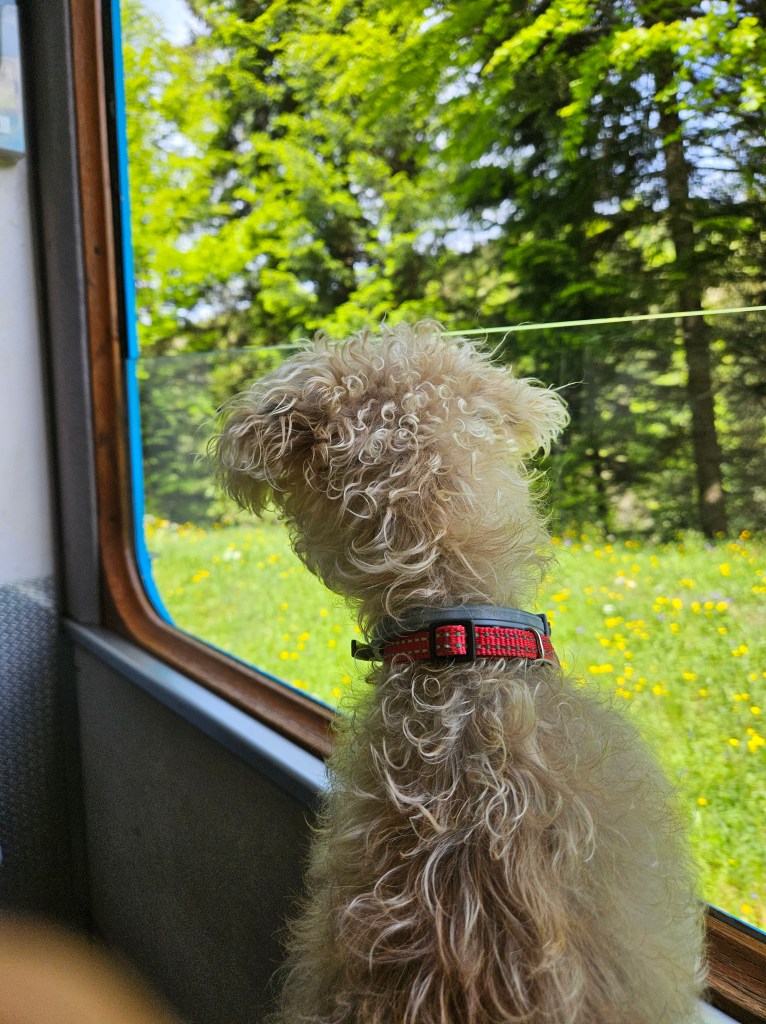
A pup and KZ await the train to descend the mountain. This pup loves the view.

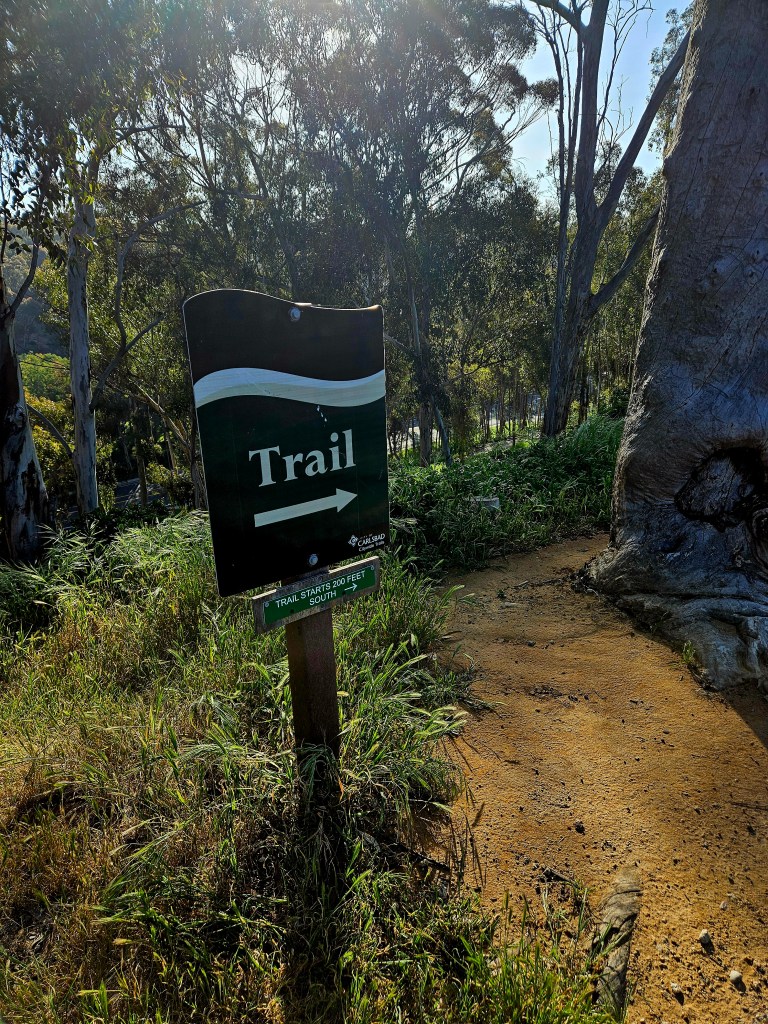
And even without a souvenir or the experience of hang gliding, Birthday Boy admitted, “That was fun.”

RETURN TO TOP

How Many Legs Can One Move Have? Leg 1: The Lead, which may be buried

Everything our family of four (and two dogs) possesses is now in my parents’ house — including us. Granted our belongings are no longer massive: approximately 25 small shipping boxes, 3 guitars, a typewriter, and 2 large suitcases per person. No furniture.

We are moving to Switzerland with stops along the way.

Stop 1: Still in Southern California, hours from the our home, I’m sitting in the house I grew up in. And now seems as good a time as any to look back on the last few months, breaking down how we ended up here. And how we will end up there. To do that, I’ll have to venture back in time a bit, and start somewhere near the trailhead for this journey.

My husband and I have talked about him leaving his job for years. He is a much nicer, much gentler, much more optimistic person than I am, so whenever I said, “It’s not gonna get better,” he’d say, “Well, they just said they would do…” (He’s a big believer in people — one of the reasons I love him — and also one of the reasons it took a while for him to leave his job.) And he’d go on working there for months and months, and we’d go through this cycle of discussion regularly.

Until he couldn’t take the stress or the angst anymore. Around the start of the school year, he told the company he was leaving at the end of the calendar year, 2023. The discussions between the two of us regarding his job shifted, necessarily, from the usual cycle we’d grown accustomed to to the unknown of the job market.

With a stable job as a teacher and a good school district for our sons, I wasn’t particularly keen to move. Still, I knew it was a real possibility that, as my husband applied to or networked for jobs that fit his particular set of (esteemed) skills, it may not be in the San Diego area. He’s a physicist. A chemical physicist. A physical chemist. It all means the same thing to me; which is to say, I don’t know what it means. (And, yes, I have no idea what he’s talking about when he tells me his tasks and shows me his graphs of what he’s working on; I just read his intonation to figure out if he’s excited or disappointed about what he’s discovering.)

“Maybe I can do something else,” he’d say, “in order to keep us here for sure. Then the boys could graduate here, at least.”

See? Sweet, gentle, giving man. Looking to make it easier for others.

“Like what?” I’d ask — though I don’t know why, because, no matter what he might be doing for a living, I’m not likely to understand a lick of it.

“I basically do a lot of data analysis now, I could probably do something in that field. I know…” or “I know a lot about ____,” and he’d continue with his list of people he knows in all sorts of fields who could help him find a job locally.

So he did everything: worked at the job he was leaving, looked for local jobs, and looked for jobs that could take us to, well, anywhere. He was speaking with companies in Paris, London, one somewhere in New Zealand, San Diego, Boston, Los Angeles, San Jose, and, of course, Zurich. It felt as though there were leads everywhere. So many, to me, that I set it on the shelf in my mind until something was more tangible. Meanwhile, he had to consider everything as imminent.

“There’s a company in Zurich,” he told me one morning, “doing direct air capture.”

This was before my morning coffee, so I did not know if Zurich was the neighboring town in San Diego or a Hawaiian island. Direct air capture sounded like logical words; I’d have to translate them later, after caffeine.

“Cool,” I said, probably with little enthusiasm.

“They have a few job openings I’m interested in. What do you think about Switzerland?”

Okay. Time to wake up, I thought. “Switzerland would be cool.”

“You know my family is Swiss? We’re from Bern.”

“Yeah, cool,” I said.

He applied to several positions at this company in Switzerland, and soon they requested an interview.

I confess, as long as I was going to a full-time job myself, working with the lovely young generation of middle schoolers I found myself with each morning, I didn’t have much headspace for his job hunt. I was excited and proud for all his leads and phone calls and even interviews, but I’d drop those thoughts for most of the day to be Teacher and then Mom. He could give you the more gripping version of this — alas, he’s busy doing consulting work these days, but we will get to that — much later.

For both of us, this job hunt felt long. Leads, leads, then nothing. Phone calls, phone calls, then quiet. It was early November when this company in Zurich, having already conducted several interviews online, told him they’d like to fly him out to have an onsite interview.

Now, if my husband is the big believer in the ability for everyone to change and things to go well, I am the bare-bones, just-the-facts, pragmatic bottom liner. So my train of thought was, “They’re willing to fly him from San Diego to Zurich? They’ll have to put him up in a hotel. That’s thousands of dollars. They are offering him the job.”

Time to learn German.

In fact, I was sitting in a traffic jam outside Lahaina on a family vacation when I figured, might as well capture this time for tutelage.

[Okay, my American friends. I know you speak English and, I don’t know, maybe a little Spanish or French you learned in high school, but you probably haven’t used it much since. So now I’m talking about European languages, yes, but I’m talking specifically about the tiny country of Switzerland, best known, I’d say, for their chocolate and their tennis star, Roger Federer. If you aren’t a tennis fan, that’s okay, and if you aren’t a Roger Federer fan, that’s really not okay, but I’m going to give you a chance to change that. Either way, you need to know that one of the most impressive things about elite tennis players in general is that they play in hours-long matches, sprinting from side to side, playing mind games with their opponents, for sometimes three or four hours before a winner is declared, and then, after all they’ve done, someone shoves a microphone in their face for an on-court interview in the language of the location. At the French Open? Speaking French. Wimbledon? That’s English. And most of these athletes are neither French, British, or American. So, take Roger Federer, an all-time great who has won every grand slam tournament there is. And, of course, he’s Swiss, but he’s gliding through these interviews in English just as he glides on the court. Same thing in French. And he’s also spoken in Italian and Mandarin in the post-match interviews, depending on where the match itself is located. Anyway, I digress. The point is I know English. I’m great at English. I know a little Spanish. I can get by with my high school Spanish. I do not know any other languages anywhere near proficient enough to survive a basic conversation, and we are talking about moving to Switzerland where the spoken language, Roger Federer’s first language, is Swiss German.]

Switzerland has four official languages, and none of them are the language Swiss children learn first. Although Swiss German is spoken, it has no grammar. It’s not really a written language. I like to think of it as the opposite of a language like Latin. In English, we call languages like Latin that are no longer spoken, a “dead language.” Swiss German isn’t dead; it’s spoken, but only spoken. I wouldn’t call it a “live language.” That seems like it would be a written and spoken language. So, not being a linguist as previously proven, I’m going to call Swiss German a “spirit language.” I think it fits. It’s not confined by grammar (aka structure, like a skeleton) so it can’t have a body. It’s not dead, it has no body, it must be spirit.

Again, I digress.

In Switzerland, the four official languages are German (thus where I began), French, Italian, and Romansh (which I’d never heard of in forty years of living). Swiss German is not an official language. Hmmm….

If my husband is going to be offered a job in Switzerland, I need to get on my language game to consider the offer seriously.

Why did I pick German to begin with? I don’t recall, though I can substantiate it with logic. I’m sure you can, too. Say “Zurich.” Really. Say it. Out loud. Whisper if you must. If you hadn’t any idea where this place was but knew it was a place where they were likely to speak German, French, Italian, or Romansh, which would you go with? German, of course. The “ch” at the end of the word chokes of guttural phlegm production. Must be German.

I open my language app I use for Spanish — since I am a teacher in the San Diego area. “Which one of these is coffee?” it asks. My choices: Milch, Kaffee, Brot.

I’m going to rock German, I think.

“Which one of these is milk?”

I’m already fluent.

“Du bist ein Dummkopf.”

Strange. I don’t know how to translate that.

So I’m sitting in a rental car in a Hawaiian traffic jam caused by I-don’t-know-what, learning German.

“I want to learn German!” I hear from the back seat. “Can I do that, too?” asks the younger of my two sons.

“Sure,” I say, thinking only about the fact that he seems exhilarated by the idea and that would make for a good distraction as we move the width of three palm trees per minute.

Then I realize I’m about as exhilarated internally as he is externally about the idea of learning another language and about the notion that we could be living abroad. I’ve always wanted to live abroad. I spent a summer in Hungary teaching English in preparation for a year in Budapest, which fell through at the last minute. And no, I don’t speak Hungarian. I am even, somewhere, on tape — yes, tape — as an eighteen-year-old at my high school Grad Night being asked about the Twenty Year Reunion twenty years in the future. (Now, when I hear this question being posed to a graduate of a few hours, my left eyebrow raises, but at the time, I took it in stride and said) “I won’t be at the reunion. I’ll be living in London.”

Which, of course, did not happen.

But my motivation for saying that was partly about living abroad — and partly about being a book editor, which, also, didn’t happen.

Arranging for an on-site interview in a country nine hours ahead of you is a bit challenging. 9:00 AM in Switzerland is midnight on the California coast. 5:00 PM there is 8:00 AM in San Diego. So, their work day overlaps with our early morning sleep schedule. Since our household gets up between 6am and 7am, we have about an hour or two each day to contact Switzerland live. Otherwise, all communication must be conducted at a snail’s pace via email, waiting through the night to receive a response — if they get to it in fewer than 24 hours.

Eventually, the interview was set for Monday November 20th. Thanksgiving week here in the States. Just another work week there in Zurich.

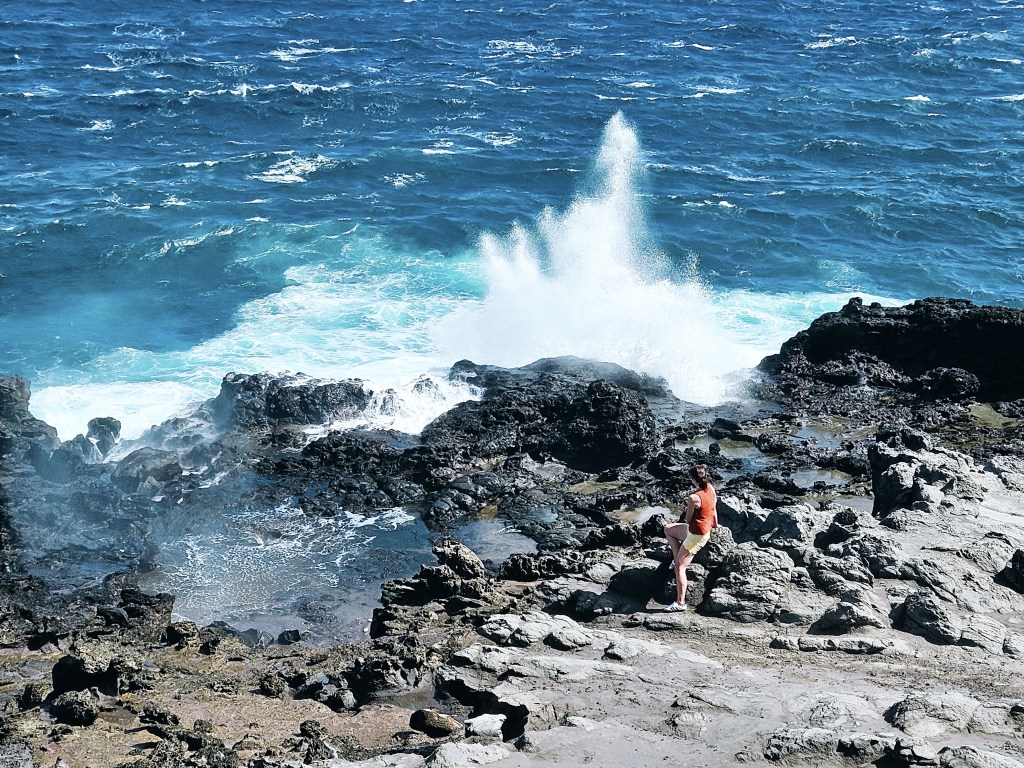
KZ sitting on the Hawaiian coast, not too far from Lahaina, Maui

No, of course, that’s not all! That’s the first leg. You thought I could tell this whole thing in one post??!

Don’t worry, Leg 2 is coming. We’re going to need at least a second leg so that I don’t fall over.