

I read Of Mice and Men as a high school freshman. Despite going on to be a Literature major, reading several more Steinbeck novels (some more than once), that first book remains the only Steinbeck I’ve enjoyed. Perhaps it’s the length of it, or the ubiquity of the references to Lennie and his strength, or just Lennie himself. I’m drawn to his innocence, his good intentions, and the complexity that with his sweetness and innocence, he’s often a threat. He embodies the notion that what we don’t know can hurt us.

We rejected the Zurich offer because Zurich had become a threat to us. To the education and the future of our children on the one hand, and to the death of a shared dream on the other. It looked to be a dead end.
Only this was a dream that wouldn’t quite die off. Through holiday travel and the ringing in of 2024, my husband continually brought up feelings of lament around the Zurich position.
“It’s really too bad…” he’d say.
“I wish they’d been able to offer…” he’d say.
“If only there were some other way,” he’d say.
And I’d sit torn between reflecting his lament back to him and encouraging him to move forward with his job search. Until he said, “I found another education consultant in Zurich.”
With intrigue and doubt, I responded, “Yes?”
“I want to have a consultation with her. The consultation is free. So, really, there’s no risk. We can see if she agrees with the other consultant, and, if she does, done deal. So long Zurich.”
“And if she doesn’t?” I asked, anxious about where the answer could lead.
“Well, if she thinks the kids could go to public school and still end up being able to attend university, I think I will contact HR at the company and see if I can have more time to think about it.”
I sat silently. Thinking. If several consultants note the impossibility, it could help him move on….
“What do you think?” Husband asked.
I shrugged my shoulders and raised my eyebrows in tandem with them, letting them all fall in unison. “Why not? The worst that can happen is they say no.” But, I thought to myself, I bet they wouldn’t. Not after all they’d invested in him.
Another 6:00 AM meeting with an education consultant later, Husband and I were convinced.
“It would not be easy,” said this second consultant. “You must have children who are really very unusual. They must work very hard. Even the Swiss children must work very hard. But to catch up and do gymnasium, this would be so difficult. I think, if you are very supportive of them, and you think they can do it, perhaps maybe they can.”
“Our kids are rather atypical,” we said. “They are bright and motivated, well-rounded and kind.”
“I want you to know,” I told her, “that when I say my children are unusual, I mean that in a very good way. And I do not say that just because I am their mother. I am a teacher. I see hundreds of students their age every year. I have taught my oldest son in my classroom, and teachers go out of their way to comment on how wonderful my youngest son is. But what is more, I did not give birth to them. They are not genetically mine. I do not see my children with the rose-colored glasses many mothers see their own children. Still, I can say they are exceptional.”
“If you are willing, then we will have to do some work. I will speak with the Zurich schools and see when it would be possible for them to take the gymnasium test. It will all be in German. So, in the meantime, you get a tutor for them. They must learn German. And some French, too, but German is the most important. I will also ask about them being given a trial year, so they can catch up their German even more — and maybe, by the end of that one year, they have to take a test again or something to prove they are in the right placement.”
“Intellectually,” we told her, “there’s no question. The challenge will be language acquisition.”
“Yes. Okay then,” she told us.

Yes. Okay then. Time to contact the company to request an extension, allowing us to consider more options. Since it was January by this time, schools in Zurich were back in session, and we could contact them directly, making the whole process a bit easier.
After Husband got a green-light on the extension to consider the job offer, he spoke with friends who had once lived in Zurich to get information about the education system, the culture, the workforce etc.. I spoke with my teacher-neighbor, who was raised in Switzerland. Everyone said, “My goodness! Even if they do not get into gymnasium, they can still be very well educated in the apprenticeship system and go to university if that’s the path they choose. It might take them longer, though.”
“Oh, really?”
“Yes, they can even intern in a programming position or something that would be very useful that they may not learn at gymnasium anyway.”
“Hmmmm….”
Husband, now done with his job from 2023, put extra time into figuring out more about the Swiss/Zurich education system. Then, when I got home from school, he and I went for a daily walk around the block to discuss the current status of what was or was not possible, what was discovered, and what tossed out — as well as draw some conclusions together. We called it the Zurich Tete-a-Tete on our shared calendar, or, more informally, our Zurich Talk Walk.
We hired the consultant, the second one. She requested I send her transcripts and information about what levels of math my sons had taken before we met with her again so that she could pass it onto those in charge in the city of Zurich, to show them how wonderful our children were.
I gathered the information and sent the document that day so that we could meet again as soon as possible.
When we did meet again, the consultant informed us, “Yes, it is good with Mrs. S. She will let the children have a trial year if they pass the test. But, she said they must be able to do B1 German.”
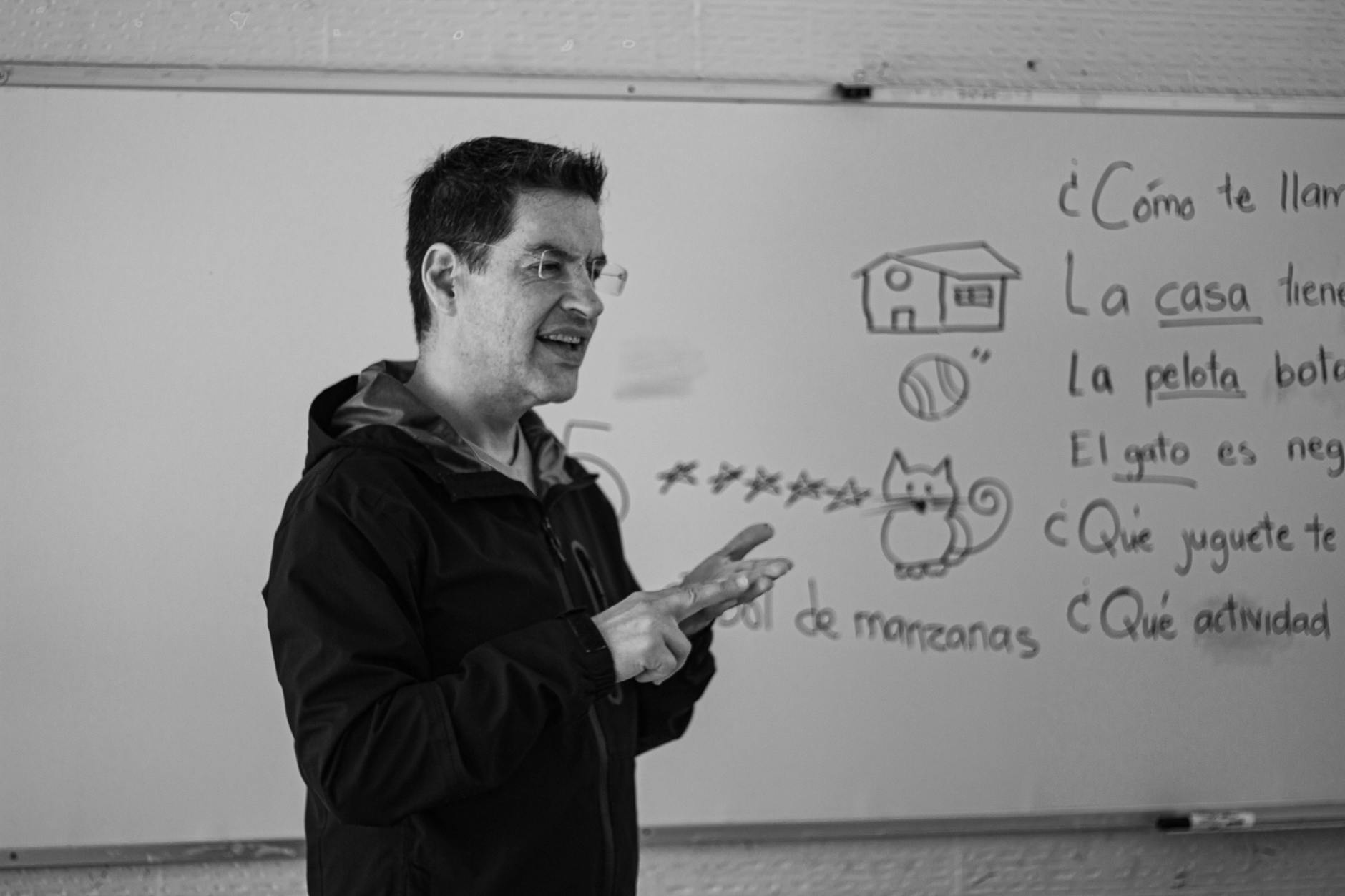
[Okay, time out. More about language. I took Spanish through 11th grade, opting out of AP Spanish my 12th grade year. I can get by in Spanish, and so I tell people I speak a little bit of Spanish. Which is true. But what does that mean when you hear it? Does it mean I can say hello, goodbye, thank you, and where is the bathroom? or does it mean I can write a letter and read a children’s book?or does it simply mean I’m not a native speaker but I am fluent? It depends entirely on the speaker because that person is calibrating their language ability for you. Then you have the same opportunity to interpret the phrase, regardless of how the speaker meant it. Did they mean they can say hello, goodbye, thank you, and where is the bathroom? or does it mean they can write a letter and read a children’s book? You see the problem.
Being a teacher, seeing a large swath of society, I can tell you with confidence, those who are perfectionists will undermine their abilities, and those who are trying to impress will exaggerate them.
[It is not this way in Europe. There, they use the Common European Framework of Reference (CEFR), which offers actual tests and certification, to declare someone’s language level. There are beginner levels, A1-A2, intermediate levels, B1-B2, and advanced levels, C1-C2. Instead of telling you I speak a little Spanish, I can tell you, I test at the B1 and B2 depending on the test and the day. For the boys to attend gymnasium for a trial year, they were to go from no German in December to B1 German in spring. That’s rough. It’s the equivalent of being a bit behind where I am in my Spanish despite their having a few months whereas I had a few years — admittedly with many years of forgetting since.]
Husband and I discussed it in our Zurich Talk Walk. If the boys don’t meet the language requirement, they go to secondary school and get to try to get into gymnasium at the end of the year anyway. That’s fine. BUT — for Older Son, that may well mean repeating a grade. If we could get him on board with that, we could say yes.
As further proof of my atypical children, not only did Older Son say he’d be willing to repeat a grade, so did Younger Son!
Husband and I took our Zurich Talk Walk around the block and decided. Let’s do this. It’s too big. Too possible. Even with things that could go wrong, we could come back if necessary. It would be one heck of an adventure, no matter what. Otherwise, we would be left forever wondering what may have happened, what we may have achieved or experienced. And that was a regret we weren’t willing to live with.
The threat of Zurich had faded, and everything around it turned into potential and possibility. Even if it was a terrifying possibility, it was also a thrilling possibility. Any threats we’d seen before transfigured into pathways, different journeys, none of which lead to despair, darkness, or death.
If you know Of Mice and Men by Steinbeck, you know it’s filled with death. Lennie often kills beings unintentionally. What you may not know is that the title wasn’t created by Steinbeck himself, nor was he the last to use it. The title comes from an 18th century poem by Robert Burns called “To a Mouse.” (You may read it if you have an affinity for Scottish poetry.) You are likely more familiar with Kurt Vonnegut, whether or not you’ve read his work, who, twenty or thirty years after Steinbeck’s novel, wrote, ” Of all the words of mice and men, the saddest are, ‘It might have been.'”
The narrative of George and Lennie is one of might-have-beens. The story of my family as ex-pats in Europe will transform from potential to actual. This blog invites you to witness the actualities with us.
What do you say? Are you ready to travel with us?

We had a LOT to do before traveling — find out about the next steps before departure in the next leg!

 KZ Rochelle