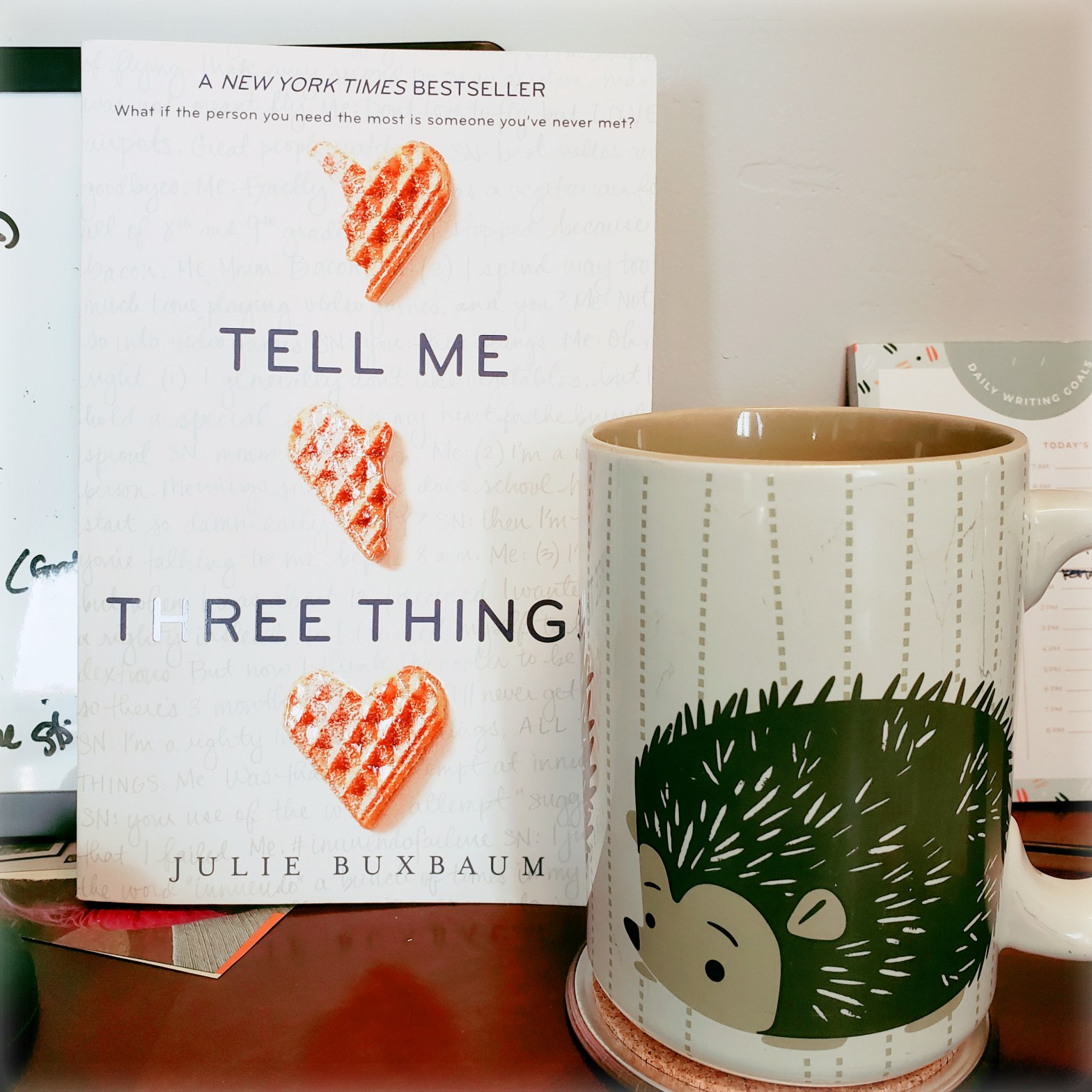
Premise: Jessie’s mom passed away 733 days ago, she’s counting. A bit too soon for her to confront her dad’s news that he is remarrying and they are moving from Chicago to LA. Jessie must start a new school, leave her friends behind, and join another household/family. At a private school for the wealthy (paid for by her new step-mother), Jessie struggles to establish a groove until an anonymous student starts emailing then texting with her. Who is this “Somebody Nobody” with whom conversing is easy and what will become of their relationship? Can you blame her if she’s struggling to feel confident in the midst of so much change?
Rating: 3/5 Target: high school, college
Title: “Tell me three things” derives from a pattern of communication between Jessie and SN (exact identity: unknown) where they begin conversing by telling each other three things about themselves, whether important or unimportant, factual or opinion-based. Record your three things in the comments, and see mine as well.
Motifs (not exhaustive): grief, moving, new kid, step families, adaptation, coming of age, friendship, romance
Great for…* (readers): fans of romance and romantic comedies (like Happily Ever After or the film You’ve Got Mail) who want something fun to read
Great for…* (teachers): students who may be reluctant readers but who get swept up in the drama of high school, free reading, quiet/bookish students
Parental Warnings: some sexual innuendo and referencing, sexual coming of age in minor characters, intermittent cursing
Start a conversation like Jessie and SN: what are three things about you? List in comments and expect a response.
*The “Great for” category is not exhaustive and does not intend to neglect the multitude of readers/teachers who could learn from this book in any number of ways.
RATINGS GUIDE
٭ = DNF, would not recommend ٭٭ = would not recommend ٭٭٭ = enjoyable, would recommend ٭٭٭٭ = very good, would recommend ٭٭٭٭٭ = amazing, would definitely recommend
I’ll tell you from the beginning. This is a post to declare to you that I would make a fabulous casting director. Or possibly a self-deceiving cheat.
I’ve finished reading French Exit by Patrick DeWitt. I always want to add an article in front of the title, declaring this book to be about the French exit, but apparently there are many French exits, several in the book, more in reality.
Anyway, I picked it up, knowing it was in production to be a film — but I didn’t know it was a finished film. In theaters now (in LA and NYC).
The several French exits in the book are declared early. Fanny Price has gone broke. Her immense wealth that grew upon her marriage has run dry. Absolutely. Nothing left after seven years of warnings from her financial advisor Mr. Baker. When the money runs out, he asks Fanny what her plan had been through those seven years. Her response epitomizes her character: “My plan was to die before the money ran out. But I kept and keep not dying, and here I am.”
Here, at the time, is stateside, but without a place to stay she soon finds it necessary to head to Paris where a friend has an apartment where Frances may stay. She travels to France with her son because it’s their only option (exit 1), all the while with the plan to rid herself of her final spending money and do as she planned: die (exit 2). But she’ll do it her way, as much as she can.
DeWitt presents Price fully formed, take her or leave her, and take her you must. She’s just quirky enough, just witty enough, and just sane enough to be mesmerizing beyond her beauty.
When I first began reading, I envisioned Price as Hepburn with a Brynn Mawr accent, an elitist prig from the early scenes of The Philadelphia Story. But as I read, as DeWitt presents flashbacks that explain the why of what you the reader already know the character is, Price took on more color. She could not be caught in the black and white films of Hepburn, held in the distance by time. No, she was fully-fleshed if standoffish, with a flat American annunciation. Her voice became Michelle Pfeiffer’s, flat and flavored as in I Am Sam where her character must hold it all together for appearances sake.
And this is where I return to my premise for this post. Can you guess which actress plays Frances Price in theaters? Why, none other than Michelle Pfeiffer herself. The character could not be played by anyone as well what with the coupling of physical beauty Pfeiffer possesses with her paradoxically cold voice with undertones of rich emotion — such that it made me wonder if DeWitt wrote the novel with Pfeiffer in mind for the role. If he did, he got what he wanted.
Either way, I got what I wanted and thus I proclaim myself a great casting director without any other evidence than that which I’ve just noted (and will tell myself that is sufficient evidence to make a case — I’m not claiming I’d make a great lawyer). Either that, or somewhere I caught a glimpse of Pfeiffer in the role and have given myself the credit all the while keeping my conscious self from this knowledge. Deceiving at least myself and possibly you in the process. Take your pick.
But if you want to read this book, you’ve got to want to read it for the dark humor and intoxicating horror of Price, whose grown son lives with her because he wants to and she wants him to. Their relationship keeps Malcolm Price from marrying his fiance. (I’m still perplexed as to why the fiance is interested in Malcolm, but that enigma is never meant to be explained. The Prices are an addiction. Logic need not have anything to do with it. And like all addictions, they’re rather dark and a bit dirty.) The book centers on Frances Price, but it’s not necessarily about her. Once you’ve read it, think about it. Tell me: is the book about Frances or Malcolm or someone else altogether? I’ll be interested to know.
Oh! By the way… I’m eager to see this movie — I hope it’s as arty as I want it to be. And since I’m already a fantastic casting director, I can confidently declare it’s in the film’s best interest to follow the notions I’ve never voiced regarding its most apt aesthetic.
Rating: 3.5/5 Target: adult readership, 16 y.o. and up
٭ = DNF, would not recommend ٭٭ = would not recommend ٭٭٭ = enjoyable, would recommend ٭٭٭٭ = very good, would recommend ٭٭٭٭٭ = amazing, would definitely recommend
The structure is the meaning. The meaning is the structure. The structure’s in the meaning. The meaning’s in the structure. If that’s too much for you, you may want to either skip this read or read it without much care.
I admit it. When I started Anxious People by Fredrik Backman, my first Backman book, I didn’t like it. I didn’t like the short, choppy chapters that read as unique short story submissions to literary journals with flashpoints in the final lines that change the entire reading of the story. Again and again and again. One was good. Two okay. Then, it irritated me. I couldn’t get my feet on the ground of this narrative without having Backman purposely launch me off them.
The interjections of interviews with equally irritating, if not obnoxious, characters proved nothing if not a nuisance.
Precisely as they were meant to do.
This will be a short review (if you can call it that) because I have no intention of revealing the plot resolution of Backman’s book featuring a bank robber without a robbery and a hostage situation with the “world’s worst hostages.” You’ll have to experience the details for yourself. But here is what I’ve come to conclude: despite all that Backman himself will tell you the book’s about (in the text itself, he will use the phrase repeatedly), if you can trust him, the story is about isolation and connection.
The jagged pieces that begin the book are reflections of the characters themselves: intriguing, well-crafted, but ultimately awkward in how they attempt to be more than alone. Because as the reader, I was somewhat lost in the nameless characters and their stories at the start, I found myself like them, weighing whether or not connecting to these characters is worth it. The more they revealed, the less annoying the characters were, and the more I recognized bits of myself in them.
That’s the genius of this narrative. You find yourself in characters who you assumed were nothing like you. You connect with them as Backman transitions from his short, stop-and-go chapters to lengthier ones. Even the shorter interviews reveal connections you may not anticipate and which bolster the meaning of the narrative.
The book is well done and meaningful. It is unusual and unique, like we are, yet immensely relatable, too. Also, like we are. If that seems enigmatic or problematic or paradoxical, well, you’ll just have to read Anxious People to understand what I mean.
Rating: 4/5 Target: adult readership, 16 y.o. (not due to word or subject-matter but due to nuance)
٭ = DNF, would not recommend ٭٭ = would not recommend ٭٭٭ = enjoyable, would recommend ٭٭٭٭ = very good, would recommend ٭٭٭٭٭ = amazing, would definitely recommend
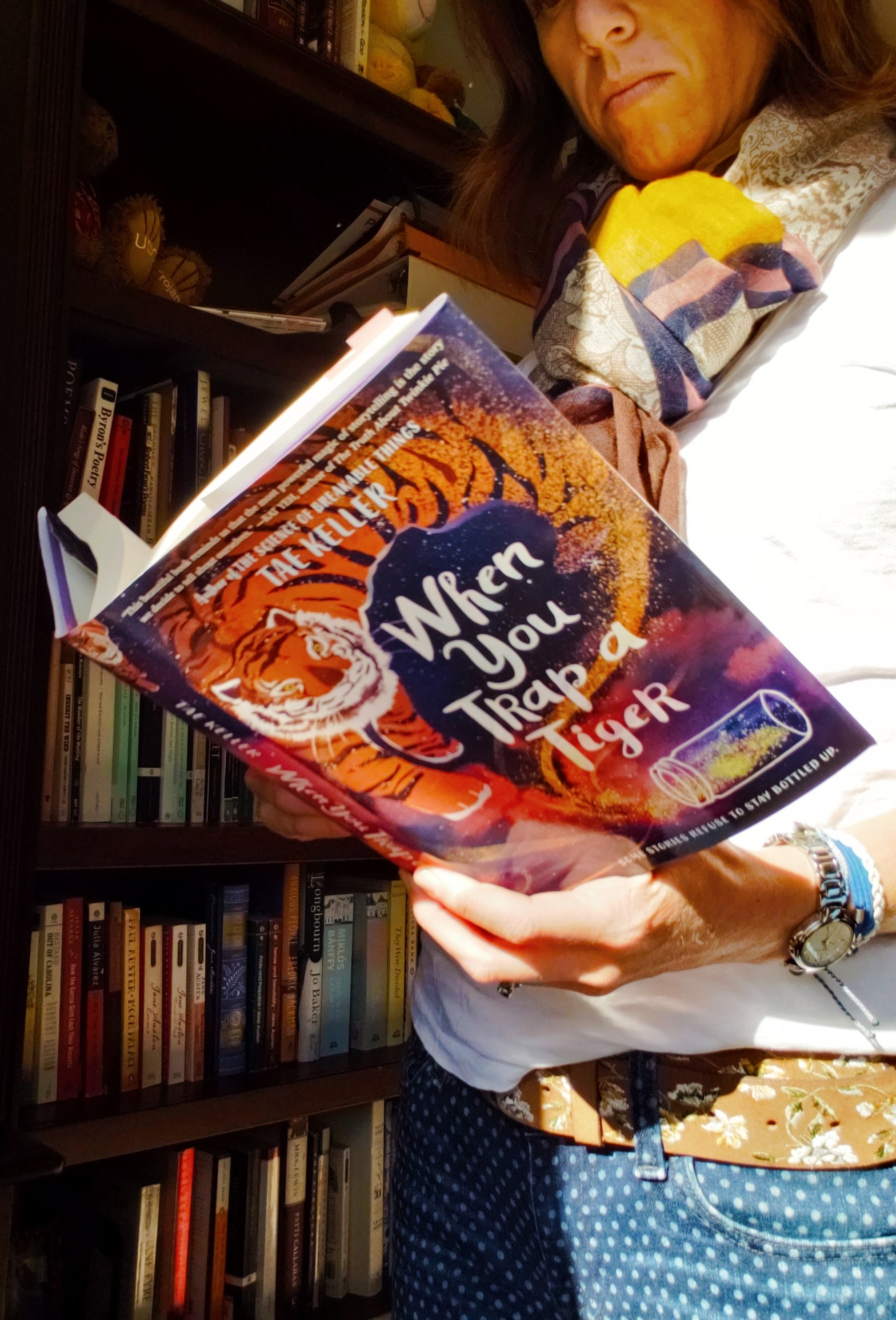
Premise: When Lily, her mom, and her sister move from California to Washington to live with her halmoni, Lily comes in contact with a car-sized tiger who her mom and sister can’t see. The tiger claims Lily’s halmoni stole stories that belong in the stars. Lily must return the stories to the tiger in order to get what she wants from the tiger. But can tigers ever be trusted? Can halmoni? Can her mom or sister? Can she?
Rating: 4/5 Target: 4th-8th grade
Motifs (not exhaustive): Korean folklore, family, female relationships, grief, coming of age, independence, tame vs. wild, captive vs. free, identity, otherness, truth
Great for..* (readers): students who are quiet or feel left out, children dealing with grief or moving
Great for…* (teachers): character development, figurative language, folklore, Asian literature/studies, character contrasts
Other Reviews referenced by KZ in this vlog: Fighting Words, a Newbery Honor book
*The “Great for” category is not exhaustive and does not intend to neglect the multitude of readers/teachers who could learn from this book in any number of ways.
RATINGS GUIDE
٭ = DNF, would not recommend ٭٭ = would not recommend ٭٭٭ = enjoyable, would recommend ٭٭٭٭ = very good, would recommend ٭٭٭٭٭ = amazing, would definitely recommend
I will say it again. (I said it on social media already.) And again and again and again. Holy Snow.
I love books. I enjoy most books. I read fun books, mostly, with some element of depth to them, but let’s call a spade a spade. They’re mostly about entertainment and empathy. But this book. Holy snow.
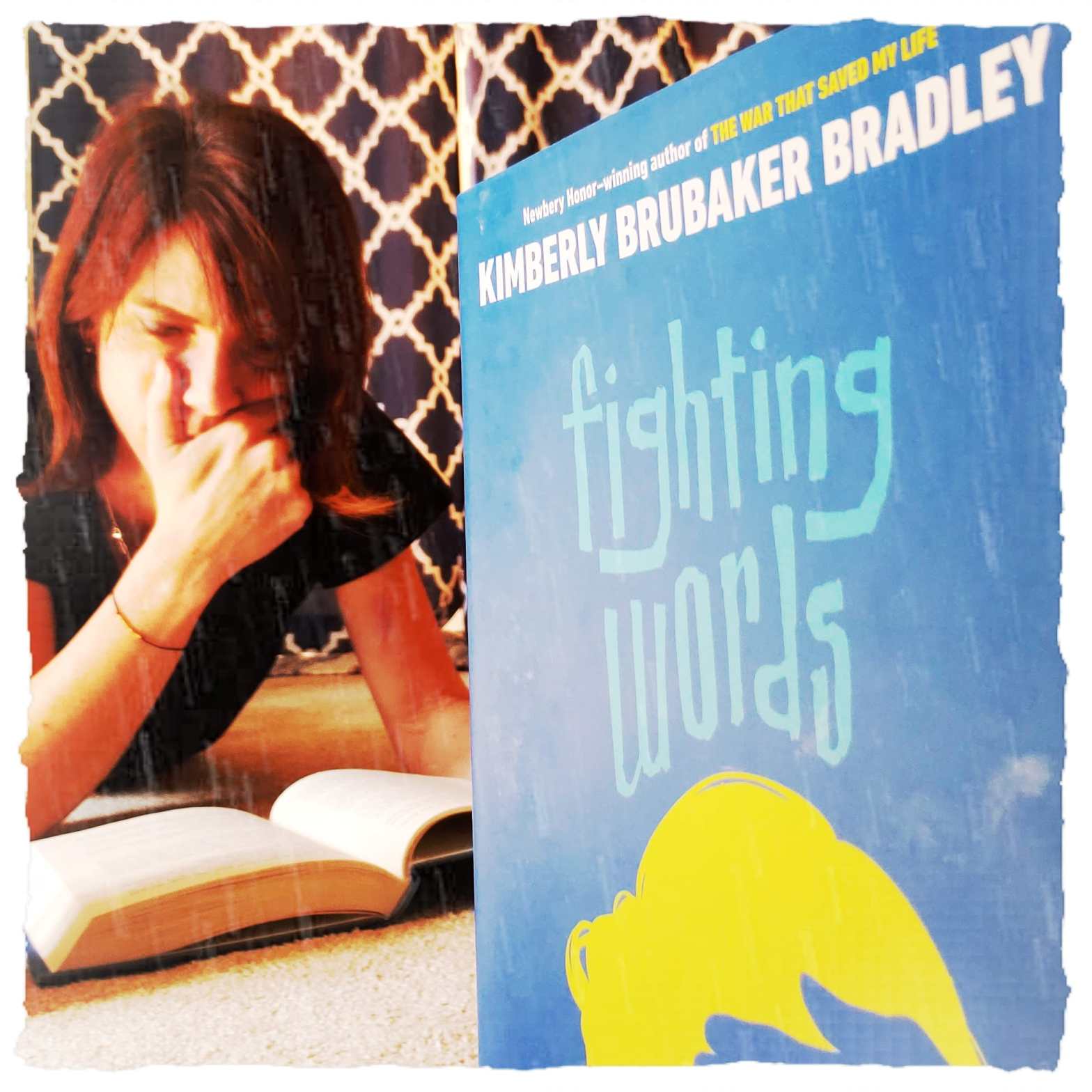
Fighting Words by Kimberly Brubaker Bradley is a powerful, heart-wrenching work about more than its premise, which is weighty and deserving in itself. Although statistics vary, data shows 1 in 4 girls and 1 in 13 boys fall victim to sexual abuse at some point in their childhood. Yet, I cannot think of a single middle grades book (other than this one) that deals with the topic at all, let alone as tactically and expertly as Bradley’s Newbery Honor Book.
Della informs you that she’s ten from the start of Fighting Words, the story she narrates. She begins with the simple facts and builds to the difficult narratives and sub-narratives. From the beginning of Della’s account, she and her older sister Suki find themselves in foster care. Their mother, whom Della barely remembers except for one explosive incident (literally), is an incarcerated meth addict. The man with whom they were left at her incarceration, well, that’s where some of the difficulty resides. It was his inappropriate assault of Della that led to their removal from his care. The scene gets told, once Della is ready to tell it, leaving the reader with a sense of horror and revulsion without feeling the scene crossed a literary line for the target audience. How can a scene be appropriately inappropriate? I don’t know. But I read one in this book.
The quality of the writing and the voice is worthy of the topic here. It would have to be to have the audacity to attempt to deal with sexual abuse, abandonment, and the aftermath. Importantly, Bradley writes from experience, and confesses to such in the author’s note. But this is not a book about trauma; it’s a book about healing.
Like any healing process, Della and Suki do not have a clear and easy path to follow. Della has trouble with a boy named Trevor at school. She pushes people away with her use of four letter words (which, in the book, she substitutes for snow, snowman, snowflake, etc.) both deftly and intelligently. Suki is the only person Della could rely on to take care of her. But Suki has had to parent Della since she was herself six. Now that they’re in foster care, and preparing for court with their abuser, there are plenty of proficient adults to care for Della. And for Suki, too. But Suki and Della don’t always know how to let them or how to trust them.
The characters grow in themselves as the narrative progresses. Della tells you the hard parts. Even the hardest part. (Read with tissue nearby. She’ll warn you it’s coming.) And show you their courage along the way.
There are multiple characters with “bad stories” in this book. Some of which you hear, some of which you don’t. (Even Della and Suki shy away from the explicit and ugly details of everything– making it both tasteful and challenging for a middle grade audience, yet better to be read with someone to talk to through it.) Some of those bad stories relate to poverty, some to abuse, some to mental health. What Bradley makes clear is each character has a story whether they tell it or not.
Fighting Words embodies its title. This is Della. Telling you her story. In her words. With courage. With bravery. With love. With fight. You may not hear many ten-year-olds tell you about their abusive experiences. I pray you don’t (not because they won’t tell you but because they don’t have them to tell). Listen to her voice. It may inspire you to use your own.
You’ve gotta read this book. It’s the kind of book I live for because it’s not just literature. It’s art.
Rating: 5/5 Target: 6th grade and up for general audience, younger for children of abuse
Parents, please read this book with your child. Do not send them off to read this and struggle through its content on their own. Better yet, you read it first. Then read it a second time with them. There’s nothing easy about it. But, much like parenting itself, it’s valuable and important. No one said it would be easy. For snowflake’s sake.
Readers, don’t scoff at the target audience. This book is for older readers as much as it is for middle grade readers. Snow. I could use this in a college course curriculum. It’s that well done.
٭ = DNF, would not recommend ٭٭ = would not recommend ٭٭٭ = enjoyable, would recommend ٭٭٭٭ = very good, would recommend ٭٭٭٭٭ = amazing, would definitely recommend
Not your capital “L” Literature, but that doesn’t mean it’s not worth the read. It’s light and fun and I love this protagonist (who is supposedly a lot like the author).
Read the review of the other book mentioned in this vlog here. And tell me if you pick up Happily Ever Afters by Elise Bryant.
RATINGS GUIDE
٭ = DNF, would not recommend ٭٭ = would not recommend ٭٭٭ = enjoyable, would recommend ٭٭٭٭ = very good, would recommend ٭٭٭٭٭ = amazing, would definitely recommend
Overall rating: 3.5/5 —- 4/5 for adventure enthusiasts
RATINGS GUIDE
٭ = DNF, would not recommend ٭٭ = would not recommend ٭٭٭ = enjoyable, would recommend ٭٭٭٭ = very good, would recommend ٭٭٭٭٭ = amazing, would definitely recommend
٭ = DNF, would not recommend ٭٭ = would not recommend ٭٭٭ = enjoyable, would recommend ٭٭٭٭ = very good, would recommend ٭٭٭٭٭ = amazing, would definitely recommend
If you have read the book, what would you rate it (out of 5)? AND, are you ready for my spoiler question???
And, can anyone tell me how to pronounce the authors’ last name?
RATINGS GUIDE
٭ = DNF, would not recommend ٭٭ = would not recommend ٭٭٭ = enjoyable, would recommend ٭٭٭٭ = very good, would recommend ٭٭٭٭٭ = amazing, would definitely recommend
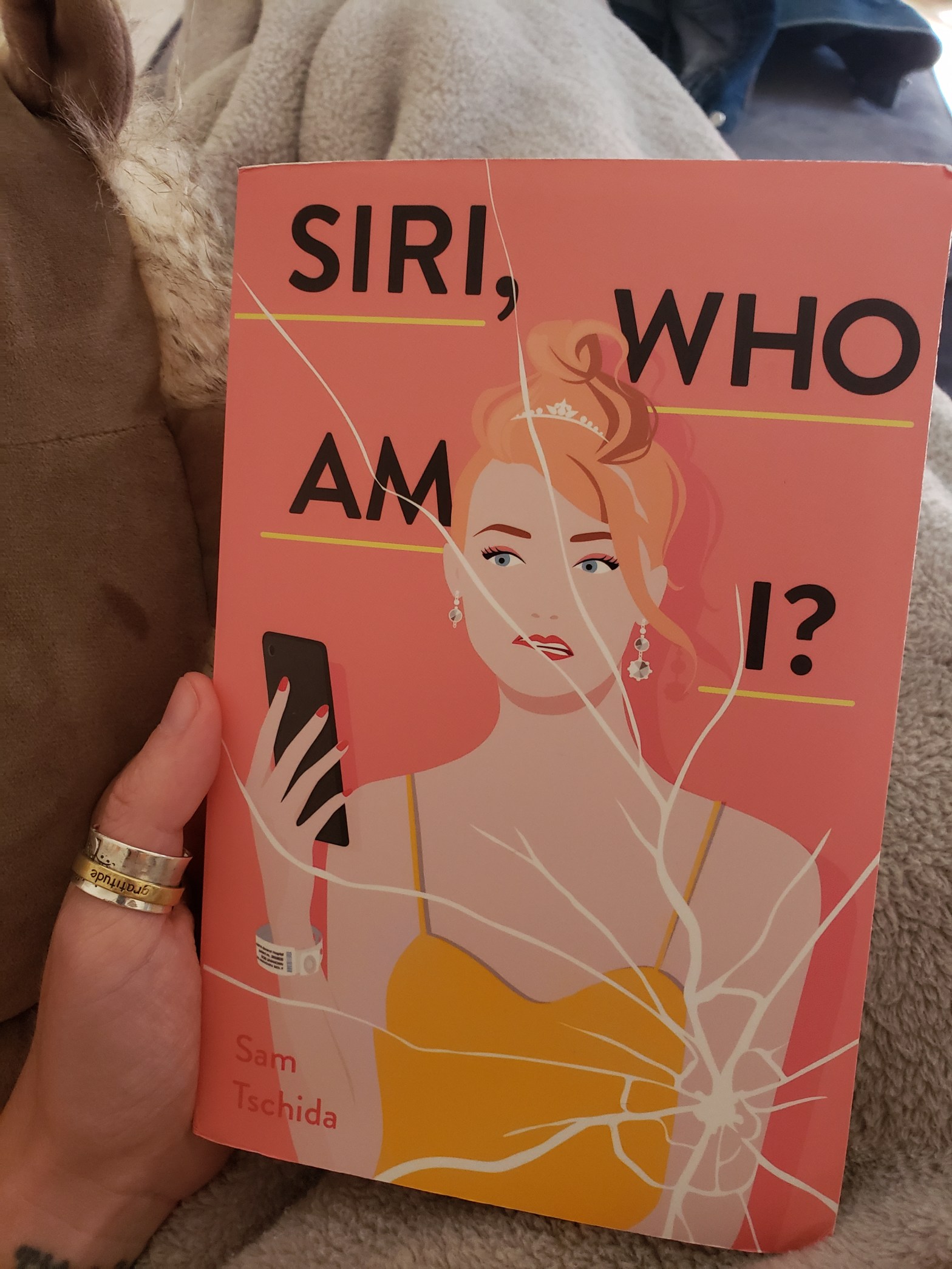
A friend of mine used to pick up Emma (Jane Austen) every year in an attempt to finish it, but the character of Emma annoyed her so much that it took her well into middle age to accomplish the goal of finishing the book. I couldn’t relate. Emma’s (albeit irritating) naivete and inflated self-importance were necessary to her character development and the plot of the book. Same is true for the character of Mia in Sam Tschida’s Siri, Who Am I? — I promise: the Austen comparison ends there.
I admit I picked this book up because I thought it would be a YA novel that undermined the image culture of social media saturating the world, and the teen world in particular. (Although I typically reach for the nonfiction work of Sherry Turkle or Jean M. Twenge in that regard, I’m open to bolstering confirmation bias through all genres. Let no one claim otherwise.) This is not a YA book. I was wrong on all my cover of the book judgements. And I’ll tell you why.
5 reasons why Siri, Who Am I? is not an anti-social media YA book
The age of the protagonist. Okay, so the premise of the book is the protagonist (at that point, name unknown — see book title) wakes up in the hospital with amnesia. She doesn’t know her name, her age, her birthday, her address, who her friends are, what her life is like, or what she is like. As the book develops, it turns out she’s somewhere in her mid- to late- twenties. YA books are all about teens. The moment your protagonist ages out of high school or maybe even college, sorry. You’re off the YA shelf.
Teenagers (AKA readers of YA) would rip Tchida a new one for regional anachronisms. Okay. It’s one regional anachronism. The story is set in Long Beach and travels all over LA and Orange counties — a region of the country, I happen to have grown up in and consider myself relatively familiar with…so familiar, in fact, that I can validate Tschida’s description of the Long Beach Museum of Art where Mia’s amnesia-inducing injury occurred. Spot on. (And, if you’re local to the area, go there….once the world opens again.) BUT, and this is a but bigger than the butts of any of the beautiful characters in this book — and they’re all beautiful characters…which works for LA — Mia repeatedly drives along Pacific Coast Highway. Every time she narrates that fact, she refers to it as the PCH. (Ex from ch.10 : “…we head north on the PCH toward Long Beach…”) I, a gracious and forgiving reader (don’t laugh), can overlook the fact that I have never heard any local refer to PCH as the PCH. Not once, let alone the forty to four hundred times Mia does in this book. (Too many? What? Did it stand out too much to me? Hit a nerve? Annoy me as much as Emma annoyed my friend? No way.) I’ve decided the author and editing team must have been fans of SNL’s “The Californians” thereby making the offense forgivable. The freeways are referred to as the 5, the 405, the 10 in Southern Cal vernacular. It’s a simple case of applying the pattern incorrectly like a child who tells you they runned a race. Teenagers, though, cherish the opportunity to mock adults who think they know what they do not. (Trust me, my day job is in a high school.) That is all they would take from this book. That, and how pretty the characters are. Which brings me to #3.
The characters are all gorgeous. Not just attractive. Gorgeous. How do you enervate the image and filter saturated culture of social media (and Insta, in particular, which plays quite a role in Mia’s search for her true self — she uses her old posts to figure out who she is — not Siri)? You don’t. At most, you can prod it a bit from the inside of the box it built. That may be what Sam Tschida is attempting to do here, but the book falls short of the standard I’d set up for it before I’d cracked the spine.
The inclusion of sex I’d like to say the sex, so I’m writing it as a reason but teenage sex occurs in YA (see Rainbow Rowell and so many more). So I can’t use sex as a reason this book is not YA. It’s more that the sex occurs between consenting adults. (see reason #1)
The number of times Mia takes a selfie and posts it.
It never changes. From being let out of the hospital and onward, once Mia has her phone, it’s multiple selfies each day, every day. And you’ll get to read when she receives likes on those posts, even some of the comments. (Actually, this all sounds rather YA, doesn’t it? Damn it. Hmmmm. How to redeem this reason….Got it! YA is not my point on this one.) All this narration around social media and social media posts lack a tinge — or should I say filter? — of negativity. Mia likes social media and it plays an important role throughout the novel and the plotline. One might even say it’s her saving grace making the novel pro social media..
Siri, Who Am I? could be read by high school aged teens. And it does encourage honesty and authenticity on social media. I will give it that. But it is not the book I expected to be reading when I read it. Can you blame me? I claim being influenced by the cover art and title of the book. (Confession: I judge books by their covers. And you do, too.)
٭ = DNF, would not recommend ٭٭ = would not recommend ٭٭٭ = enjoyable, would recommend ٭٭٭٭ = very good, would recommend ٭٭٭٭٭ = amazing, would definitely recommend



 KZ Rochelle