Many people love to camp. They grab their tent, their sleeping bag, flashlight, and frying pan and they’re off to enjoy the outdoors, take in the scents of nature 24hr/day.
Not me. Oh, I love the outdoors, but only for a select amount of time. No overnighting, thank you very much. After a dirty day in the elements, take me home to my shower and my bed, please and thank you. I’d put myself somewhere on the spectrum between glamping and Troop Beverly Hills. Luckily for me, camping in your own home is on that spectrum.
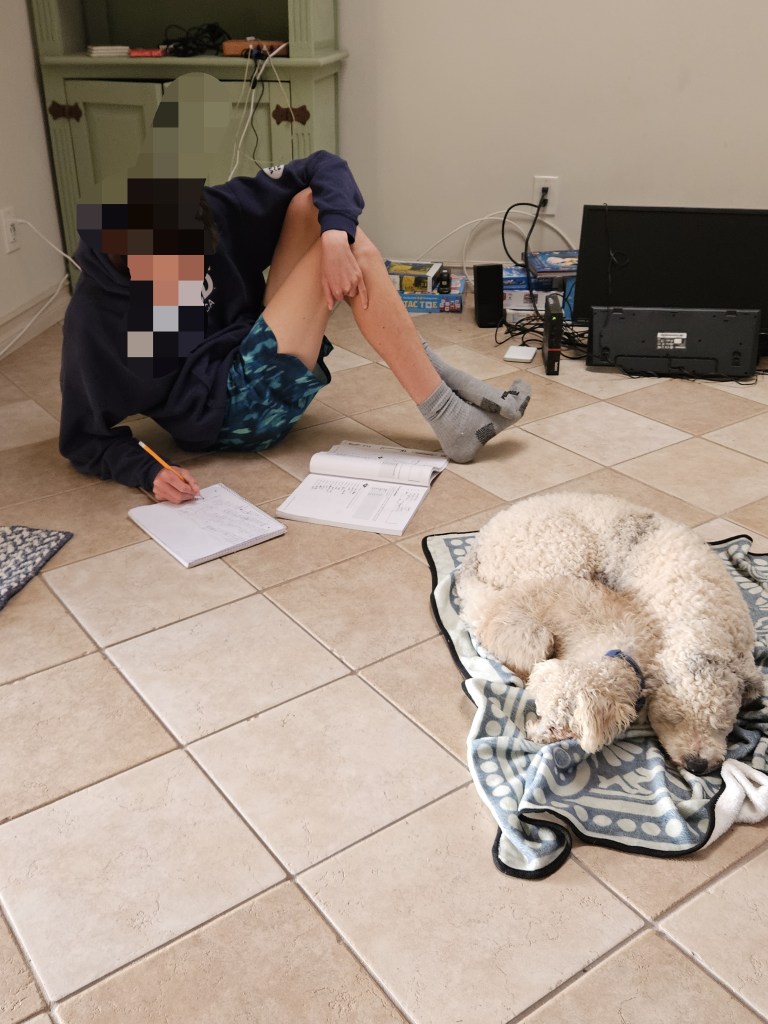
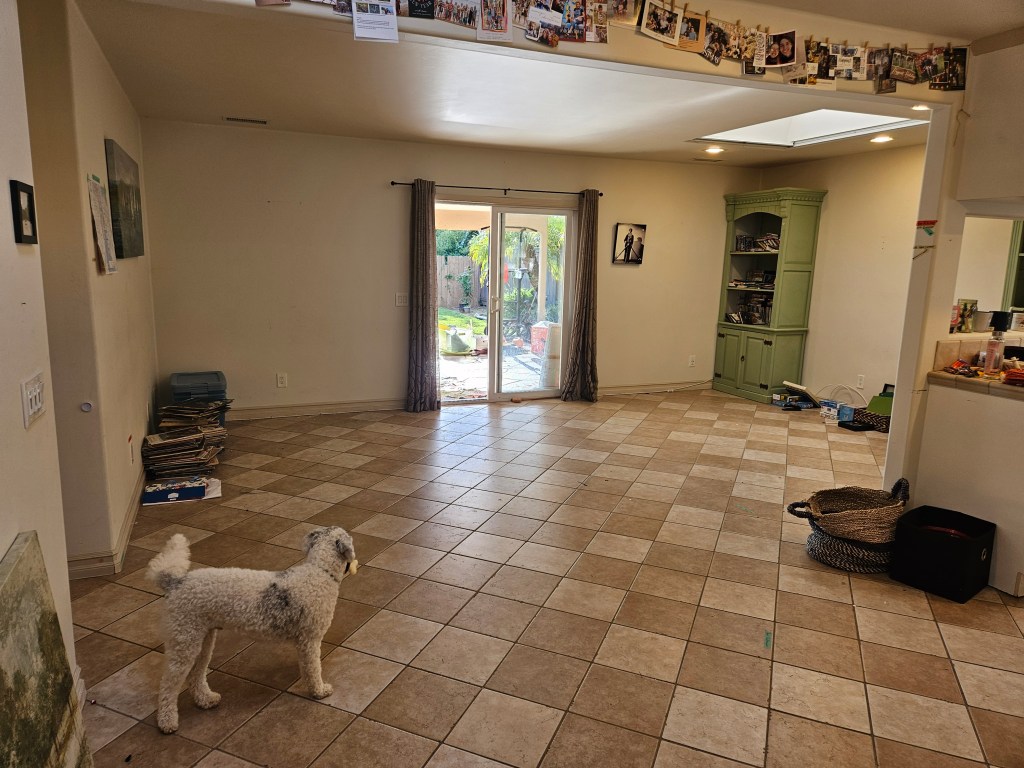
After the estate sale, we’d been left with our beds (which we’d put behind a locked door), two green floor-to-ceiling cabinets, and a wooden chair the dogs had gotten the better of. We saved some pots and kitchenware, notably the coffee machine, and were otherwise living out of suitcases as of the beginning of March.
Three weeks until departure. This, we could do.
Homework on the floor in empty rooms after the Estate Sale left us with very few pieces of furniture. Dinner was on the floor, too, until we discovered we still had a card table we could use. The boys used crates for chairs.
The idea of a minimalist life was urgently appealing. Who needs all this stuff? A towel, a bed, and a nightstand — that’s all I need. Oh, and a closet. And preferably a set of drawers, too. Hangers, of course. And, I mean, I don’t need a coffee machine, but the people who interact with me need me to have a coffee machine. And my books, of course. So somewhere to put my books. And all my kitchen gadgets so I can make my meals. A television, of course — because I don’t want to watch all the Liverpool and San Diego Wave matches on a phone. And, with that, I’ll need a comfy couch. With pillows.
Ah, the minimalist life.
We were enjoying this strange, new existence, looking down at the final days of school and U.S. residency when Husband received a request for a meeting with his new company.
“I wonder if they want to offer us more money for the move,” Husband said. He had a point. The move money they gave us was laughable. They had a requisite amount/limit for anyone moving inside the country and anyone moving outside of the country. Of course, they were accustomed to outside of the country being within the E.U., not the West Coast of the United States.
Deep breath; I digress.
“I wonder if they want to offer us more money for the move,” Husband said.
“Maybe,” I said, wanting to believe that could be true. I didn’t see why that would require a face-to-face meeting though. Send an email. We’re increasing the measly amount we offered to give you for your relocation four fold. Congratulations. See you in Switzerland. Easy peasy. No, this was going to be weightier. And it already made me sweat to carry the thought of that weight.
So Husband took another 6AM meeting, but this one didn’t require me, so he took it alone. Afterall, I had to get ready for work. He set his computer on a built-in shelf in our empty closet and met with the onboarding team.
I couldn’t hear too much from the bathroom. Just enough to be able to tell the person on the line with him was not a native English speaker. The accent was telling. And Husband’s tone of voice. (Husband’s tone of voice is almost always the same: light, jovial, soft, pleasant. I’ve only heard it go edgy when I poke his buttons for long enough, or when our kids do the same thing. Oh, and a bunch of times when he took meetings with Old Boss.)
Husband’s tone of voice quickly changed from friendly to tense. I emerged from the bathroom to hear him say, “…because we have our house rented out. As of April 1st, we have no place to live.”
And shortly thereafter, “We have booked our flights. We arrive March 24th. Our renters arrive April 1st.”
The bottom line: our visas did not go through quickly enough for the April 1st start date. The company hoped everything would work out to have Husband start May 1st instead.
We had planned to camp in our own home, with minimal gear, for three weeks. We had not planned to take our suitcases and book a campsite to sleep outdoors. Hopefully, we wouldn’t have to…
I’ve moved plenty of times. Within a city. Across a state. From West to East and East to West. From North to South and back again. I’ve lived all over the United States. Any time there’s a move, a massive to-do list materializes around closing up shop in the current venue and opening afresh in a different location. The list of what needs to happen seems to self-populate, then overpopulate.
Some of that stays true for an international move — the old standbys remain: find a place to live, pack, set a departure date. Some new ones pop up, though: what do I need to do to get a visa? is my passport up-to-date? do dogs need passports? how do I look for a job in a country in which I do not speak the languages? how do we get on House Hunters International? So, while many Americans were planning what to do for Superbowl Sunday, my husband and I were sitting down to plan out what we knew to plan out for an international relocation.
Backwards planning, here we go: Husband’s first day on the job is April 1. We want at least a few days to adjust to the time change (9 hours), so let’s plan on March 23rd-ish. Holy crap! Those plane tickets are expensive! Is it any cheaper if we make about 14 stops along the way? The dogs can’t make 14 stops along the way. Someone has to fly direct with them. I wonder how much stuff we can manage to fit in a suitcase to bring on a flight.
“Hey, by the way, what are we doing with all our stuff?”
“What do you mean what are we doing with all our stuff?”
“Do we ship it all to Switzerland?”
“That sounds like an insane cost. It’s expensive enough to move within the country, but, overseas would be nasty.”
“So what are we going to do with all our stuff?”
“Mmmm… sell it?”
“All of it?”
“Or most of it?”
“That sounds like some insane logistics. Who will be here taking photos, creating posts, scheduling people to check out our stuff or pick it up?”
“Mmmm… Well, I have to go to work every day,” I gave Husband a you-know-what-I-mean look, and he gave me an Ain’t-No-Way-I’m-Doing-All-This response, so I said, “I guess we better get started.”
“Let’s start with the bikes,” suggested Husband. “They take up so much space in the garage anyway, and I hate how crowded it gets in there.”
“Yeah, if you help me bring them out, I can handle the bike posts.”
I opened the garage door, stepped outside, and Husband and I started dragging bikes up the driveway. I took pictures of their frames, their handlebars, their wheels, etc.
“Are you going to post them on Facebook Marketplace or Craigslist or OfferUp or what?” he asked.
“Yes,” I said. “Only I can’t access my Facebook account to use Facebook Marketplace.”
“Why not?”
I sighed heavily. “Ugh. New phone. Different computer. They don’t believe I’m me and I’ve no way to prove it anymore.”
“Well, just use mine.”
After three hours having the bikes up for sale, I decided this was not going to work. I could not stand the bombardment of emails asking if any of our eight bikes were still available or haggling for a cheaper price or suspiciously requesting that a distant relative pick up a bike after asking for Zelle or Venmo information. If a handful of bikes caused this much headache, what would it look like to sell almost everything we own?
Husband and I are thrifty shoppers. We do not disparage goods that belonged to someone else before we encounter them, and we welcome their story into our home. We have picked up numerous pieces of free furniture next to our neighbors’ mailboxes, and, if there’s a garage sale nearby, we head over with our vision piqued for a few key items. (I won’t tell you what they are because I’m not going to invite the competition.)
“Maybe we have a garage sale,” Husband thought out loud. “At least then all our stuff goes at once. Or several garage sales.”
“That’s probably wise,” I said.
Even as I voiced it, I thought it sounded exhausting. People are exhausting. Lack of structure is exhausting. A garage sale is both lots of people swarming in waves and hours and hours long right outside the door that leads to my very comfy bed — which I am not selling until I absolutely have to.
“I’m going to look into estate sales,” I said as the notion occurred to me. I would definitely pay someone to handle this mess for me.
So that’s what we did. I found the numbers for a couple of local companies, handed them off to Husband, and he did the rest. Set up appointments with them, selected one to use, set the dates, and we were on our way.
“Add it to the calendar!” Husband said. “The last week of February into the first week of March.”
“Why a whole week?” I asked.
“Because they do everything for us.”
“What do you mean everything?”
“Everything. They organize all our stuff and price it during the week so that on the weekend they are ready to have people shop. Then they run it like a store. They don’t even want us around.”
“That sounds awesome!” I declared.
“And get this?” he said. “The woman who will be in charge of our estate sale is named Richelle.”
I smiled. “Well, it’s meant to be.”
“Indeed. But anyway, we’ve got to be out of the house by the final week of February — and we have to have gone through everything in the house to know what we’re bringing to Switzerland and what we’re not so it can get sold. We need our suitcases so we can pack them and see what fits. We need some boxes to…uh… will your parents let us store some things?”
“You mean some stuff before we find a permanent apartment.”
Yes, in the meantime, Husband’s company committed to finding us a temporary apartment — three months on their dime. I mean, on their Swiss franc — because finding an apartment in Zurich is notoriously difficult. And what do we know about where to live in Zurich?
“Yeah. We’re bound to have some things we don’t need to travel with but will ultimately need while we live there.”
“Or want.” I thought of my antique books, my collection of Jane Eyre, the Ephesians study I’d written in college.
“Keepsake type stuff, too.”
“Yeah, they’d probably let us,” I told him. “I’ll ask my dad, buy suitcases for everyone since we only have one or two that remain usable, and figure out where we are going to stay during this estate sale while I still have work and the kids still have school.”
“And I’ll ask around to see if anyone will let us stay with them.”
“Great.”
“Speaking of school, we need to sit down and determine the boys’ last day.”
We met with Older Son’s high school counselor to gather information to make our decision and discovered that, because his school was on a trimester system, grades closed on March 7th on the day of his last final.
Perfect. March 7th would be his last day. And, since it turned out Younger Son’s grades closed on March 8th, we made that his last day and informed both schools of the plan.
“How about I finish before them?” I asked, thinking about how challenging it would be to live out of a suitcase at someone else’s home or in a hotel during the week of the estate sale, all while teaching a full time schedule.
“That’d be nice,” said Husband, “but I think I’ll have to punch some numbers and see what we can manage.”
GRRRRRR!!! Stupid logic! Can’t I just stop working now? I’m ready. Say the word. [see more about this mindset in the original post, The Preface] No? Sigh. Okay. Fine. Let math have its way. As always.
We ended up setting my last day a week after the boys’ left school: March 15th. The Ides of March. For an English teacher, it was fitting, but I’d rather have gone out on Pi Day. I didn’t want to be Caesar in this play! No et tu, Brute for me.
After weeks of revisions, the final [simplified — because I can’t even follow the madness of the full, complex, arrows-everywhere, to-do list post-its layered on top full version] schedule of events looked rather like this:
April 1: Husband’s first day on the job March 26: Everyone arrives in Zurich March 25: KZ departs from LA with the dogs on a direct flight to Zurich March 22: Husband and Boys depart from LA with stops to see relatives in different states along the way to Zurich March 18-22: Sell KZ’s car March 18: Leave San Diego, stay in LA March 16: Goodbye Gathering March 15: KZ’s last day teaching March 10-15: Sell Husband’s car March 7&8: Kids’ last day of school February 28 – March 3: Estate Sale (find a place to stay)
Sounds simple enough, right? Yes, that is the simple list. — Oh, what the heck. Just to give you an idea, here are some of the to-do items flying out from that simple list. Dog training — do they have to be crated or do they go in the cabin on the flight? Rent out house — company? utilities? etc. Fingerprints to FBI ASAP! (Visa) U.S. Phone Numbers/Cell Phone situation ALL Autopayments & Subscriptions — cancel USPS Forwarding Medical Records Donation receipts Electronic Waste Shipping Guitars
You can see how these would have all sorts of arrows associated with them. It was chaos. It’s John Nash’s office after he was sent to the psychiatric hospital, or at least the film version of it.
It felt a bit like that, too. Not to belittle mental illness, but, my goodness, we felt the paranoia of missing something vital that would set us back or keep us from moving altogether, as well as the schizophrenia of a voice popping up, albeit our own, adding items and deadlines to the already haywire list. Something was bound to go wrong. It was only a matter of time before we found out what…
Everything our family of four (and two dogs) possesses is now in my parents’ house — including us. Granted our belongings are no longer massive: approximately 25 small shipping boxes, 3 guitars, a typewriter, and 2 large suitcases per person. No furniture.
We are moving to Switzerland with stops along the way.
Stop 1: Still in Southern California, hours from the our home, I’m sitting in the house I grew up in. And now seems as good a time as any to look back on the last few months, breaking down how we ended up here. And how we will end up there. To do that, I’ll have to venture back in time a bit, and start somewhere near the trailhead for this journey.
My husband and I have talked about him leaving his job for years. He is a much nicer, much gentler, much more optimistic person than I am, so whenever I said, “It’s not gonna get better,” he’d say, “Well, they just said they would do…” (He’s a big believer in people — one of the reasons I love him — and also one of the reasons it took a while for him to leave his job.) And he’d go on working there for months and months, and we’d go through this cycle of discussion regularly.
Until he couldn’t take the stress or the angst anymore. Around the start of the school year, he told the company he was leaving at the end of the calendar year, 2023. The discussions between the two of us regarding his job shifted, necessarily, from the usual cycle we’d grown accustomed to to the unknown of the job market.
With a stable job as a teacher and a good school district for our sons, I wasn’t particularly keen to move. Still, I knew it was a real possibility that, as my husband applied to or networked for jobs that fit his particular set of (esteemed) skills, it may not be in the San Diego area. He’s a physicist. A chemical physicist. A physical chemist. It all means the same thing to me; which is to say, I don’t know what it means. (And, yes, I have no idea what he’s talking about when he tells me his tasks and shows me his graphs of what he’s working on; I just read his intonation to figure out if he’s excited or disappointed about what he’s discovering.)
“Maybe I can do something else,” he’d say, “in order to keep us here for sure. Then the boys could graduate here, at least.”
See? Sweet, gentle, giving man. Looking to make it easier for others.
“Like what?” I’d ask — though I don’t know why, because, no matter what he might be doing for a living, I’m not likely to understand a lick of it.
“I basically do a lot of data analysis now, I could probably do something in that field. I know…” or “I know a lot about ____,” and he’d continue with his list of people he knows in all sorts of fields who could help him find a job locally.
So he did everything: worked at the job he was leaving, looked for local jobs, and looked for jobs that could take us to, well, anywhere. He was speaking with companies in Paris, London, one somewhere in New Zealand, San Diego, Boston, Los Angeles, San Jose, and, of course, Zurich. It felt as though there were leads everywhere. So many, to me, that I set it on the shelf in my mind until something was more tangible. Meanwhile, he had to consider everything as imminent.
“There’s a company in Zurich,” he told me one morning, “doing direct air capture.”
This was before my morning coffee, so I did not know if Zurich was the neighboring town in San Diego or a Hawaiian island. Direct air capture sounded like logical words; I’d have to translate them later, after caffeine.
“Cool,” I said, probably with little enthusiasm.
“They have a few job openings I’m interested in. What do you think about Switzerland?”
Okay. Time to wake up, I thought. “Switzerland would be cool.”
“You know my family is Swiss? We’re from Bern.”
“Yeah, cool,” I said.
He applied to several positions at this company in Switzerland, and soon they requested an interview.
I confess, as long as I was going to a full-time job myself, working with the lovely young generation of middle schoolers I found myself with each morning, I didn’t have much headspace for his job hunt. I was excited and proud for all his leads and phone calls and even interviews, but I’d drop those thoughts for most of the day to be Teacher and then Mom. He could give you the more gripping version of this — alas, he’s busy doing consulting work these days, but we will get to that — much later.
For both of us, this job hunt felt long. Leads, leads, then nothing. Phone calls, phone calls, then quiet. It was early November when this company in Zurich, having already conducted several interviews online, told him they’d like to fly him out to have an onsite interview.
Now, if my husband is the big believer in the ability for everyone to change and things to go well, I am the bare-bones, just-the-facts, pragmatic bottom liner. So my train of thought was, “They’re willing to fly him from San Diego to Zurich? They’ll have to put him up in a hotel. That’s thousands of dollars. They are offering him the job.”
Time to learn German.
In fact, I was sitting in a traffic jam outside Lahaina on a family vacation when I figured, might as well capture this time for tutelage.
[Okay, my American friends. I know you speak English and, I don’t know, maybe a little Spanish or French you learned in high school, but you probably haven’t used it much since. So now I’m talking about European languages, yes, but I’m talking specifically about the tiny country of Switzerland, best known, I’d say, for their chocolate and their tennis star, Roger Federer. If you aren’t a tennis fan, that’s okay, and if you aren’t a Roger Federer fan, that’s really not okay, but I’m going to give you a chance to change that. Either way, you need to know that one of the most impressive things about elite tennis players in general is that they play in hours-long matches, sprinting from side to side, playing mind games with their opponents, for sometimes three or four hours before a winner is declared, and then, after all they’ve done, someone shoves a microphone in their face for an on-court interview in the language of the location. At the French Open? Speaking French. Wimbledon? That’s English. And most of these athletes are neither French, British, or American. So, take Roger Federer, an all-time great who has won every grand slam tournament there is. And, of course, he’s Swiss, but he’s gliding through these interviews in English just as he glides on the court. Same thing in French. And he’s also spoken in Italian and Mandarin in the post-match interviews, depending on where the match itself is located. Anyway, I digress. The point is I know English. I’m great at English. I know a little Spanish. I can get by with my high school Spanish. I do not know any other languages anywhere near proficient enough to survive a basic conversation, and we are talking about moving to Switzerland where the spoken language, Roger Federer’s first language, is Swiss German.]
Switzerland has four official languages, and none of them are the language Swiss children learn first. Although Swiss German is spoken, it has no grammar. It’s not really a written language. I like to think of it as the opposite of a language like Latin. In English, we call languages like Latin that are no longer spoken, a “dead language.” Swiss German isn’t dead; it’s spoken, but only spoken. I wouldn’t call it a “live language.” That seems like it would be a written and spoken language. So, not being a linguist as previously proven, I’m going to call Swiss German a “spirit language.” I think it fits. It’s not confined by grammar (aka structure, like a skeleton) so it can’t have a body. It’s not dead, it has no body, it must be spirit.
Again, I digress.
In Switzerland, the four official languages are German (thus where I began), French, Italian, and Romansh (which I’d never heard of in forty years of living). Swiss German is not an official language. Hmmm….
If my husband is going to be offered a job in Switzerland, I need to get on my language game to consider the offer seriously.
Why did I pick German to begin with? I don’t recall, though I can substantiate it with logic. I’m sure you can, too. Say “Zurich.” Really. Say it. Out loud. Whisper if you must. If you hadn’t any idea where this place was but knew it was a place where they were likely to speak German, French, Italian, or Romansh, which would you go with? German, of course. The “ch” at the end of the word chokes of guttural phlegm production. Must be German.
I open my language app I use for Spanish — since I am a teacher in the San Diego area. “Which one of these is coffee?” it asks. My choices: Milch, Kaffee, Brot.
I’m going to rock German, I think.
“Which one of these is milk?”
I’m already fluent.
“Du bist ein Dummkopf.”
Strange. I don’t know how to translate that.
So I’m sitting in a rental car in a Hawaiian traffic jam caused by I-don’t-know-what, learning German.
“I want to learn German!” I hear from the back seat. “Can I do that, too?” asks the younger of my two sons.
“Sure,” I say, thinking only about the fact that he seems exhilarated by the idea and that would make for a good distraction as we move the width of three palm trees per minute.
Then I realize I’m about as exhilarated internally as he is externally about the idea of learning another language and about the notion that we could be living abroad. I’ve always wanted to live abroad. I spent a summer in Hungary teaching English in preparation for a year in Budapest, which fell through at the last minute. And no, I don’t speak Hungarian. I am even, somewhere, on tape — yes, tape — as an eighteen-year-old at my high school Grad Night being asked about the Twenty Year Reunion twenty years in the future. (Now, when I hear this question being posed to a graduate of a few hours, my left eyebrow raises, but at the time, I took it in stride and said) “I won’t be at the reunion. I’ll be living in London.”
Which, of course, did not happen.
But my motivation for saying that was partly about living abroad — and partly about being a book editor, which, also, didn’t happen.
Arranging for an on-site interview in a country nine hours ahead of you is a bit challenging. 9:00 AM in Switzerland is midnight on the California coast. 5:00 PM there is 8:00 AM in San Diego. So, their work day overlaps with our early morning sleep schedule. Since our household gets up between 6am and 7am, we have about an hour or two each day to contact Switzerland live. Otherwise, all communication must be conducted at a snail’s pace via email, waiting through the night to receive a response — if they get to it in fewer than 24 hours.
Eventually, the interview was set for Monday November 20th. Thanksgiving week here in the States. Just another work week there in Zurich.
KZ sitting on the Hawaiian coast, not too far from Lahaina, Maui
No, of course, that’s not all! That’s the first leg. You thought I could tell this whole thing in one post??!
Don’t worry, Leg 2 is coming. We’re going to need at least a second leg so that I don’t fall over.
Premise: It’s been 278 days since Rain’s brother Guthrie died, and Rain and her parents are moving 288 miles to have a fresh start (even if her mom is the only one who wants one). What happened that night is a big who knows to everyone except for Rain, but that secret means Guthrie’s death is her fault. With her secret and very few other items packed, Rain moves to NYC to process through the loss of her brother and the degradation of her parents’ marriage while she tries to fit into a new environment where she’s off on the wrong foot. (Check out the motifs section, there’s a ton of issues brought up by this book — and all well done.)
Rating: 4/5 Target: 4-8
Title: The title’s meaning remains open to numerous interpretations — so it’s a great discussion point post-read. I’ll wait for you to tell me your interpretation before I divulge mine.
Great for…* (readers): who have friends experiencing grief. As a mother of kids with nuclear family member loss, I want to give this book to all their friends so that they get an inside perspective of what it’s like. Also good for kids who feel alone, different, isolated, or are experiencing change.
Great for…* (teachers): This book is rife with figurative language and symbolism. It even weaves poetry in (as a school assignment), so it’s kind of asking for work on that front. Many allusions to The One and Only Ivan make for a great pairing if Ivan comes first.
Parental Warning(s): For children who have experienced death of a nuclear family member, this book could stir up difficult emotions.
Interact: Rain runs to wipe her thoughts away and empty her brain. What works for you?
*The “Great for” category is not exhaustive and does not intend to neglect the multitude of readers/teachers who could learn from this book in any number of ways.
RATINGS GUIDE
٭ = DNF, would not recommend ٭٭ = would not recommend ٭٭٭ = enjoyable, would recommend ٭٭٭٭ = very good, would recommend ٭٭٭٭٭ = amazing, would definitely recommend
Premise: Jessie’s mom passed away 733 days ago, she’s counting. A bit too soon for her to confront her dad’s news that he is remarrying and they are moving from Chicago to LA. Jessie must start a new school, leave her friends behind, and join another household/family. At a private school for the wealthy (paid for by her new step-mother), Jessie struggles to establish a groove until an anonymous student starts emailing then texting with her. Who is this “Somebody Nobody” with whom conversing is easy and what will become of their relationship? Can you blame her if she’s struggling to feel confident in the midst of so much change?
Rating: 3/5 Target: high school, college
Title: “Tell me three things” derives from a pattern of communication between Jessie and SN (exact identity: unknown) where they begin conversing by telling each other three things about themselves, whether important or unimportant, factual or opinion-based. Record your three things in the comments, and see mine as well.
Motifs (not exhaustive): grief, moving, new kid, step families, adaptation, coming of age, friendship, romance
Great for…* (readers): fans of romance and romantic comedies (like Happily Ever After or the film You’ve Got Mail) who want something fun to read
Great for…* (teachers): students who may be reluctant readers but who get swept up in the drama of high school, free reading, quiet/bookish students
Parental Warnings: some sexual innuendo and referencing, sexual coming of age in minor characters, intermittent cursing
Start a conversation like Jessie and SN: what are three things about you? List in comments and expect a response.
*The “Great for” category is not exhaustive and does not intend to neglect the multitude of readers/teachers who could learn from this book in any number of ways.
RATINGS GUIDE
٭ = DNF, would not recommend ٭٭ = would not recommend ٭٭٭ = enjoyable, would recommend ٭٭٭٭ = very good, would recommend ٭٭٭٭٭ = amazing, would definitely recommend

















 KZ Rochelle