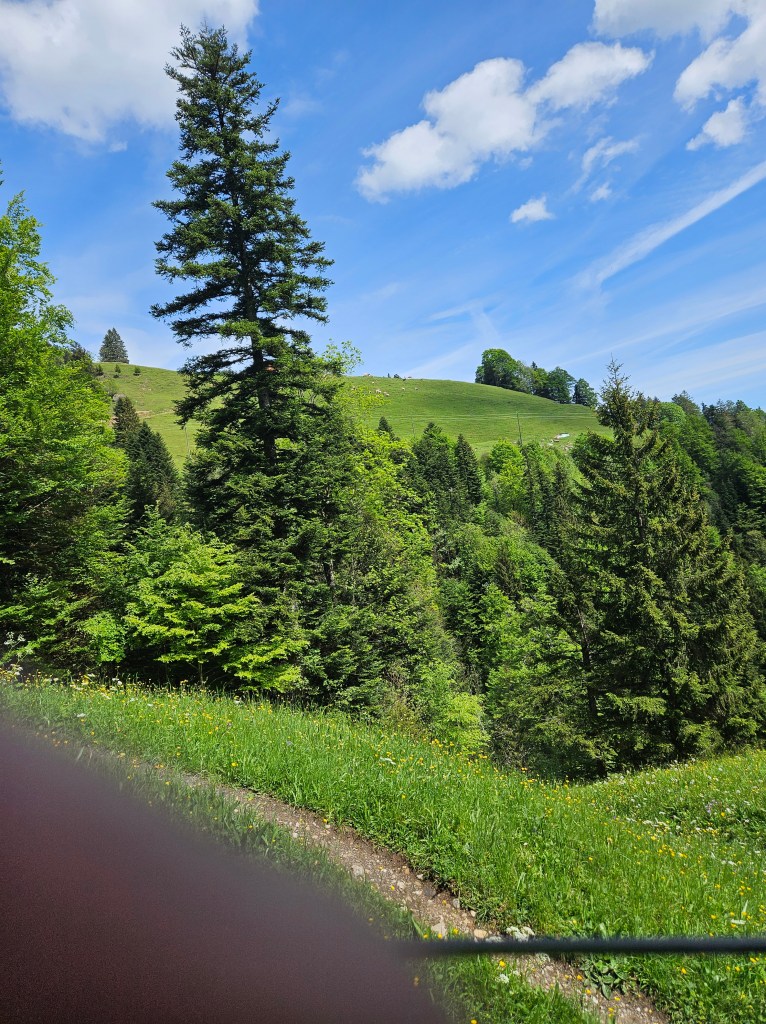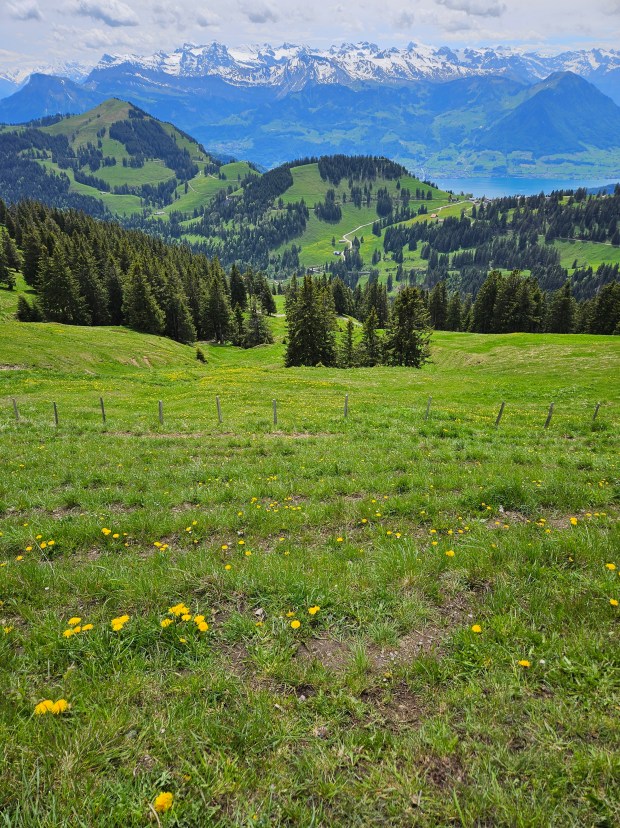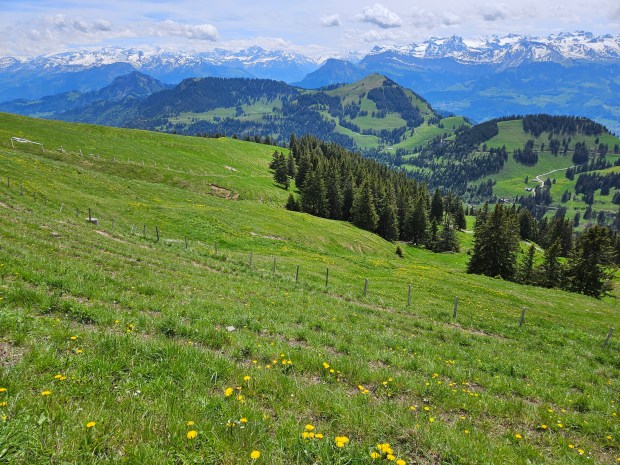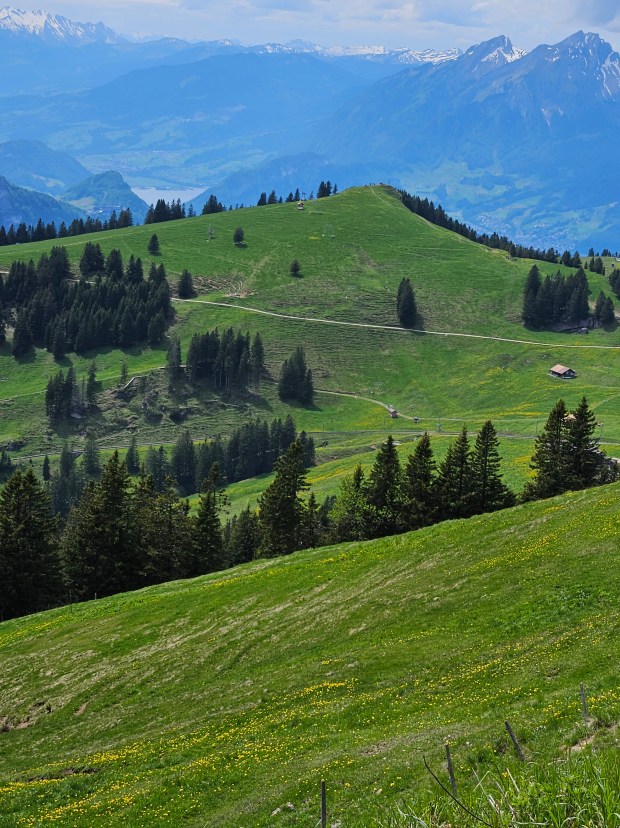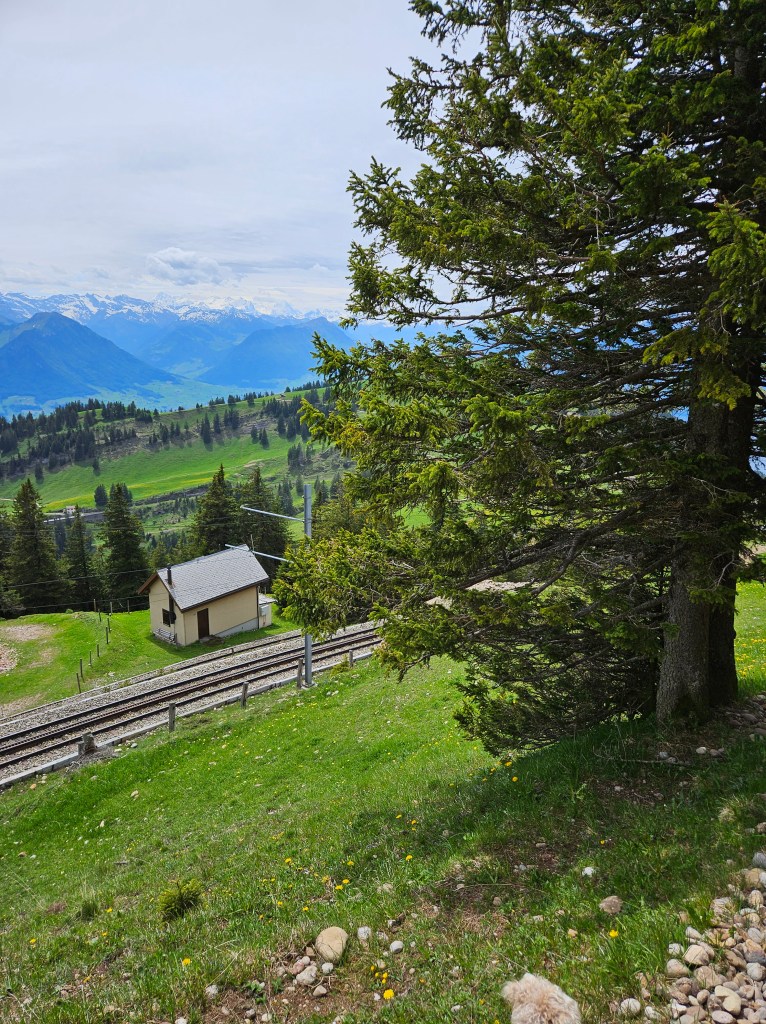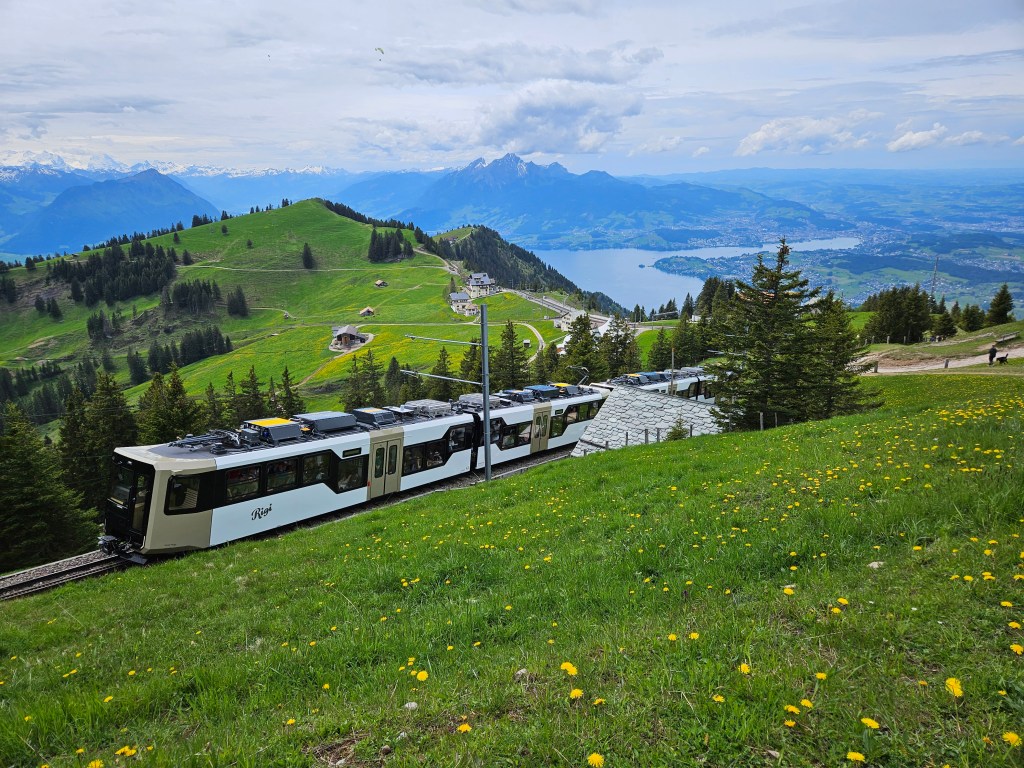
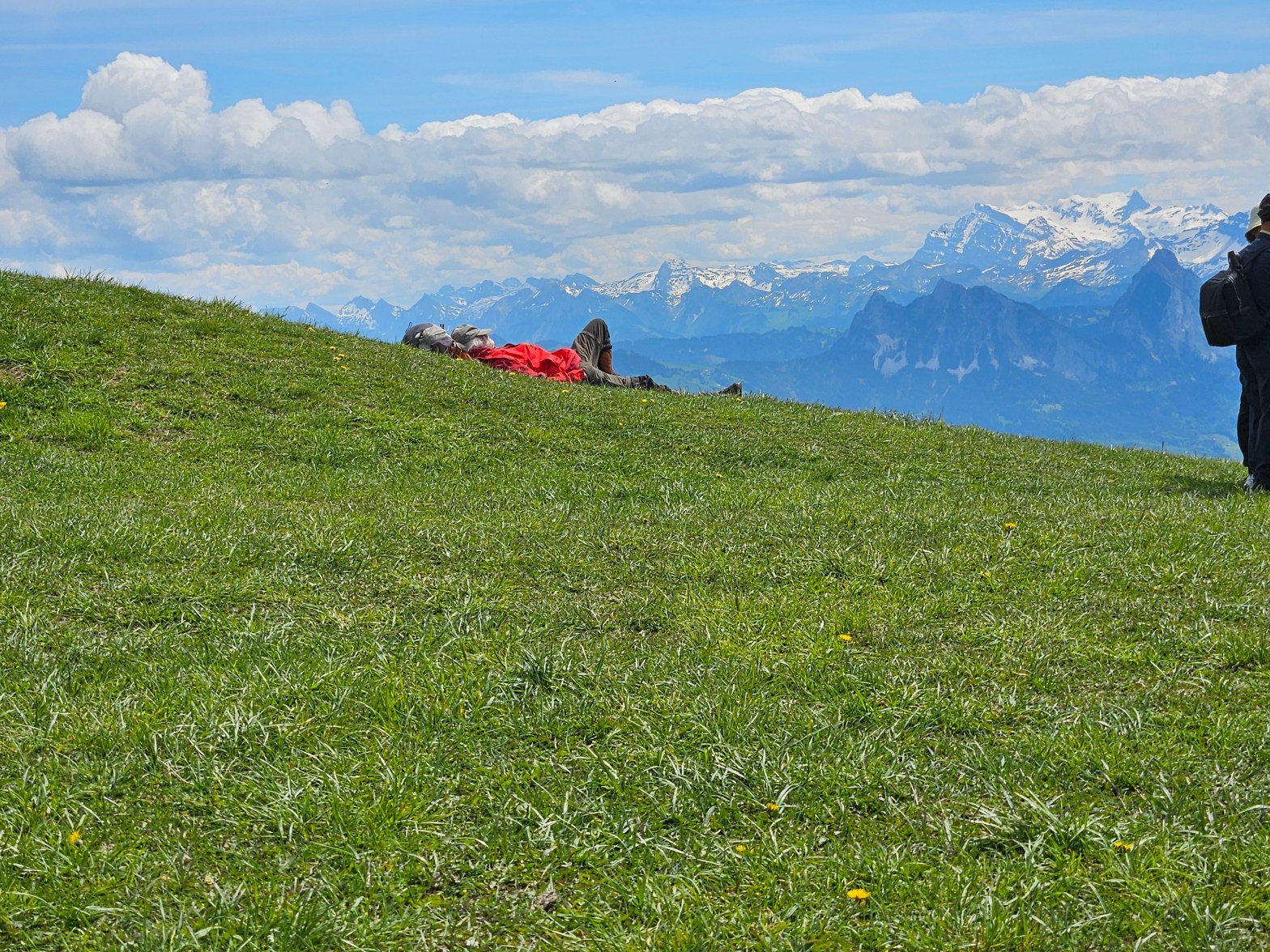
Mount Rigi, Switzerland

All photographs in this post are unedited and accredited to KZRochelle

This post includes: The Story, Travel by Train, The Bookish Connection, Scenes from Above, and Return Home.

The Story

One month in Switzerland, and we had already arrived at the first family birthday. The honors of the first Swiss celebration fell to my youngest son, so Younger chose the event of the day — sort of.

“I want to go to the Alps,” he declared without hesitation. The hesitation belonged to Husband and to me.

It’s late May; down in the city of Zurich, most days all you need is a light sweater. The Alps are still covered in snow — and, as a result of our minimization of material goods in our move, we have a small selection of clothing to don. As Southern California beach-dwellers, our winter attire leaves something quite a lot to be desired.

In addition, we have our two dogs to think about; we can’t leave them home all day, and they haven’t been on a long journey since the flight from Los Angeles to Zurich. (Should I tell you about the flight in the Leaving San Diego chapter? Leave a comment.)

We had to tell Younger about the problems his birthday wish posed on a practical level.

“If we can’t do that,” Younger said with poorly hidden discouragement, “maybe we can watch Friends all day.”

Husband and I retreated behind closed doors to discuss without an audience.

“We’ve got to make this happen for him.”

“But a trip to the Alps is hours and hours away, right? We can’t get into the Alps.”

As Zurich-region residents, we live in the Northern part of Switzerland, close to Germany. The Alps are in the Southern half, closer to Italy, though they do take up a gigantic portion of Switzerland. That’s the technical term recorded in all topographical literature.

While Switzerland is not a large country (especially to those of us who are accustomed to the size of the United States), it takes close to two hours to travel the nearly 150km from Zurich to the Alps. To be at the base. If we were to do that, we would not have time to get into the mountains themselves before needing to return for evening festivities.

We’d already booked the evening, having promised Younger a Thai dinner for his birthday that night. That promise had hung in the air for over a week. It wasn’t getting changed.

Husband worked his magic and found we could split the difference if we traveled to Mt. Origi, originally called Mt. Rigi, but renamed after footballer (soccer player) Divock Origi after he scored a brace (two goals) in Liverpool FC’s iconic comeback over Barcelona in May of 2019, including the sneak-attack corner kick from Alexander-Arnold.

With a peak at 1800 meters (or 5900 feet — over a mile for those of you who didn’t grow up with mathematicians for parents), Rigi would allow us to look out on the surrounding land which included three lakes, and, of course, the Swiss Alps to the South. We wouldn’t even have to hike up to the peak, though we could some other time — when we had the time — we could take the cogwheel train to the highest point. [Check out this map of routes which is also available in brochure form, in several languages, at the base.]

“Let’s do it,” I said. “And that Divock Origi thing? He’s Belgian! Why would a Swiss mountain be named after a Belgian playing for an English club?”

“Yeah, I know. Of course it’s not really called Divock Origi Mountain or Mt. Origi — except, perhaps, to Liverpool fans.”

“So, just us?”

“Yeah, just us.”

Actually, according to JungFrau Tours, Mt. Rigi’s name origin is disputed — though only Husband has placed a Belgian athlete in the mix. While some say Albrecht von Bonstetten, a Swiss humanist, named the mountain in the late 1400s, calling the mountain Regina, others say it’s more likely derived from local phrases for the grass and rocks that band around the mountain. Either way, Mt. Rigi is also referred to as Queen of the Mountains.

arrow pointing to location of Mt Rigi on map of Switzerland
Map of Swtizerland featuring Rigi courtesy of SwissFamilyFun.com

RETURN TO TOP

Travel by Train

Our family of six was able to get tickets on the train from Zurich HB (the main train station) to the Arth-Goldau station. We decided we would take the dogs instead of leaving them home for a bit more time than we were comfortable only to come home, shower, and leave again for dinner.
Duration: 45 minutes
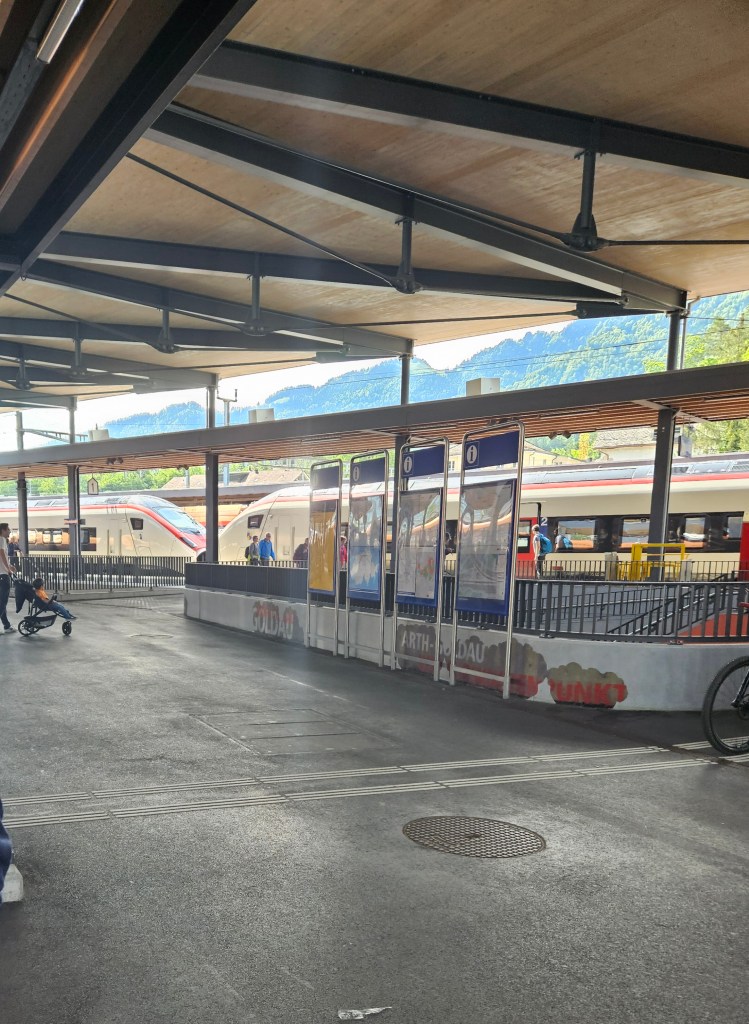
Arth-Goldau Station
Mt. Rigi in the distance straight ahead; train platform and cog train visible approximate 50 yards ahead.

Once we arrived in Arth-Goldau, we walked about 5 minutes to the cogwheel train station. We boarded to go all the way to the peak, Rigi Kulm, though many passengers got off at the several stops along the way — presumably for excursions on foot. [Check out this map of routes which is also available in brochure form, in several languages, at the base.]
Duration: 45 minutes

We boarded what was originally Europe’s first cog railway which fascinated Husband more than anyone else. We were almost all mesmerized by what appeared out the window on the ascent though. Only Older had his nose in a book and missed that opportunity. Out the window, we saw numerous hikers, plenty of cows (Younger and I won the Cow Game), and several hotels in which to stay.
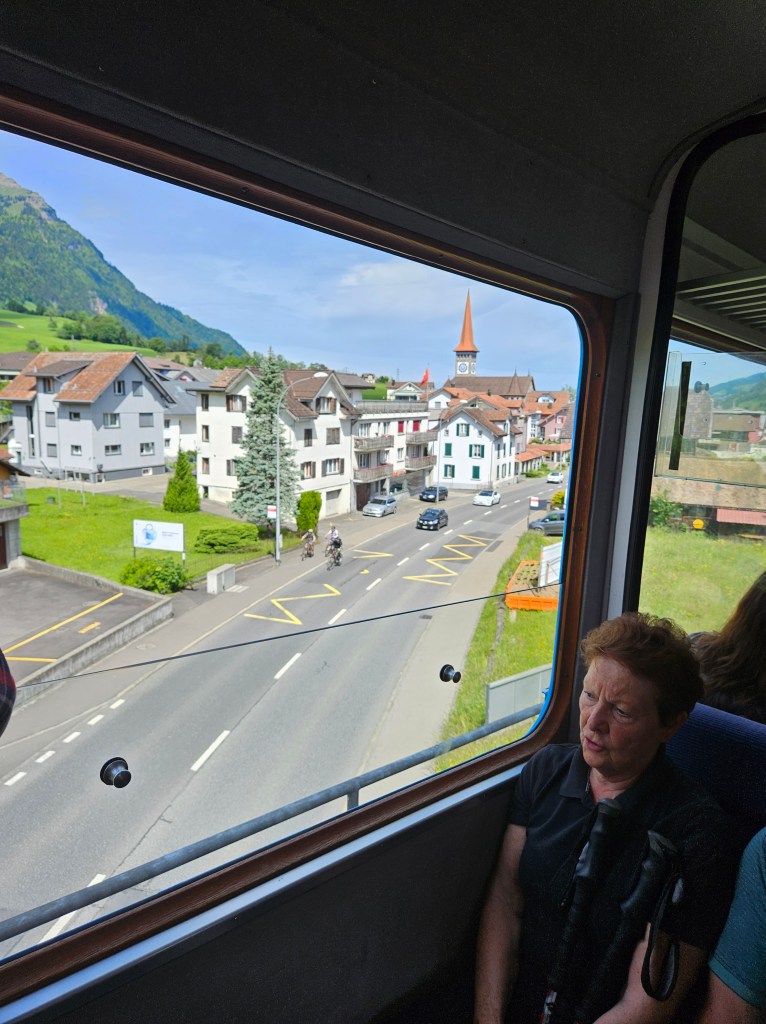
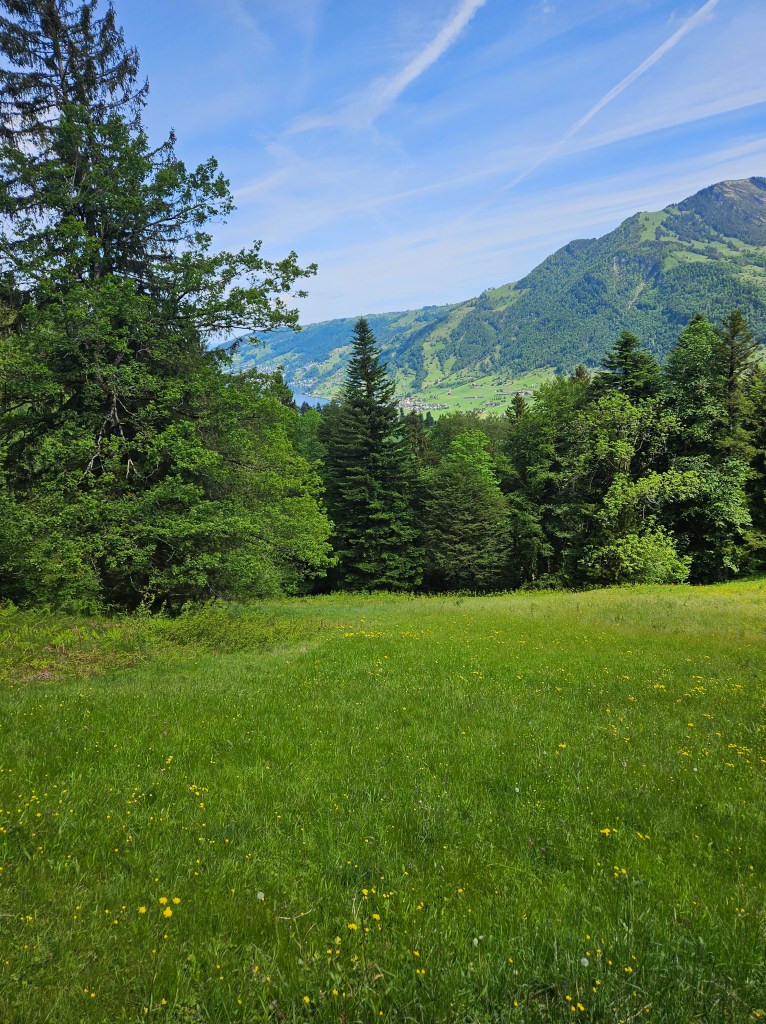
Leaving town, heading for Mt. Rigi on the cog railway. Notice the open window, from which we would soon snap scenic shots.

After a total of 90 minutes of travel from Zurich, even the dogs were amazed and we arrived just below the peak.
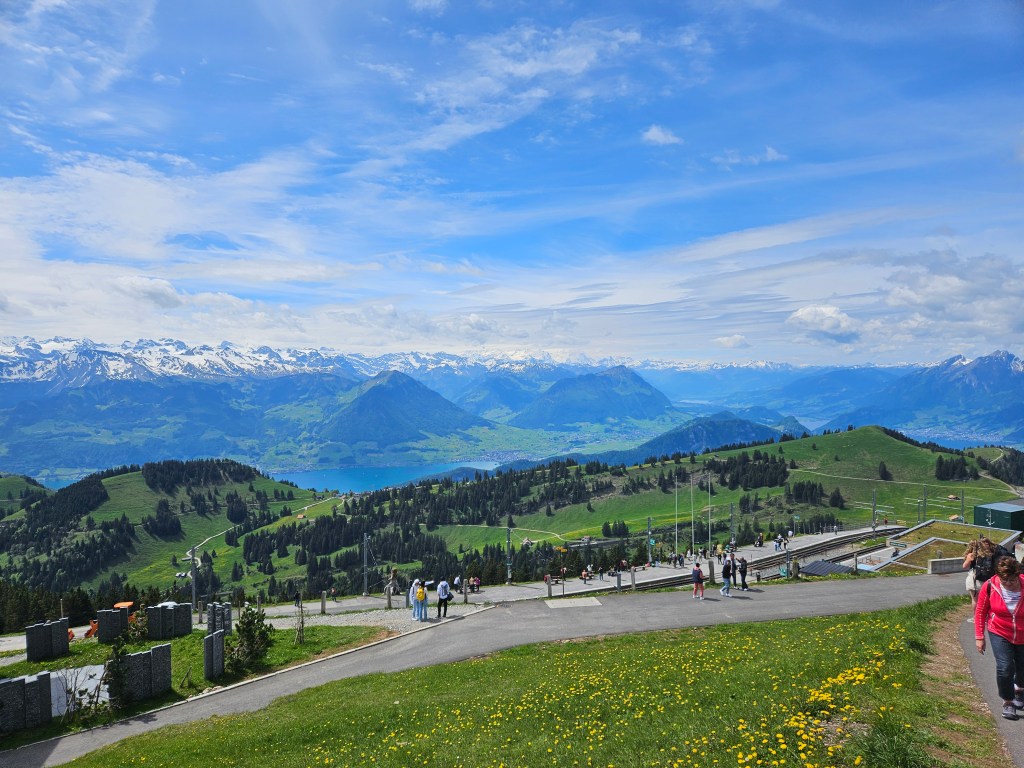
The view on arrival of the Alps, Zugersee, and some of Rigi’s paths & visitors.

RETURN TO TOP

The Bookish Connection

I am a collector of old books. Our move has rampaged my former library and even my antiquarian library was not left unscathed, but I could not give up a poor condition copy of a narrative by Samuel Clemens. Yes, Samuel Clemens. That is what the book declares. (I could prove this to you if the book were not, still, in my parents’ home inside a box until we are able to ship it.)

If you haven’t recognized that author, perhaps you’ll recognize the work. It’s a short book called The Adventures of Tom Sawyer. Ever heard of it? Ever heard of him, Samuel Clemens? Give yourself a bit of wiggle there, most people know Clemens by his pen name, Mark Twain. That same author penned these words.

“THE Rigi-Kulm is an imposing Alpine mass, 6,000 feet high, which stands by itself, and commands a mighty prospect of blue lakes, green valleys, and snowy mountains a compact and magnificent picture three hundred miles in circumference. The ascent is made by rail, or horseback, or on foot, as one may prefer.” Thus begins chapter 28 of a book mentioned momentarily.
Mark Twain, American writer, essayist, humorist (are these necessarily distinct categories?) rather famously visited Rigi and wrote about it in his A Tramp Abroad, published in 1880. Twain speaks of steamboats and “locomotives” leaving smoke tracks. He notes fog and jodlers (yodelers) in his quest to see the sunrise from the summit of Rigi. We witnessed none of these, nor any of Twain’s foolish moments in ascent — neither did we experience them. Of course, we took the direct route to the top 150 years later.

Twain reports staying in the hotel at Rigi Kulm, which I was unaware of when I suggested to Husband that perhaps we return some year on an anniversary or some such celebration and stay atop the Rigi. Heck! Apparently, you can even travel in his footsteps if you are as big a nerd as I am.
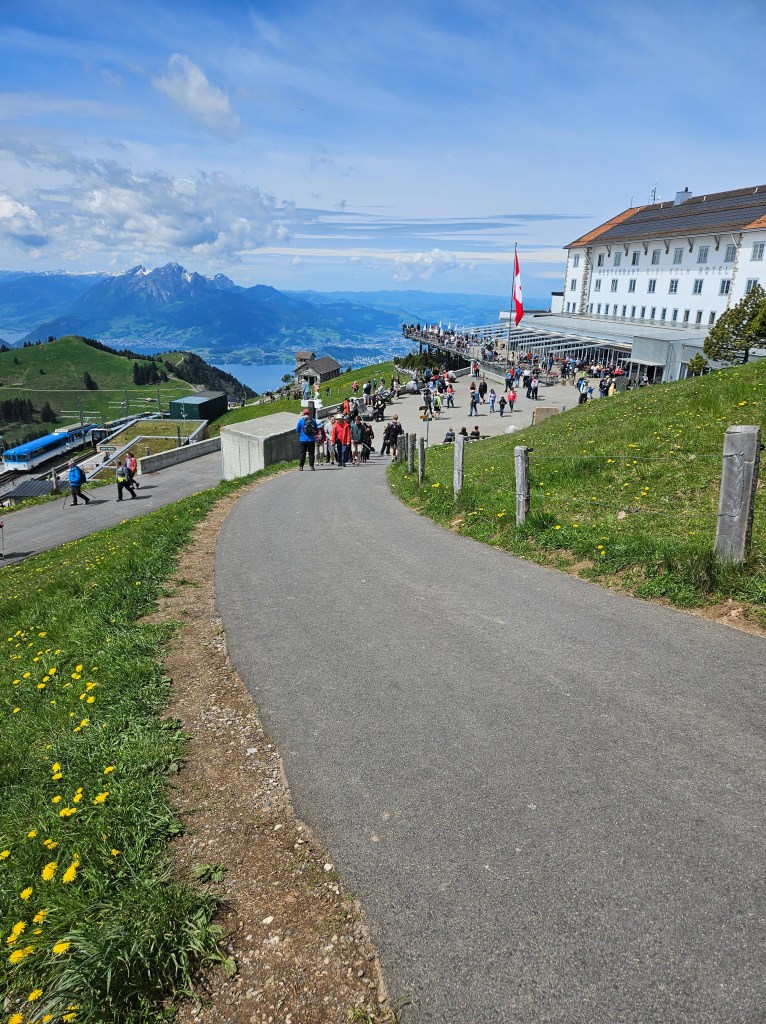
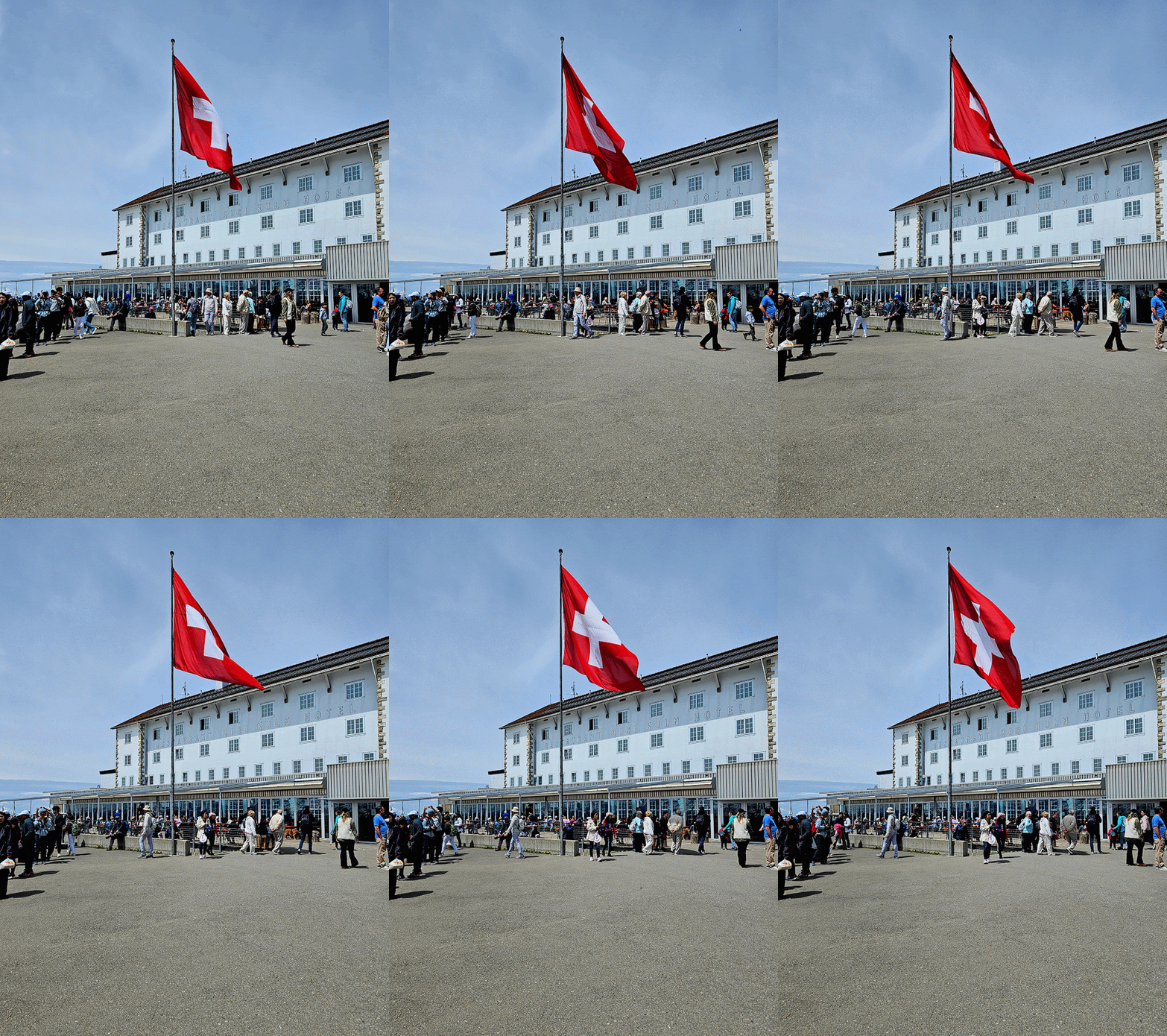
The Rigi Kulm Hotel and view

RETURN TO TOP

Scenes from Above

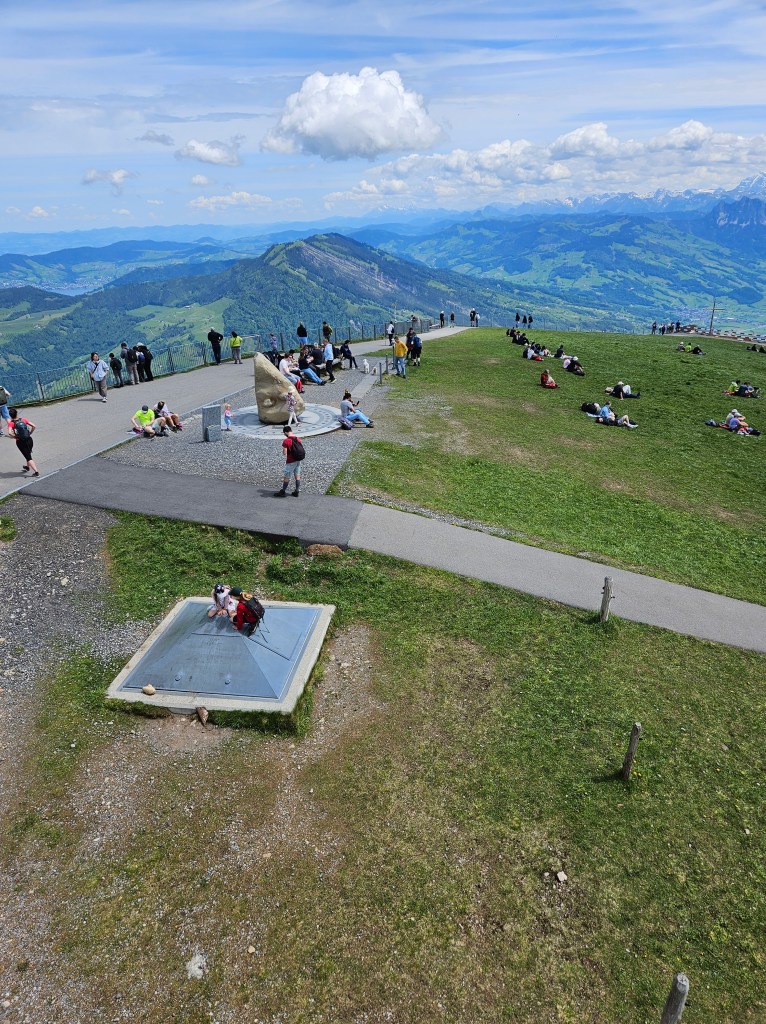
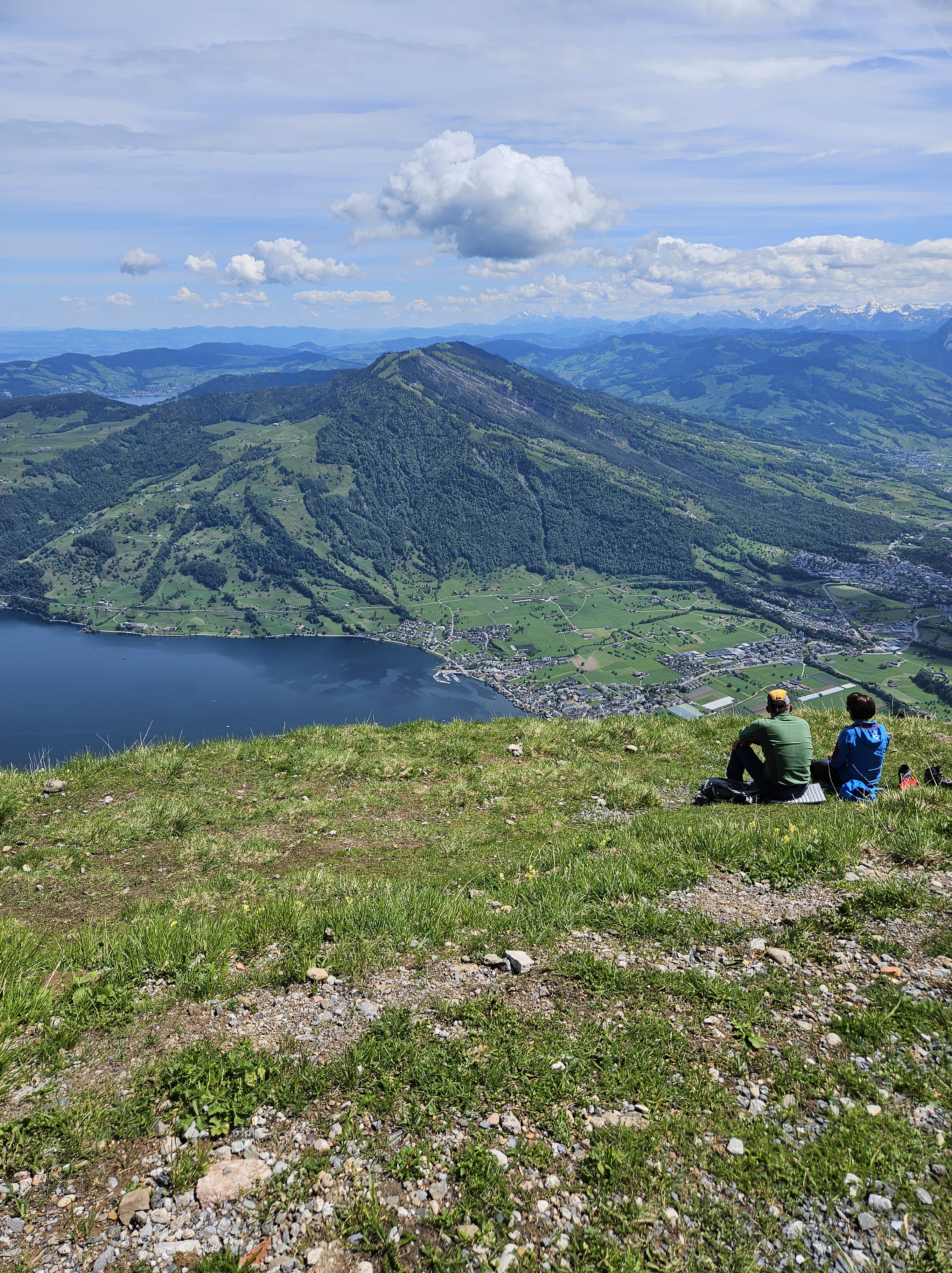
Mt. Rigi Kulm is a popular place in Switzerland, and there were plenty of people there on a beautiful and relatively sunny Sunday in May. Sometimes, the people made the shot better, some times they did not — but there weren’t so many that a few shots couldn’t be found without any people at all.
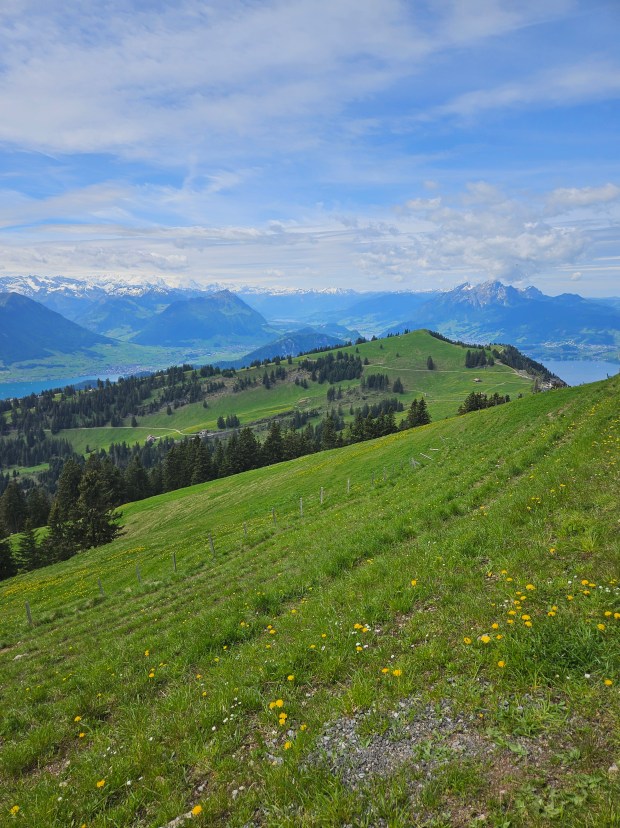
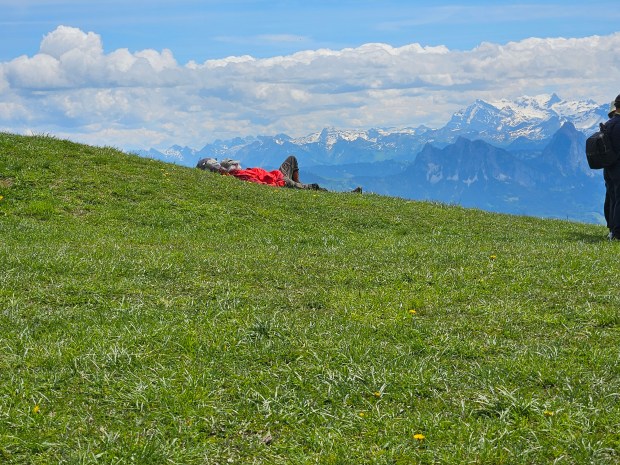
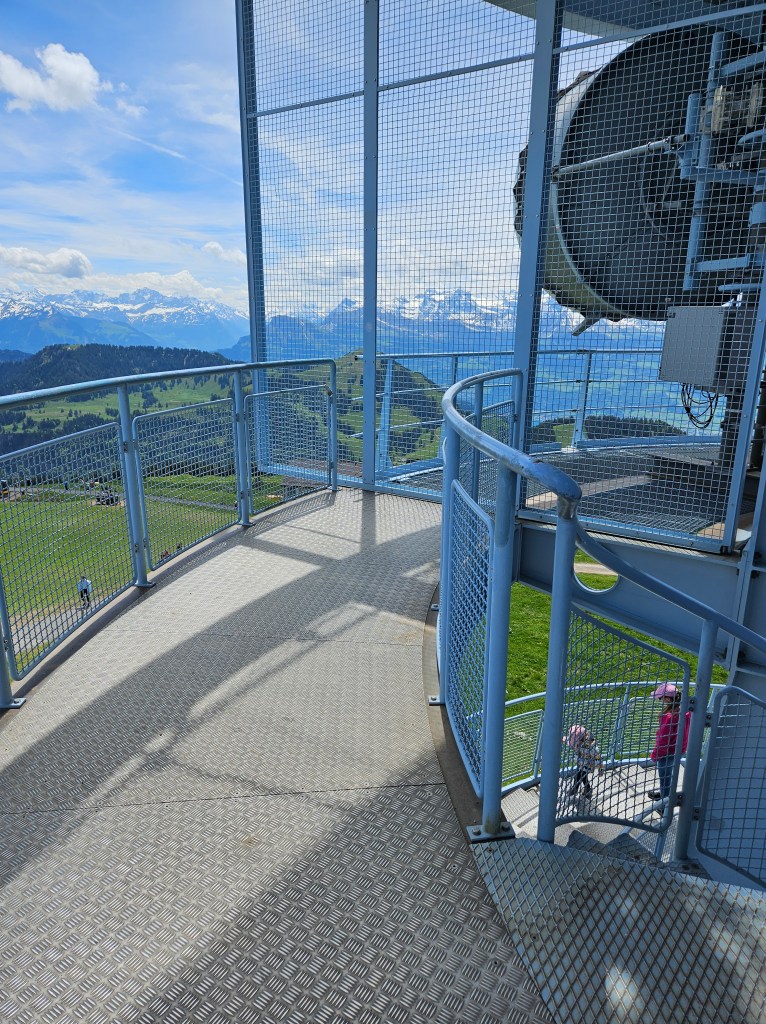
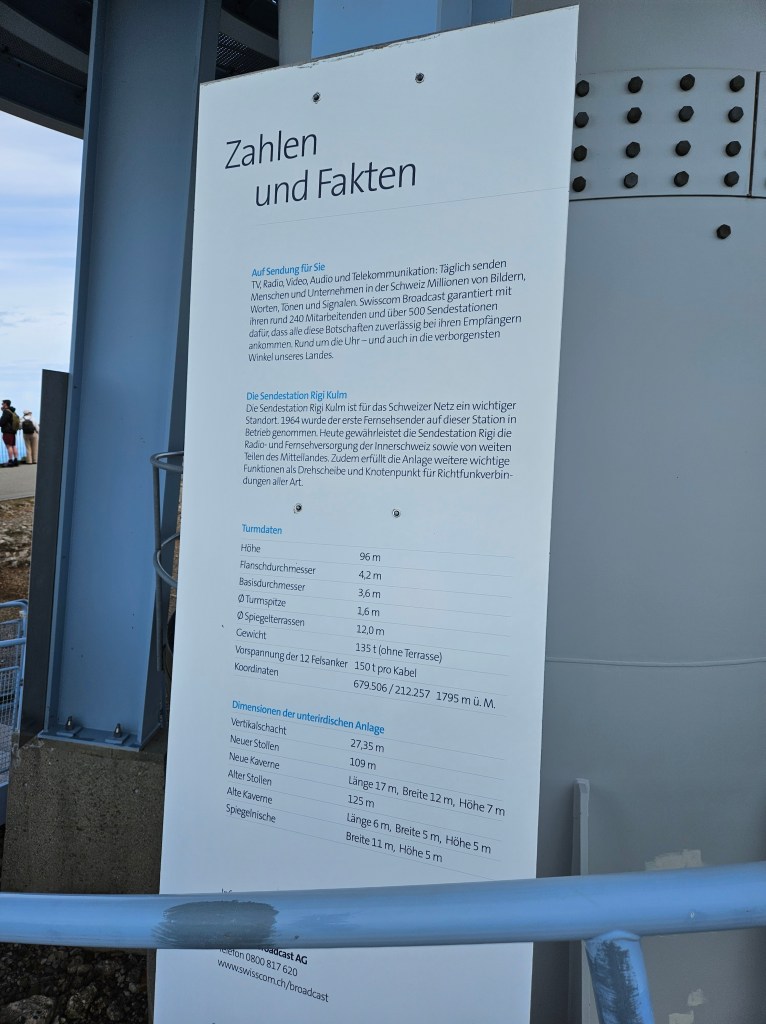
I presume Twain saw something of this view, if somewhat colder and less verdant. In the years that have passed since his visit, there have been a few technological changes in the world. As a result, there is a communications station at Rigi Klum, visible from below.
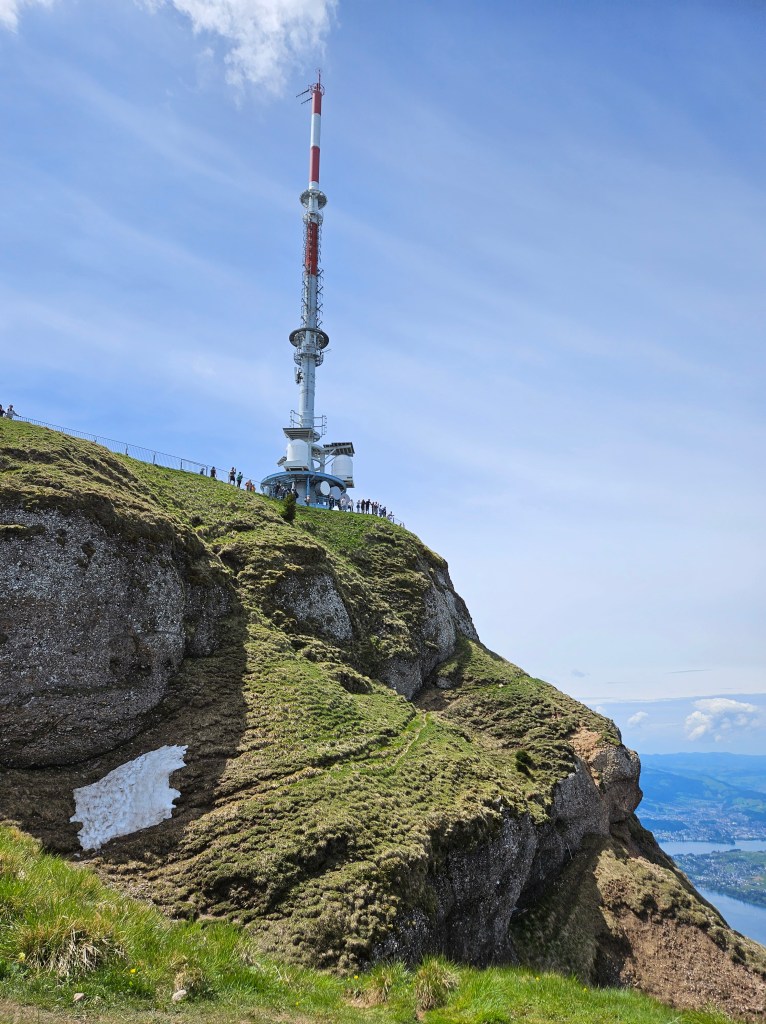
RigiComms, as I’ve coined it, from the side of the mountain. And snow.

As the tower includes stairs, I hoped to climb to a lookout several stories above the mountain’s actual peak. I brought Younger along to make sure to catch this Birthday View. However, upon ascent, it became clear that fences limited the public to a rather low one story gain above the terrain, and the view there, not markedly different but for the addition of a huge block of metal.

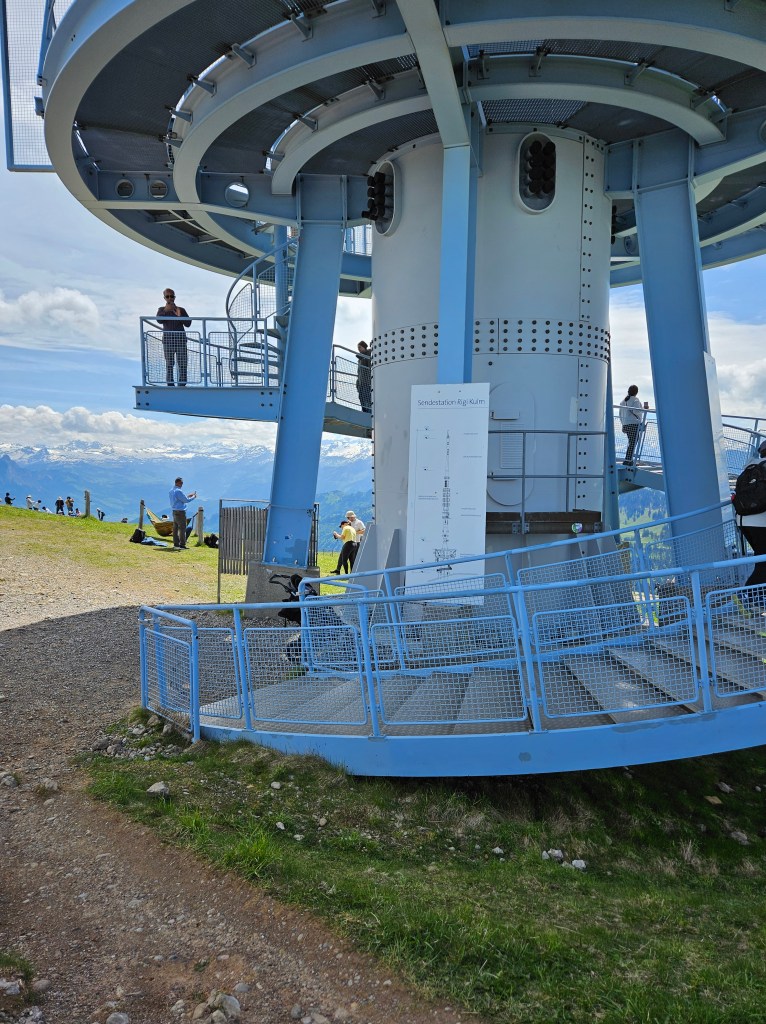
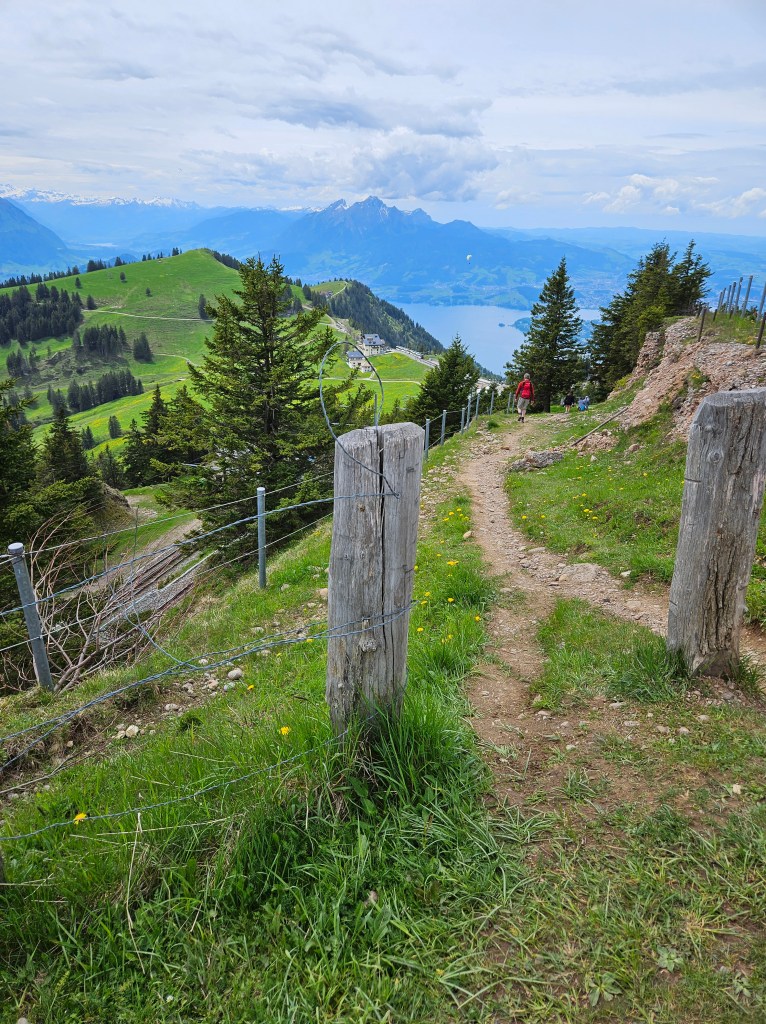
A fence keeps the crowds safe(r) from the sharp decline down the mountain, and, in one spot on the northwest perimeter, a gate hides itself in the fence. We, of course went through this gate — and trekked a short ways to a drop-off, which could have been navigated around if we’d wanted. I suspect some people ascend/descend on this route.

The narrow path beyond the gate.

While we explored the mountain’s face, we were surprised to see quite a few hang gliders. Younger spoke repeatedly about wanting to participate in this, as though the repetition of his desire would convince his parents that, it being his birthday, they ought to put him in a sack in the sky and let him go. — They didn’t.

RETURN TO TOP

Return Home

We sat down on a bench, ate our lunch, bought a bar of chocolate, and came down the same way we went up.
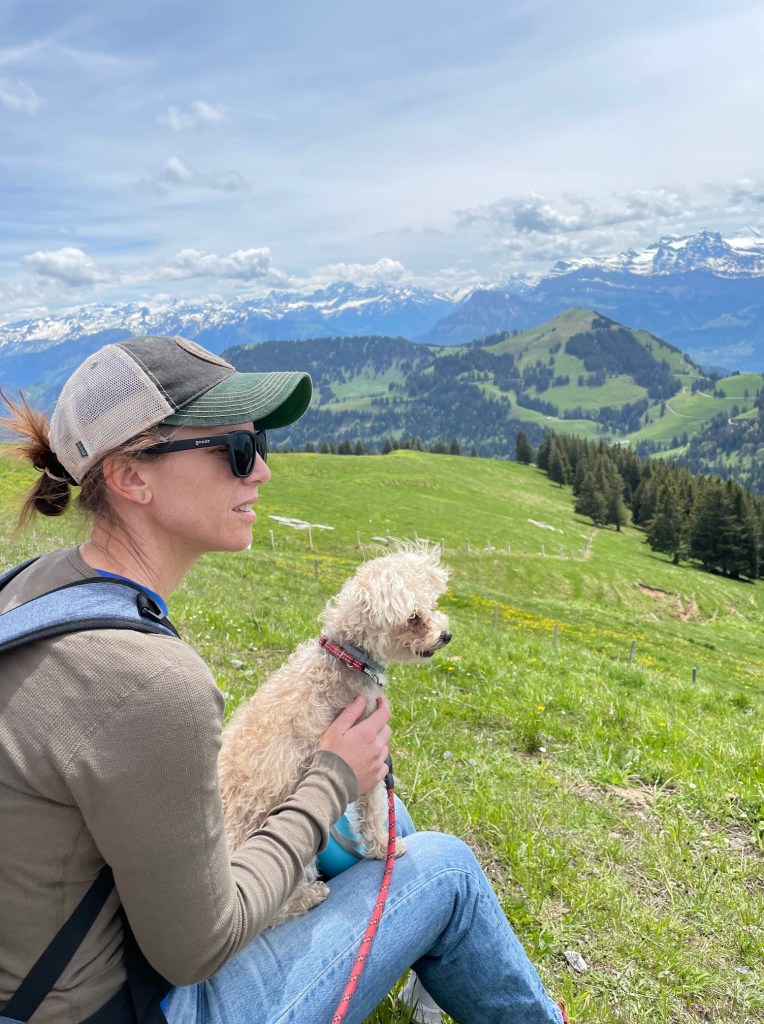
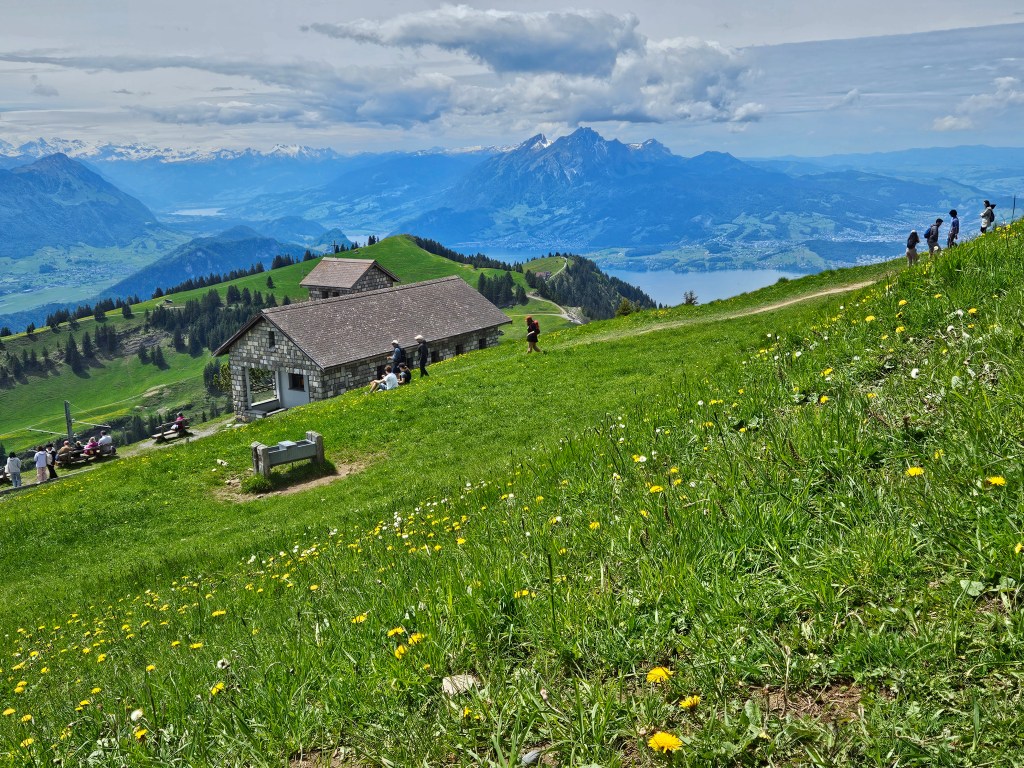
A pup and KZ await the train to descend the mountain. This pup loves the view.

And even without a souvenir or the experience of hang gliding, Birthday Boy admitted, “That was fun.”

RETURN TO TOP

Leg 5: Camping in the House

Many people love to camp. They grab their tent, their sleeping bag, flashlight, and frying pan and they’re off to enjoy the outdoors, take in the scents of nature 24hr/day.

Not me. Oh, I love the outdoors, but only for a select amount of time. No overnighting, thank you very much. After a dirty day in the elements, take me home to my shower and my bed, please and thank you. I’d put myself somewhere on the spectrum between glamping and Troop Beverly Hills. Luckily for me, camping in your own home is on that spectrum.

After the estate sale, we’d been left with our beds (which we’d put behind a locked door), two green floor-to-ceiling cabinets, and a wooden chair the dogs had gotten the better of. We saved some pots and kitchenware, notably the coffee machine, and were otherwise living out of suitcases as of the beginning of March.

Three weeks until departure. This, we could do.

The idea of a minimalist life was urgently appealing. Who needs all this stuff? A towel, a bed, and a nightstand — that’s all I need. Oh, and a closet. And preferably a set of drawers, too. Hangers, of course. And, I mean, I don’t need a coffee machine, but the people who interact with me need me to have a coffee machine. And my books, of course. So somewhere to put my books. And all my kitchen gadgets so I can make my meals. A television, of course — because I don’t want to watch all the Liverpool and San Diego Wave matches on a phone. And, with that, I’ll need a comfy couch. With pillows.

Ah, the minimalist life.

We were enjoying this strange, new existence, looking down at the final days of school and U.S. residency when Husband received a request for a meeting with his new company.

“I wonder if they want to offer us more money for the move,” Husband said. He had a point. The move money they gave us was laughable. They had a requisite amount/limit for anyone moving inside the country and anyone moving outside of the country. Of course, they were accustomed to outside of the country being within the E.U., not the West Coast of the United States.

Deep breath; I digress.

“I wonder if they want to offer us more money for the move,” Husband said.

“Maybe,” I said, wanting to believe that could be true. I didn’t see why that would require a face-to-face meeting though. Send an email. We’re increasing the measly amount we offered to give you for your relocation four fold. Congratulations. See you in Switzerland. Easy peasy. No, this was going to be weightier. And it already made me sweat to carry the thought of that weight.

So Husband took another 6AM meeting, but this one didn’t require me, so he took it alone. Afterall, I had to get ready for work. He set his computer on a built-in shelf in our empty closet and met with the onboarding team.

I couldn’t hear too much from the bathroom. Just enough to be able to tell the person on the line with him was not a native English speaker. The accent was telling. And Husband’s tone of voice. (Husband’s tone of voice is almost always the same: light, jovial, soft, pleasant. I’ve only heard it go edgy when I poke his buttons for long enough, or when our kids do the same thing. Oh, and a bunch of times when he took meetings with Old Boss.)

Husband’s tone of voice quickly changed from friendly to tense. I emerged from the bathroom to hear him say, “…because we have our house rented out. As of April 1st, we have no place to live.”

And shortly thereafter, “We have booked our flights. We arrive March 24th. Our renters arrive April 1st.”

The bottom line: our visas did not go through quickly enough for the April 1st start date. The company hoped everything would work out to have Husband start May 1st instead.

We had planned to camp in our own home, with minimal gear, for three weeks. We had not planned to take our suitcases and book a campsite to sleep outdoors. Hopefully, we wouldn’t have to…

Leg 3: Decision Revisited

I read Of Mice and Men as a high school freshman. Despite going on to be a Literature major, reading several more Steinbeck novels (some more than once), that first book remains the only Steinbeck I’ve enjoyed. Perhaps it’s the length of it, or the ubiquity of the references to Lennie and his strength, or just Lennie himself. I’m drawn to his innocence, his good intentions, and the complexity that with his sweetness and innocence, he’s often a threat. He embodies the notion that what we don’t know can hurt us.

Photo by Yaroslav Shuraev on Pexels.com

We rejected the Zurich offer because Zurich had become a threat to us. To the education and the future of our children on the one hand, and to the death of a shared dream on the other. It looked to be a dead end.

Only this was a dream that wouldn’t quite die off. Through holiday travel and the ringing in of 2024, my husband continually brought up feelings of lament around the Zurich position.

“It’s really too bad…” he’d say.
“I wish they’d been able to offer…” he’d say.
“If only there were some other way,” he’d say.

And I’d sit torn between reflecting his lament back to him and encouraging him to move forward with his job search. Until he said, “I found another education consultant in Zurich.”

With intrigue and doubt, I responded, “Yes?”

“I want to have a consultation with her. The consultation is free. So, really, there’s no risk. We can see if she agrees with the other consultant, and, if she does, done deal. So long Zurich.”

“And if she doesn’t?” I asked, anxious about where the answer could lead.

“Well, if she thinks the kids could go to public school and still end up being able to attend university, I think I will contact HR at the company and see if I can have more time to think about it.”

I sat silently. Thinking. If several consultants note the impossibility, it could help him move on….

“What do you think?” Husband asked.

I shrugged my shoulders and raised my eyebrows in tandem with them, letting them all fall in unison. “Why not? The worst that can happen is they say no.” But, I thought to myself, I bet they wouldn’t. Not after all they’d invested in him.

Another 6:00 AM meeting with an education consultant later, Husband and I were convinced.

“It would not be easy,” said this second consultant. “You must have children who are really very unusual. They must work very hard. Even the Swiss children must work very hard. But to catch up and do gymnasium, this would be so difficult. I think, if you are very supportive of them, and you think they can do it, perhaps maybe they can.”

“Our kids are rather atypical,” we said. “They are bright and motivated, well-rounded and kind.”

“I want you to know,” I told her, “that when I say my children are unusual, I mean that in a very good way. And I do not say that just because I am their mother. I am a teacher. I see hundreds of students their age every year. I have taught my oldest son in my classroom, and teachers go out of their way to comment on how wonderful my youngest son is. But what is more, I did not give birth to them. They are not genetically mine. I do not see my children with the rose-colored glasses many mothers see their own children. Still, I can say they are exceptional.”

“If you are willing, then we will have to do some work. I will speak with the Zurich schools and see when it would be possible for them to take the gymnasium test. It will all be in German. So, in the meantime, you get a tutor for them. They must learn German. And some French, too, but German is the most important. I will also ask about them being given a trial year, so they can catch up their German even more — and maybe, by the end of that one year, they have to take a test again or something to prove they are in the right placement.”

“Intellectually,” we told her, “there’s no question. The challenge will be language acquisition.”

“Yes. Okay then,” she told us.

Photo by Skylar Kang on Pexels.com

Yes. Okay then. Time to contact the company to request an extension, allowing us to consider more options. Since it was January by this time, schools in Zurich were back in session, and we could contact them directly, making the whole process a bit easier.

After Husband got a green-light on the extension to consider the job offer, he spoke with friends who had once lived in Zurich to get information about the education system, the culture, the workforce etc.. I spoke with my teacher-neighbor, who was raised in Switzerland. Everyone said, “My goodness! Even if they do not get into gymnasium, they can still be very well educated in the apprenticeship system and go to university if that’s the path they choose. It might take them longer, though.”

“Oh, really?”

“Yes, they can even intern in a programming position or something that would be very useful that they may not learn at gymnasium anyway.”

“Hmmmm….”

Husband, now done with his job from 2023, put extra time into figuring out more about the Swiss/Zurich education system. Then, when I got home from school, he and I went for a daily walk around the block to discuss the current status of what was or was not possible, what was discovered, and what tossed out — as well as draw some conclusions together. We called it the Zurich Tete-a-Tete on our shared calendar, or, more informally, our Zurich Talk Walk.

We hired the consultant, the second one. She requested I send her transcripts and information about what levels of math my sons had taken before we met with her again so that she could pass it onto those in charge in the city of Zurich, to show them how wonderful our children were.

I gathered the information and sent the document that day so that we could meet again as soon as possible.

When we did meet again, the consultant informed us, “Yes, it is good with Mrs. S. She will let the children have a trial year if they pass the test. But, she said they must be able to do B1 German.”

Photo by Fco Javier Carriola on Pexels.com

[Okay, time out. More about language. I took Spanish through 11th grade, opting out of AP Spanish my 12th grade year. I can get by in Spanish, and so I tell people I speak a little bit of Spanish. Which is true. But what does that mean when you hear it? Does it mean I can say hello, goodbye, thank you, and where is the bathroom? or does it mean I can write a letter and read a children’s book?or does it simply mean I’m not a native speaker but I am fluent? It depends entirely on the speaker because that person is calibrating their language ability for you. Then you have the same opportunity to interpret the phrase, regardless of how the speaker meant it. Did they mean they can say hello, goodbye, thank you, and where is the bathroom? or does it mean they can write a letter and read a children’s book? You see the problem.
Being a teacher, seeing a large swath of society, I can tell you with confidence, those who are perfectionists will undermine their abilities, and those who are trying to impress will exaggerate them.

[It is not this way in Europe. There, they use the Common European Framework of Reference (CEFR), which offers actual tests and certification, to declare someone’s language level. There are beginner levels, A1-A2, intermediate levels, B1-B2, and advanced levels, C1-C2. Instead of telling you I speak a little Spanish, I can tell you, I test at the B1 and B2 depending on the test and the day. For the boys to attend gymnasium for a trial year, they were to go from no German in December to B1 German in spring. That’s rough. It’s the equivalent of being a bit behind where I am in my Spanish despite their having a few months whereas I had a few years — admittedly with many years of forgetting since.]

Husband and I discussed it in our Zurich Talk Walk. If the boys don’t meet the language requirement, they go to secondary school and get to try to get into gymnasium at the end of the year anyway. That’s fine. BUT — for Older Son, that may well mean repeating a grade. If we could get him on board with that, we could say yes.

As further proof of my atypical children, not only did Older Son say he’d be willing to repeat a grade, so did Younger Son!

Husband and I took our Zurich Talk Walk around the block and decided. Let’s do this. It’s too big. Too possible. Even with things that could go wrong, we could come back if necessary. It would be one heck of an adventure, no matter what. Otherwise, we would be left forever wondering what may have happened, what we may have achieved or experienced. And that was a regret we weren’t willing to live with.

The threat of Zurich had faded, and everything around it turned into potential and possibility. Even if it was a terrifying possibility, it was also a thrilling possibility. Any threats we’d seen before transfigured into pathways, different journeys, none of which lead to despair, darkness, or death.

If you know Of Mice and Men by Steinbeck, you know it’s filled with death. Lennie often kills beings unintentionally. What you may not know is that the title wasn’t created by Steinbeck himself, nor was he the last to use it. The title comes from an 18th century poem by Robert Burns called “To a Mouse.” (You may read it if you have an affinity for Scottish poetry.) You are likely more familiar with Kurt Vonnegut, whether or not you’ve read his work, who, twenty or thirty years after Steinbeck’s novel, wrote, ” Of all the words of mice and men, the saddest are, ‘It might have been.'”

The narrative of George and Lennie is one of might-have-beens. The story of my family as ex-pats in Europe will transform from potential to actual. This blog invites you to witness the actualities with us.

What do you say? Are you ready to travel with us?

Photo by Element5 Digital on Pexels.com

We had a LOT to do before traveling — find out about the next steps before departure in the next leg!

Next

Vlog Review: You Go First

Hit Play on the video above.

Premise: One school week in the lives of online Scrabble friends Charlotte and Ben are eventful. Charlotte’s begins with being called out of class with the news that her dad is in the hospital after suffering a heart attack. Meanwhile, Ben’s parents announce their divorce. Though the two kids do not attend the same school (they don’t even live in the same state), they both have to learn what friendship means in the midst of the most difficult challenges of their lives.

Rating: 3/5
Target: 3-7 grade

Title:  The statement, “You go first” is repeated several times throughout the novel and has to do with taking risks and being vulnerable in relationships and other settings.

Main Character(s): 6th graders Charlotte (she/her) and Ben (he/him)

Motifs (not exhaustive): friendship, isolation, change, trauma, bullying, scrabble, board games, nerds, social group, empathy, public speaking, student council, regret

Great for…* (readers): who are experiencing the shifting sands of friendships during tweenagerdom or isolated socially.

Great for…* (teachers): structure! This is essentially two novels that parallel one another than then intersect. There’s not much in here that requires guidance for young readers, so it could be a great Lit Circle or independent reading book.

Parental Warning(s): None.

Interact: What’s your favorite board game (or online game played by more than one person)?

Shop local bookstores.
Shop Amazon.
Add on Goodreads.

*The “Great for” category is not exhaustive and does not intend to neglect the multitude of readers/teachers who could learn from this book in any number of ways.

RATINGS GUIDE

٭ = DNF, would not recommend
٭٭ = would not recommend
٭٭٭ = enjoyable, would recommend
٭٭٭٭ = very good, would recommend
٭٭٭٭٭ = amazing, would definitely recommend

Vlog Review: Right as Rain

Hit Play on the video above.

Premise: It’s been 278 days since Rain’s brother Guthrie died, and Rain and her parents are moving 288 miles to have a fresh start (even if her mom is the only one who wants one). What happened that night is a big who knows to everyone except for Rain, but that secret means Guthrie’s death is her fault. With her secret and very few other items packed, Rain moves to NYC to process through the loss of her brother and the degradation of her parents’ marriage while she tries to fit into a new environment where she’s off on the wrong foot. (Check out the motifs section, there’s a ton of issues brought up by this book — and all well done.)

Rating: 4/5
Target: 4-8

Title: The title’s meaning remains open to numerous interpretations — so it’s a great discussion point post-read. I’ll wait for you to tell me your interpretation before I divulge mine.

Main Character(s): Rain Andrews, 11 y/o (she/her)

Motifs (not exhaustive): grief/loss, depression, friendship, moving, change, divorce/separation, gardening, teamwork, community, homelessness, gentrification, otherness/belonging, poetry

Great for…* (readers): who have friends experiencing grief. As a mother of kids with nuclear family member loss, I want to give this book to all their friends so that they get an inside perspective of what it’s like. Also good for kids who feel alone, different, isolated, or are experiencing change.

Great for…* (teachers): This book is rife with figurative language and symbolism. It even weaves poetry in (as a school assignment), so it’s kind of asking for work on that front. Many allusions to The One and Only Ivan make for a great pairing if Ivan comes first.

Parental Warning(s): For children who have experienced death of a nuclear family member, this book could stir up difficult emotions.

Interact: Rain runs to wipe her thoughts away and empty her brain. What works for you?

Shop local bookstores.
Shop Amazon.
Add on Goodreads.

*The “Great for” category is not exhaustive and does not intend to neglect the multitude of readers/teachers who could learn from this book in any number of ways.

RATINGS GUIDE

٭ = DNF, would not recommend
٭٭ = would not recommend
٭٭٭ = enjoyable, would recommend
٭٭٭٭ = very good, would recommend
٭٭٭٭٭ = amazing, would definitely recommend

Vlog Review: Turtle Boy

Hit Play on the video above.

Premise: 12 y/o Will Levine just wants to be left alone with his four turtles. He doesn’t want to be called Turtle Boy by the kids at school. He doesn’t want to have surgery on his jaw. He doesn’t want new friends and he doesn’t want his one friendship to change. When Will must complete community service hours in preparation for his Bar Mitzvah, though, his world begins to shift. Will hates hospitals but is assigned to visit a terminally ill teenager with a bucket list he needs help completing. Can a boy who prefers a habitat inside his shell venture beyond it without destroying himself in the process?

Rating: 4/5
Target: 4-9

Title: The title has multiple meanings. The kids at school taunt Will with the name “Turtle Boy” because of the way he looks, but he is also interested in turtles. However, the significance of the title really rests in Will’s propensity to shelter himself from discomfort — like a turtle in a shell.

Main Character(s): Will Levine, 12 y/o (he/him)

Motifs (not exhaustive): grief/death, friendship, terminal disease, bar/bat mitzvah, change, music/drum therapy, turtles/pets, nature, single mom

Great for…* (readers): who are shy, bullied, anxious, or frightened. Many male characters make this a good read for boys while still being appealing to girls, too.

Great for…* (teachers): There’s a bucket list project, a community service project, and a cross-curriculum science/nature project waiting to happen with this book. Plenty to explore there, but the literary merit is mainly in character development, round/flat, dynamic/static, etc.

Parental Warning(s): For children who have experienced death of a parent/friend, this book could bring up memories.

Interact: Will’s favorite animal is, of course, the turtle. He does have a room full of terrariums and turtles, after all. Will says they are not pets, but, for the sake of this activity, let’s talk pets. What kind of pet did/do you want as a kid? Why? And did you ever get it?

Shop local bookstores.
Shop Amazon.
Add on Goodreads.

*The “Great for” category is not exhaustive and does not intend to neglect the multitude of readers/teachers who could learn from this book in any number of ways.

RATINGS GUIDE

٭ = DNF, would not recommend
٭٭ = would not recommend
٭٭٭ = enjoyable, would recommend
٭٭٭٭ = very good, would recommend
٭٭٭٭٭ = amazing, would definitely recommend

Book Review: The Marriage Code

I am not a foodie. I recall the expression “Eat to live don’t live to eat” being used in our house from time to time. So, if I don’t do the food elements justice in The Marriage Code by Brooke Burroughs, I both ask your forgiveness and plead ignorance.

Burroughs’s realistic fiction, multicultural romance (tending toward romantic comedy) centers on two characters: Emma and Rishi. Their meet-cute is not so cute. They strongly dislike each other — dare I say distaste for each other? — and there may or may not be (there is) some theft of office treats between the two of them. Their work brings them together in Seattle then sends them off to Bangalore for a year to work on an app. Both seek the same team lead position and when only one gets the job, the other is bitter.

At least for a time.

Like a film (which this could be), it’s clear from the onset that the two will end up together despite the external conflicts of work and culture. Through the third person limited narration, each character shows himself/herself struggling with feelings and thoughts for the other. Sometimes that struggle requires no interpretation as it’s stated outright. Other times, well, let’s just say the word choice is…..suggestive. 

Actually, let’s say more. There were several points early on in the book where I began to get nervous. I wondered if the book was on a trajectory into eroticism. The diction seemed to suggest it was imminent. Thankfully, it did not. Oh, there is sex. But, given the word choice in the build-up, there was shockingly little sex shown. (Yes, I just said “shockingly little sex shown”. Cherish it. The language is more about the tease and the build-up than the act itself.)

However, Burroughs does not hold back on food scenes. Rishi comes to call Emma “Indian food’s number one fan” as they journey through different restaurants where they eat a variety of Indian foods that often evoke moans of appreciation from Emma. (I warned you.) Whether it’s pineapple, lentil-and-rice popadam, prathas, sambar, green beans poriyal. I could go on and on because, well, Burroughs does. To write so much about Indian food, she must be an Indian foodie herself and I cannot do it justice.

The food supplies the scrumptious transition for Emma and Rishi to talk about culture, and that leads to marriage talk. Rishi’s parents have an arranged marriage, but his brother has a love match that causes a divide in his family. Emma, on the other hand, lost her parents at the age of eight and has no family to speak of, but she left Seattle after rejecting a proposal from her long-time boyfriend. 

If you want to read a book about Indian culture, universal family problems, with a lot of food and plenty of sexual referencing, this is a great book for you. I appreciate it, but, like I said, not a foodie so not a big star rating from me.

Rating: 3/5
Target: adult readership

Shop local bookshops.
Shop Amazon.
Add on Goodreads.

RATINGS GUIDE

٭ = DNF, would not recommend
٭٭ = would not recommend
٭٭٭ = enjoyable, would recommend
٭٭٭٭ = very good, would recommend
٭٭٭٭٭ = amazing, would definitely recommend

Book Review: French Exit

I’ll tell you from the beginning. This is a post to declare to you that I would make a fabulous casting director. Or possibly a self-deceiving cheat.

I’ve finished reading French Exit by Patrick DeWitt.  I always want to add an article in front of the title, declaring this book to be about the French exit, but apparently there are many French exits, several in the book, more in reality. 

Anyway, I picked it up, knowing it was in production to be a film — but I didn’t know it was a finished film. In theaters now (in LA and NYC). 

The several French exits in the book are declared early. Fanny Price has gone broke. Her immense wealth that grew upon her marriage has run dry. Absolutely. Nothing left after seven years of warnings from her financial advisor Mr. Baker. When the money runs out, he asks Fanny what her plan had been through those seven years. Her response epitomizes her character: “My plan was to die before the money ran out. But I kept and keep not dying, and here I am.” 

Here, at the time, is stateside, but without a place to stay she soon finds it necessary to head to Paris where a friend has an apartment where Frances may stay. She travels to France with her son because it’s their only option (exit 1), all the while with the plan to rid herself of her final spending money and do as she planned: die (exit 2). But she’ll do it her way, as much as she can. 

DeWitt presents Price fully formed, take her or leave her, and take her you must. She’s just quirky enough, just witty enough, and just sane enough to be mesmerizing beyond her beauty. 

When I first began reading, I envisioned Price as Hepburn with a Brynn Mawr accent, an elitist prig from the early scenes of The Philadelphia Story. But as I read, as DeWitt presents flashbacks that explain the why of what you the reader already know the character is, Price took on more color. She could not be caught in the black and white films of Hepburn, held in the distance by time. No, she was fully-fleshed if standoffish, with a flat American annunciation. Her voice became Michelle Pfeiffer’s, flat and flavored as in I Am Sam where her character must hold it all together for appearances sake.

And this is where I return to my premise for this post. Can you guess which actress plays Frances Price in theaters? Why, none other than Michelle Pfeiffer herself. The character could not be played by anyone as well what with the coupling of physical beauty Pfeiffer possesses with her paradoxically cold voice with undertones of rich emotion — such that it made me wonder if DeWitt wrote the novel with Pfeiffer in mind for the role. If he did, he got what he wanted. 

Either way, I got what I wanted and thus I proclaim myself a great casting director without any other evidence than that which I’ve just noted (and will tell myself that is sufficient evidence to make a case — I’m not claiming I’d make a great lawyer). Either that, or somewhere I caught a glimpse of Pfeiffer in the role and have given myself the credit all the while keeping my conscious self from this knowledge. Deceiving at least myself and possibly you in the process. Take your pick.

But if you want to read this book, you’ve got to want to read it for the dark humor and intoxicating horror of Price, whose grown son lives with her because he wants to and she wants him to. Their relationship keeps Malcolm Price from marrying his fiance. (I’m still perplexed as to why the fiance is interested in Malcolm, but that enigma is never meant to be explained. The Prices are an addiction. Logic need not have anything to do with it. And like all addictions, they’re rather dark and a bit dirty.) The book centers on Frances Price, but it’s not necessarily about her. Once you’ve read it, think about it. Tell me: is the book about Frances or Malcolm or someone else altogether? I’ll be interested to know.

Oh! By the way… I’m eager to see this movie — I hope it’s as arty as I want it to be. And since I’m already a fantastic casting director, I can confidently declare it’s in the film’s best interest to follow the notions I’ve never voiced regarding its most apt aesthetic.

Rating: 3.5/5
Target: adult readership, 16 y.o. and up

Shop local bookshops.
Shop Amazon.
Add on Goodreads.

RATINGS GUIDE

٭ = DNF, would not recommend
٭٭ = would not recommend
٭٭٭ = enjoyable, would recommend
٭٭٭٭ = very good, would recommend
٭٭٭٭٭ = amazing, would definitely recommend

Vlog Book Review: Amari and the Night Brothers

Check out the book trailer referred to in today’s vlog.

Overall rating: 3.5/5 —- 4/5 for adventure enthusiasts

RATINGS GUIDE

٭ = DNF, would not recommend
٭٭ = would not recommend
٭٭٭ = enjoyable, would recommend
٭٭٭٭ = very good, would recommend
٭٭٭٭٭ = amazing, would definitely recommend

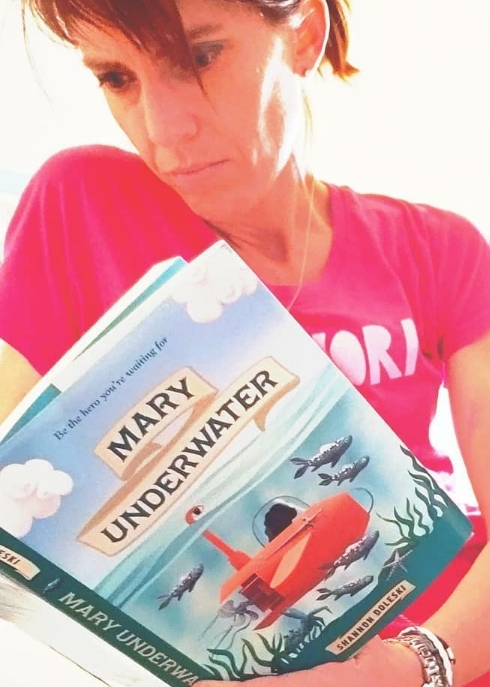
Vlog Review: Mary Underwater

Watch the vlog, read the book, share your rating!

Rating 3/5

RATINGS GUIDE

٭ = DNF, would not recommend
٭٭ = would not recommend
٭٭٭ = enjoyable, would recommend
٭٭٭٭ = very good, would recommend
٭٭٭٭٭ = amazing, would definitely recommend