

Leg 2: The Decision

“I’ve booked the flight to Zurich,” my husband said several weeks in advance of his interview for what I figured would be an onsite job offer.

The last time my husband left the country for business-related travel, he’d gone to Japan, Kobe’s helicopter crashed, and COVID locked the doors for a year. I don’t have positive associations with his international travel. But he’d not traveled to Switzerland.

November being holiday insanity time, adding international travel that had nothing to do with the holidays had the potential to throw us into an elfish spin. The plan required Husband to take a very short trip to Switzerland in order to return home from his Monday interview before Thanksgiving Thursday that same week. He’d spend a few hours at Heathrow before catching his flight to Zurich. Leave on November 18th, a Saturday, and return on the 21st, a Tuesday. All he needed to be prepared before taking off was a fitting wardrobe for an interview.

Switzerland Map by RailPass.com

After laying out a pair of royal blue Bonobos, a blue-accented white dress shirt, and his orange and blue tie (trust me, this works), I pulled out his sweater options. Average highs in Zurich in November range within the mid-40s. (November in San Diego: about 70.) I held a camel half-zip up to the outfit.

“Wear this sweater with a tie?” he asked in disbelief.

“Yeah.”

“Really?”

“Yeah.”

He looked at me. Incredulous.

I took this as a thrown glove. “Trying to find out if I’ll cave in and say ‘No’?” I tested his resolve for a duel. “Yeah, really.”

“No,” he said. “I just [insert vocal hedge and tennis match head rotations between the shirt with tie and the sweater] I don’t think I can wear that. I’ll feel weird about it.”

I picked up my proverbial glove, contemplating how much battle I wanted to pursue. The sweater worked. He’d look great in it. In other circumstances, I may have pushed him to wear it, but for a job interview, I wouldn’t dare. I’d already picked the combination I had because I knew he liked it and felt good in it. He may not be willing to do my 90 seconds of Power Pose in the bathroom beforehand, but I can dress him so that he’ll be confident.

“Okay,” I said. “But you don’t have a coat that goes with it.”

“I know. Are you okay with going shopping for one?”

For the record: I hate shopping. Hate it. But I can handle it and am willing to do it if I have a specific goal in mind.

“Sure,” I told him.

“Can we get, more like, a blazer than a coat coat?”

“I assume so. It depends on what’s in stock, but I don’t see why they wouldn’t carry something like that all the time.”

So the evening before the flight, his attire, including a new camel blazer — no elbow patches despite my nerdish affinity for them, was packed. I had no idea what time he planned to leave in the morning because I planned to be asleep through his early morning departure. At least the departure from our home.

On the morning of November 18th, Husband left while I slept. His alarm went off and I didn’t whine or anything. I just prayed for quiet and a return to sleep.

I believe in answered prayers. Here’s my evidence. I received a text from Husband that morning at 5:53am. “Somehow left my e-ink tablet at home. Sigh. I’ll be fine, but I had hoped to use it to brainstorm [prep work for the interview].” There’s no record of a response from me for two hours — so either, I ignored him or I slept through the message. Now I might take a good ten or fifteen minutes to respond to something I don’t want to when I’m not busy, but if I’m available, I’m not going to sit on an unanswered text.

This is our actual exchange via text that morning:
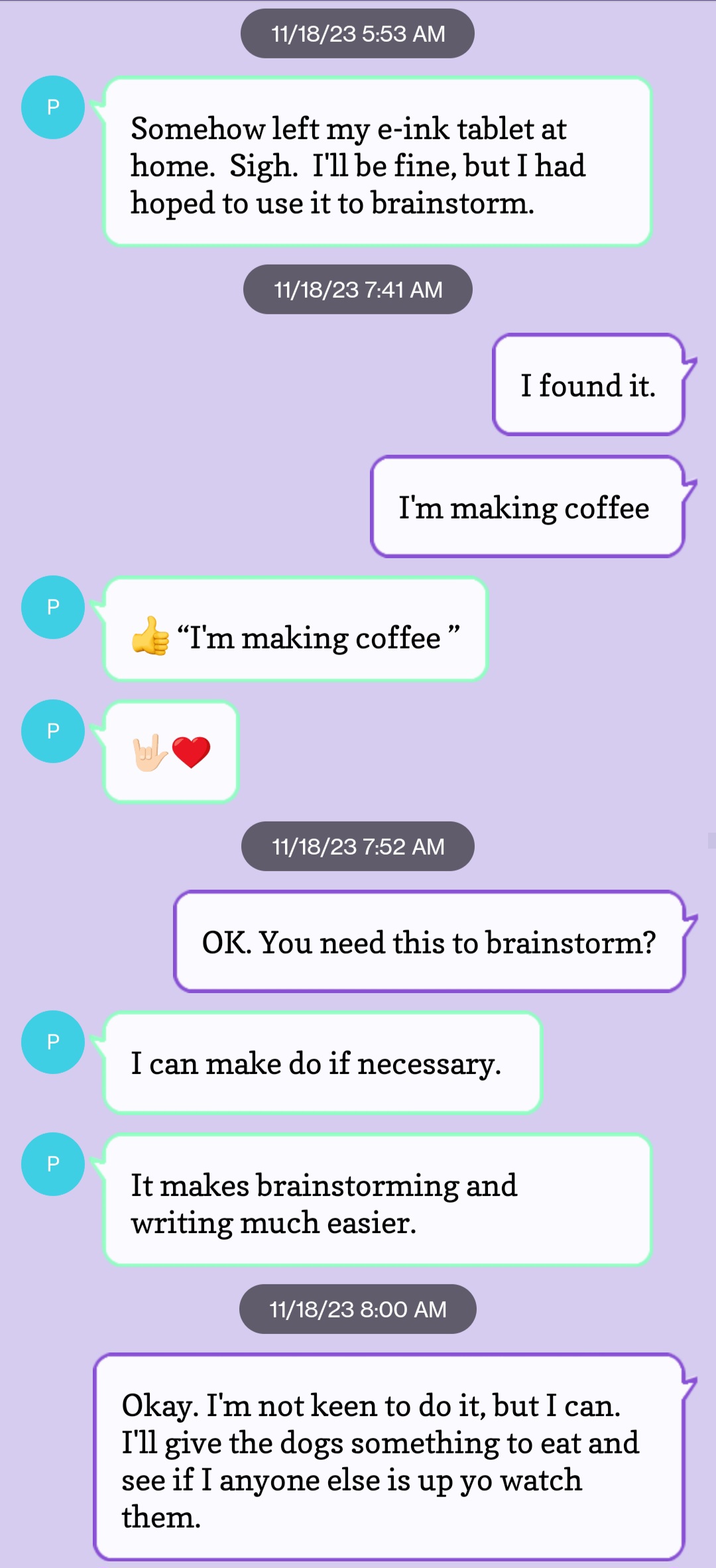
You may be able to tell something didn’t make it into this written exchange. And that something was the request that I deliver the tablet to Husband at the airport because his flight was delayed.

Before I could carry out my plans to grumble in an empty car about driving all the way to the airport when I hate the airport and crowds of people, and the general self-importance of everyone needing to get to their destination on time to make their lives operate or they’ll keel over like a dead rat, Husband called. His flight had been delayed further. With so much time until the new departure, he’d just come home and get it himself.

My angst averted. His turned up with an anxious simmer.

He was home when the flight was cancelled and began arranging new travel plans that could get him to Switzerland as soon as possible. Although he left that night, there was no way he’d make a Monday meeting with the new arrangement. The new schedule required that he stay overnight in London, not landing in Zurich until Tuesday.

After much toing and froing on his part, Husband had a new plan. Interview pushed to Tuesday. Keeping some elements from the old plan, he still thought it a good idea to rock the interview with a camel jacket instead of sweater and tie.

Both plans: ☑️☑️. He flew to London, stayed overnight, bought himself a scarf because it was even colder than expected, departed and landed in Zurich, interviewed for several hours on extreme jet lag, and then turned around and began heading back to the States. By golly, there was turkey to be consumed and thanks to be given; no time could be wasted.

Two items remained to be figured after Husband’s Switzerland trip: when would the offer come? and how much would it be? Zurich, afterall, is one of the most expensive cities in the world.

We are not wealthy relative to the area we live, but we live in a relatively wealthy area, and, looking into the cost of living in Zurich, I was floored to discover it would be more expensive than the Southern California metro area we called home. More than that, as of January 2024, Zurich was listed by Architectural Digest as the most expensive city in the world to live in.

Photo by Frankentoon Studio on Pexels.com

Great. There goes any plan of total retirement from the working world.

In the days after the interview and after the Thanksgiving holiday, my husband and I, expecting an offer but also on vacation, passively researched life in Switzerland.
We discovered the number of official languages. We decided our buddy Roger Federer (Rog, as we call him), would be happy to show us around. We looked into what we would need to bring in as a salary to live in Zurich, or if we could make it outside of Zurich, assuming Rog didn’t take us up on our offer to let him pay our living expenses. We crunched numbers considering if we sold our cars — factored in a lack of car insurance payments. Then what would we need?

And we dreamed.
If we moved to Zurich, we could go see the areas both our families are from that aren’t too far away. Bern for him. Milan for me. Go back to Lake Keszthely, where I spent a summer teaching English. See Champions League matches because they aren’t on in the middle of the day while we’re at work or school. Go to Champions League matches. Speak German. See Liverpool play! Practice our French. Hike in the Alps! Each chocolate and pastries. Kayak on Lake Zurich. And, for me, perhaps, stop teaching.

The dreams began by the bucket load, pouring down upon us throughout the day and splashing over us when we talked at night or early in the morning. After a week of not hearing anything from the company, the steady downpour decreased to a light stream, only splashing over into dialogue every so often. After a couple of weeks, it turned into a trickle that sounded a lot like—

“Maybe it didn’t go as well as I thought it did.”

“Maybe. It’s so weird that they’d fly you all the way out there, though. I mean, unless you bombed it, I would have expected that you’d hear from them by now.”

“I know. Me, too. I really thought it went well.”

And doubts began filling our drained buckets.

Husband was checking his email every morning when he woke up, looking to receive something during the Swiss work day. Before coffee, before the covers were off, before he was vertical, he’d check his phone. Nothing. Nothing. Nothing. Morning after morning. So he stopped checking first thing.

The holidays hold a sharp turn between Thanksgiving and Christmas, and Christmas was only about a week away. My classroom had the same old look to it, no special decor, no extra scent in the final week of school in December. On that weekday morning, like any good teacher, I was counting down the days to vacation and wishing a fast forward button would appear on my desk where my computer mouse sat, already tired from use with the morning bell yet to ring.

A ringing sounded. I checked the clock. Still before eight. It’s not the school bell. A vibration followed the ring, demanding my attention. Ah ha! My phone!

HUSBAND CALLING

Why is my husband calling me before eight in the morning?

A flash of a thought: “It could be Switzerland.” It appeared then fell into the darkness without a flicker.

“Oh, please don’t tell me one of our kids is sick again,” I thought, as we’d seemed to run through at least a week-long illness for each one. I didn’t want to cycle through it again, now that it seemed it’d run its course.

I took a deep breath to prepare myself and slid the green button on my phone screen. “Hey, what’s up?”

“Hey. Are you sitting?”

Oh, Good God. This is bad, bad, bad. “Yes….” I said and took a deep breath to handle whatever deluge followed.

“We got an offer from Switzerland.”

“Yesss!!!” I whisper-shouted into a room of 34 empty desks and clenched a fist as though I’d scored a goal in stoppage time to win the game.
Zurich Photo by Yovan Verma on Pexels.com

“We’re going to Switzerland.”

“Yessssss!”

“Do you want details?”

“Not yet. We’ll chat after school. Just read me the acceptance sentence.”

Husband read it to me and said, “Okay, now this feels reel.”

Of course we wanted to go to Swtizerland. We’d begun to entertain its plausibility, but with the details to be able to figure out how realistic, how practical, plausible was, we felt thrilled and overwhelmed. How does someone make an informed decision about moving to a place where almost everything is unknown? And we were on a 10 day deadline. After the offer came through, we had until just after Christmas to weigh its viability. They expected an answer by December 29th.

Without kids, that answer is easy: yes, yes, yes, yes, yes! With little kids, that answer is a deliberating yes; they’re acquiring language so fast at that age, the language barriers they have as they land in Switzerland due to their Americanness will dissolve by the time we get through customs. With tweens and teenagers, hmph. This will be complicated.

Kids, at all ages, are vicious. If we take our teenage boys to Switzerland, where they do not speak the language, kids will get made fun of — And, if we stay Stateside, they’ll get made fun of for different reasons because, well, kids are vicious. Sometimes cliches are true. However, being foreigners will certainly force some empathy on them, and humility for that matter. Of course, they’d also learn the language. Eventually. It may take longer than for a 7-year-old because their brains are more developed, because the language mastery a (reader/)teenager has over a child is alarming, but the adolescent brain is undergoing a major construction project. — Hmm, with construction already begun, it seems like a good time to make changes to the site plan, upgrade the appliances, perhaps. Instead of gas, electric. Instead of English, German.

If only it were so simple. The kids being the primary concern, Husband and I wanted to speak with someone at the schools they might attend — and discover the options of where they could go. Switzerland’s education system is not the same as the American. The first thing we researched was the option for the kids to attend school in English and discovered that opportunity translated to attending American schools in Zurich. Such institutions are private and therefore require a tuition. There are several options, each with its own rate. Assuming openings for our sons, they could continue an American-styled education. For approximately $40,000.

 Best-American-Schools-Switzerland Best American Schools in Switzerland | World Schools
Photo featured on “Best American Schools in Switzerland” by World Schools. Read about those schools here. We did.

Per year.

Per kid.

Yowzahs!

That bit of information narrowed things down a bit. Either the kids manage to attend the free public schools without major detriment to their learning or their educational prospects or we do not go to Switzerland.

The guiding question became: can the boys make their way either to university in Europe or back to the U.S. for college by going through the Swiss system of education?

What language are they even taught in?

For that, we got a relatively quick answer. Public school instruction in the Canton of Zurich (sort of like a county if not a state) is conducted in German, high German. —Oh yeah, remember all the language talk from the last post? We’re not done with it. Let’s revive the spirit language of Swiss German. The one Swiss kids grow up speaking but has no grammatical structure. Since you cannot use an unwritten language in formal academic instruction that includes reading, writing, and arithmetic, Swiss schools do not operate in Swiss German (at least not once the kids can write a sentence). That’ll have to be normal German.

Screeching halt here for my Marketing/PR buddies. Normal German? Making Swiss German…ab-normal? Oh, no. No, no, no, no. This cannot be. We will not call German normal and Swiss ab-normal. Swiss German is spirit; it is effervescent, formless, free. Abnormal is a far too negative term of such loftiness. We will call that German form of German “Hochdeutsch” and we will use Sweizerdeutsch.

[Note: The only verifiable fact in the paragraph above is that the German used in education is called Hochdeutsch, literal translation is “High German.” Don’t worry Marketing friends, I know, I know. What I do not know know is how that “Hoch” (high) part identifies this type of German as Standard German. I know this, too: standard is boring, dull, basic, sleepytime. I’ll take my VW with the upgrades, please, not just what comes standard.]

I’m sure I’ve lost you by now with my word nerdery and ability to get lost in the possibilities that haven’t any merit to them but sound kind of fun to me. Let me give it to you straight: If we go to Switzerland, the boys would need to learn German — and learn their other subjects through German. They would probably need Swiss German, too, for the playground. Oh, and Swiss students start taking French around 5th grade. They’ll need to learn that as well.

This was mounting up. Perhaps I could do one thing I’ve been avoiding since I stepped into motherhood.

What are the guidelines around homeschooling? Perhaps that could be our free and English way to learn. I am a talented teacher. I’d already taught Older Kid in my public school English class, and he’d survived it. More impressive: so had I. Maybe I’d just have to do all subjects with all kids all the time.

Ugh. That sounded exhausting.

Or maybe there was an Americans in Zurich homeschooling group that worked together on some days or in some subjects.

I did my research with scholarly depth and precision.

Oh, All-Knowing Google, tell me about homeschooling in Zurich.

Did you know that in the Canton of Zurich homeschooling must be done in the official language of the local schools? German. I did not. Did you know that homeschooling instruction can only be done by a parent without a teaching credential for one year? I did not. Did you know that needs to be a Swiss credential, not a Californian one? — Yeah, I bet you did.

Oy to the vey. Goodbye to that solution.

How about an online school? In the States? That we access in Switzerland? I mean, I HAAAAAAAAAAAAAAAAAAAAAAATE the idea of online education for my children. I was a teacher during the pandemic. I knew that fiasco firsthand. But, instead of $80K/year, I’d at least look into it.

Briefly. Because that was another dead end. Time zones alone could provide issue. If the kids attended school in an American time zone, could they even connect with kids in Switzerland outside of school hours? Eek. Sounds like loneliness. Trouble ensues. No thank you.

As I spent time debriefing Husband on these things, he’d then debrief on his findings, trying to get questions answered by people in Switzerland. Couldn’t we talk to someone at an actual school?

Well, of course we could not. It was Christmastime! Schools were closed for the vacation, just like my school would be in two more days. I was waking up in those too dark hours of the alarm clock howl to see my husband sitting at a desk in our bedroom, making phone calls to try to connect with anyone who could tell us more about Swiss education.
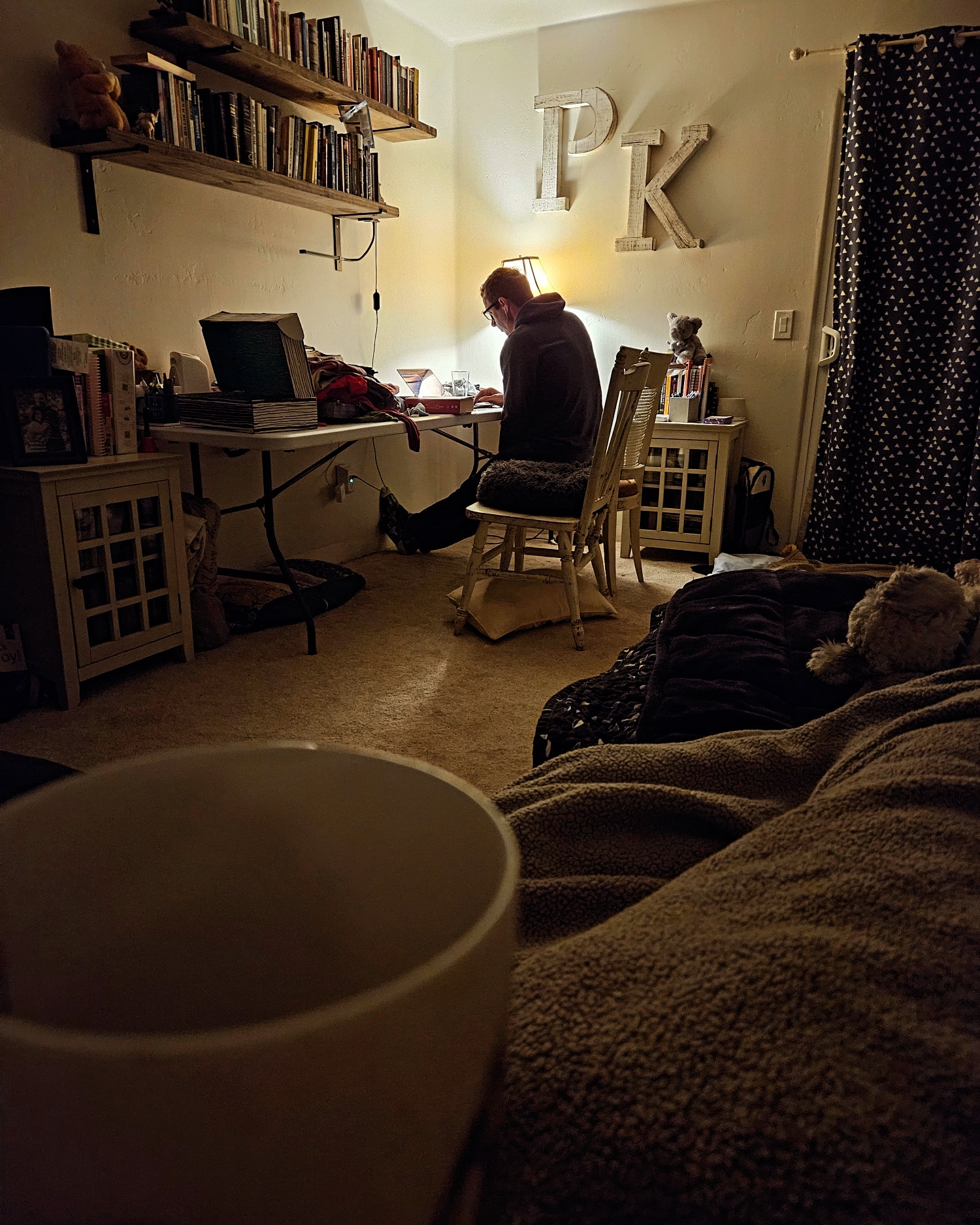
Husband making early morning phone calls from US West Coast to Zurich

“Hallo. Sprechen Sie Englisch?” I’d hear him say from behind my coffee cup. or the cover held over my eyes. You know, depending on the day.

Every time he said it, “Sprechen Sie Englisch?” I heard Chris Rock’s voice respond as Marty the Zebra in Madagascar. “Yeah. I sprecken!”

Making these phone calls, Husband found us an educational specialist with whom to speak, someone who had worked in the school systems for a while, both public and private. We made an appointment for a free consultation on Tuesday morning at 6am. Rise and shine.

The night before said consultation, I’d cleaned up after participating in the Younger Kid’s soccer practice, and the husband and I were in agreement: we wanted our kids to learn more languages, experience other cultures, push out from their (and our) American boundaries. We would send them to public school. They could use the academic challenge, certainly. Even though we were a solid 90% certain on our decision, we decided to keep the appointment for no other reason than “Why not?”

Why not? Why not? Why? Not? That is a bad question.

Going into the discussion, we knew about the tracks in the Swiss system. The higher track, gymnasium, leading to university and the lower to an internship. In order to access the upper track, a student must pass a test. In what language? German, of course.

“Oh nein,” said Education Specialist. “Oh. This is really something very difficult. Very difficult. Even native speakers cannot make it into gymnasium. And to get to university, your kids must go to gymnasium. It is famous, you know, that Albert Einstein, he failed the test to get into the Zurich gymnasium,” the consultant informed us as we sat partly poker-faced and partly stun gunned by the words she spoke from the other side of the world to us.

[The Einstein story is not the whole truth, and, in being so, rather misleading — but it is the popular culture version, so it didn’t matter that the Einstein thing was only partially true — it was true enough to carry emotional weight.]

“Really,” she said, ” I am sorry to be sounding so negative. But it is really very difficult. Very small chance unless your kids go to the private schools. The international school system. Are you interested in doing that?”

Oh, nein is right. We couldn’t send the kids to private school. That would take a job I did not have, and the whole of its salary to do so. It sounded as though sending our kids to school in Zurich would mean they’d never get to go to universities, here in the States or elsewhere.

Armed with that information, we asked the company offering Husband the job if they would pay for the American schooling of our children.

In short, they said no.

And, in short, we then had to say no right back to them.
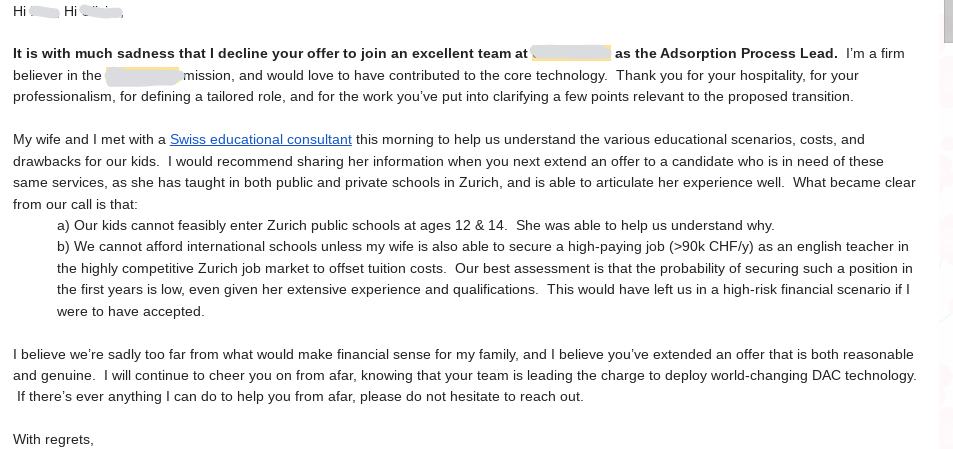
WAIT, WHAT??!!

I know. We said no. Which means of course there’s more to tell! Third leg is on the way.

How Many Legs Can One Move Have? Leg 1: The Lead, which may be buried

Everything our family of four (and two dogs) possesses is now in my parents’ house — including us. Granted our belongings are no longer massive: approximately 25 small shipping boxes, 3 guitars, a typewriter, and 2 large suitcases per person. No furniture.

We are moving to Switzerland with stops along the way.

Stop 1: Still in Southern California, hours from the our home, I’m sitting in the house I grew up in. And now seems as good a time as any to look back on the last few months, breaking down how we ended up here. And how we will end up there. To do that, I’ll have to venture back in time a bit, and start somewhere near the trailhead for this journey.

My husband and I have talked about him leaving his job for years. He is a much nicer, much gentler, much more optimistic person than I am, so whenever I said, “It’s not gonna get better,” he’d say, “Well, they just said they would do…” (He’s a big believer in people — one of the reasons I love him — and also one of the reasons it took a while for him to leave his job.) And he’d go on working there for months and months, and we’d go through this cycle of discussion regularly.

Until he couldn’t take the stress or the angst anymore. Around the start of the school year, he told the company he was leaving at the end of the calendar year, 2023. The discussions between the two of us regarding his job shifted, necessarily, from the usual cycle we’d grown accustomed to to the unknown of the job market.

With a stable job as a teacher and a good school district for our sons, I wasn’t particularly keen to move. Still, I knew it was a real possibility that, as my husband applied to or networked for jobs that fit his particular set of (esteemed) skills, it may not be in the San Diego area. He’s a physicist. A chemical physicist. A physical chemist. It all means the same thing to me; which is to say, I don’t know what it means. (And, yes, I have no idea what he’s talking about when he tells me his tasks and shows me his graphs of what he’s working on; I just read his intonation to figure out if he’s excited or disappointed about what he’s discovering.)

“Maybe I can do something else,” he’d say, “in order to keep us here for sure. Then the boys could graduate here, at least.”

See? Sweet, gentle, giving man. Looking to make it easier for others.

“Like what?” I’d ask — though I don’t know why, because, no matter what he might be doing for a living, I’m not likely to understand a lick of it.

“I basically do a lot of data analysis now, I could probably do something in that field. I know…” or “I know a lot about ____,” and he’d continue with his list of people he knows in all sorts of fields who could help him find a job locally.

So he did everything: worked at the job he was leaving, looked for local jobs, and looked for jobs that could take us to, well, anywhere. He was speaking with companies in Paris, London, one somewhere in New Zealand, San Diego, Boston, Los Angeles, San Jose, and, of course, Zurich. It felt as though there were leads everywhere. So many, to me, that I set it on the shelf in my mind until something was more tangible. Meanwhile, he had to consider everything as imminent.

“There’s a company in Zurich,” he told me one morning, “doing direct air capture.”

This was before my morning coffee, so I did not know if Zurich was the neighboring town in San Diego or a Hawaiian island. Direct air capture sounded like logical words; I’d have to translate them later, after caffeine.

“Cool,” I said, probably with little enthusiasm.

“They have a few job openings I’m interested in. What do you think about Switzerland?”

Okay. Time to wake up, I thought. “Switzerland would be cool.”

“You know my family is Swiss? We’re from Bern.”

“Yeah, cool,” I said.

He applied to several positions at this company in Switzerland, and soon they requested an interview.

I confess, as long as I was going to a full-time job myself, working with the lovely young generation of middle schoolers I found myself with each morning, I didn’t have much headspace for his job hunt. I was excited and proud for all his leads and phone calls and even interviews, but I’d drop those thoughts for most of the day to be Teacher and then Mom. He could give you the more gripping version of this — alas, he’s busy doing consulting work these days, but we will get to that — much later.

For both of us, this job hunt felt long. Leads, leads, then nothing. Phone calls, phone calls, then quiet. It was early November when this company in Zurich, having already conducted several interviews online, told him they’d like to fly him out to have an onsite interview.

Now, if my husband is the big believer in the ability for everyone to change and things to go well, I am the bare-bones, just-the-facts, pragmatic bottom liner. So my train of thought was, “They’re willing to fly him from San Diego to Zurich? They’ll have to put him up in a hotel. That’s thousands of dollars. They are offering him the job.”

Time to learn German.

In fact, I was sitting in a traffic jam outside Lahaina on a family vacation when I figured, might as well capture this time for tutelage.

[Okay, my American friends. I know you speak English and, I don’t know, maybe a little Spanish or French you learned in high school, but you probably haven’t used it much since. So now I’m talking about European languages, yes, but I’m talking specifically about the tiny country of Switzerland, best known, I’d say, for their chocolate and their tennis star, Roger Federer. If you aren’t a tennis fan, that’s okay, and if you aren’t a Roger Federer fan, that’s really not okay, but I’m going to give you a chance to change that. Either way, you need to know that one of the most impressive things about elite tennis players in general is that they play in hours-long matches, sprinting from side to side, playing mind games with their opponents, for sometimes three or four hours before a winner is declared, and then, after all they’ve done, someone shoves a microphone in their face for an on-court interview in the language of the location. At the French Open? Speaking French. Wimbledon? That’s English. And most of these athletes are neither French, British, or American. So, take Roger Federer, an all-time great who has won every grand slam tournament there is. And, of course, he’s Swiss, but he’s gliding through these interviews in English just as he glides on the court. Same thing in French. And he’s also spoken in Italian and Mandarin in the post-match interviews, depending on where the match itself is located. Anyway, I digress. The point is I know English. I’m great at English. I know a little Spanish. I can get by with my high school Spanish. I do not know any other languages anywhere near proficient enough to survive a basic conversation, and we are talking about moving to Switzerland where the spoken language, Roger Federer’s first language, is Swiss German.]

Switzerland has four official languages, and none of them are the language Swiss children learn first. Although Swiss German is spoken, it has no grammar. It’s not really a written language. I like to think of it as the opposite of a language like Latin. In English, we call languages like Latin that are no longer spoken, a “dead language.” Swiss German isn’t dead; it’s spoken, but only spoken. I wouldn’t call it a “live language.” That seems like it would be a written and spoken language. So, not being a linguist as previously proven, I’m going to call Swiss German a “spirit language.” I think it fits. It’s not confined by grammar (aka structure, like a skeleton) so it can’t have a body. It’s not dead, it has no body, it must be spirit.

Again, I digress.

In Switzerland, the four official languages are German (thus where I began), French, Italian, and Romansh (which I’d never heard of in forty years of living). Swiss German is not an official language. Hmmm….

If my husband is going to be offered a job in Switzerland, I need to get on my language game to consider the offer seriously.

Why did I pick German to begin with? I don’t recall, though I can substantiate it with logic. I’m sure you can, too. Say “Zurich.” Really. Say it. Out loud. Whisper if you must. If you hadn’t any idea where this place was but knew it was a place where they were likely to speak German, French, Italian, or Romansh, which would you go with? German, of course. The “ch” at the end of the word chokes of guttural phlegm production. Must be German.

I open my language app I use for Spanish — since I am a teacher in the San Diego area. “Which one of these is coffee?” it asks. My choices: Milch, Kaffee, Brot.

I’m going to rock German, I think.

“Which one of these is milk?”

I’m already fluent.

“Du bist ein Dummkopf.”

Strange. I don’t know how to translate that.

So I’m sitting in a rental car in a Hawaiian traffic jam caused by I-don’t-know-what, learning German.

“I want to learn German!” I hear from the back seat. “Can I do that, too?” asks the younger of my two sons.

“Sure,” I say, thinking only about the fact that he seems exhilarated by the idea and that would make for a good distraction as we move the width of three palm trees per minute.

Then I realize I’m about as exhilarated internally as he is externally about the idea of learning another language and about the notion that we could be living abroad. I’ve always wanted to live abroad. I spent a summer in Hungary teaching English in preparation for a year in Budapest, which fell through at the last minute. And no, I don’t speak Hungarian. I am even, somewhere, on tape — yes, tape — as an eighteen-year-old at my high school Grad Night being asked about the Twenty Year Reunion twenty years in the future. (Now, when I hear this question being posed to a graduate of a few hours, my left eyebrow raises, but at the time, I took it in stride and said) “I won’t be at the reunion. I’ll be living in London.”

Which, of course, did not happen.

But my motivation for saying that was partly about living abroad — and partly about being a book editor, which, also, didn’t happen.

Arranging for an on-site interview in a country nine hours ahead of you is a bit challenging. 9:00 AM in Switzerland is midnight on the California coast. 5:00 PM there is 8:00 AM in San Diego. So, their work day overlaps with our early morning sleep schedule. Since our household gets up between 6am and 7am, we have about an hour or two each day to contact Switzerland live. Otherwise, all communication must be conducted at a snail’s pace via email, waiting through the night to receive a response — if they get to it in fewer than 24 hours.

Eventually, the interview was set for Monday November 20th. Thanksgiving week here in the States. Just another work week there in Zurich.

KZ sitting on the Hawaiian coast, not too far from Lahaina, Maui

No, of course, that’s not all! That’s the first leg. You thought I could tell this whole thing in one post??!

Don’t worry, Leg 2 is coming. We’re going to need at least a second leg so that I don’t fall over.

Vlog Review: The Night Gardener

Hit Play on the video above.

Premise: Molly and her brother Kip must find a way to support themselves without their parents, so they book posts at an isolated home in an avoided wood in England. When they arrive, they discover something peculiar happens there that causes the house’s inhabitants to become sickly — and there seems to be a man who roams the house each night. Who is he? Why is he there? And what is happening to this family? Find out in this paranormal fantasy thriller.

Rating: 3/5
Target: 4-9

Title:  You guessed it. The man in the premise (above) is the night gardener. I won’t tell you why he’s called that, though, but he drives the plot in more ways than one, so it makes sense that he’d have the title of the book.

Main Character(s): Molly, 14 y.o. (she/her) & Kip, 11 y.o.. (he/him) — siblings

Motifs (not exhaustive): home, story, truth, desire, life/death, independence/dependence, strength/weakness, perception/reality, specters, gardening, gifts, sacrifice

Great for…* (readers): who want action, suspense, or a little fright — this one’s plot driven, which tends to be a good match for reluctant readers.

Great for…* (teachers): Oh, goodness, the symbolism is pretty heavy-handed in this book, so that could go over well as a study, but so could character development

Parental Warning(s): None.

Interact: What kind of nightmares did/do you have as a kid?

Shop local bookstores.
Shop Amazon.
Add on Goodreads.

*The “Great for” category is not exhaustive and does not intend to neglect the multitude of readers/teachers who could learn from this book in any number of ways.

RATINGS GUIDE

٭ = DNF, would not recommend
٭٭ = would not recommend
٭٭٭ = enjoyable, would recommend
٭٭٭٭ = very good, would recommend
٭٭٭٭٭ = amazing, would definitely recommend

Vlog Review: Other Words for Home, a novel in verse

Hit Play on the video above.

Premise: Division erupts in Jude’s hometown in Syria, causing her brother to side and react differently than her father and sending Jude and her mother to live with family in Ohio. Jude needs courage to leave Syria and begin a life in the U.S. but she also needs courage to face a culture that sees her as someone who does not belong, as someone “middle eastern,” and figure out what home really means when everything is different than it was before.

Rating: 4/5
Target: 4-7

Title:  Jude must improve her English skills while living as a refugee in the United States, so the title can be taken literally, but there’s much more to the concept of home than a word.

Main Character(s): Jude, 12 y/o (she/her)

Motifs (not exhaustive): culture, hope, home, bravery/courage, war, change, terrorism, war, dislocation/refugees, language, middle eastern/syria, anti-refugee behavior, EMPATHY

Great for…* (readers): who appreciate deep thinking OR who are intimidated by the text on a page (as this book is written in verse).

Great for…* (teachers): Symbolism and discussion, discussion, discussion. There is so much in this book that lends itself to deeper meaning than just the words on the page (thereby also playing into the motif of language/communication). The book can be used to challenge preconceived notions and assumptions, so, again: discussion!

Parental Warning(s): Anti-refugee behaviors and words but no cursing

Interact: Who or what means home for you? (Consider sights, scents, textures, etc.)

Shop local bookstores.
Shop Amazon.
Add on Goodreads.

*The “Great for” category is not exhaustive and does not intend to neglect the multitude of readers/teachers who could learn from this book in any number of ways.

RATINGS GUIDE

٭ = DNF, would not recommend
٭٭ = would not recommend
٭٭٭ = enjoyable, would recommend
٭٭٭٭ = very good, would recommend
٭٭٭٭٭ = amazing, would definitely recommend

Vlog Review: Once Upon a Quinceañera

Hit Play on the video above.

Premise: Carmen Aguilar must complete a summer project if she wants to graduate high school this year. She’s ruined one project, but her best friend helps her land a new internship with a party princess company. Carmen plays the role of Belle and is mortified when her ex shows up as the Beast. Now she has to learn to deal with him and with her wicked stepsister of a cousin who’s just hired the company to perform at her quince.

Rating: 4/5
Target: 8th grade and up, Latinx especially

Title: The motif of dreams and muddled realities, Disney princesses and villainy run rampant through this novel. I don’t love the title, but it makes sense.

Motifs (not exhaustive): coming of age, Latinx culture, Cuban-American culture, OWN voices, princesses, Disney, beauty & the beast, family relationships, mending broken relationships, growth, multiple cultures, extended family

Great for…* (readers): from a Latinx culture, interested in Latinx culture, or needing exposure to Latinx culture — some Spanish (occasionally, though not always translated to English)

Great for…* (teachers): character arc/growth, motif/theme, culture exposure

Parental Warnings: clear sexual references and scenes, intermittent cursing

Shop local bookstores.
Shop Amazon.
Add on Goodreads.

*The “Great for” category is not exhaustive and does not intend to neglect the multitude of readers/teachers who could learn from this book in any number of ways.

RATINGS GUIDE

٭ = DNF, would not recommend
٭٭ = would not recommend
٭٭٭ = enjoyable, would recommend
٭٭٭٭ = very good, would recommend
٭٭٭٭٭ = amazing, would definitely recommend

Vlog Review: I Can Make This Promise

Hit Play on the video above.

Premise: Who is Edie Green and what makes her different? Firstly, she didn’t know she was different until kindergarten when her teacher asked her where her family is from and all she could say was Seattle. Secondly, her mom is Native American, adopted into a white family. As far as Edie knows, they have no connection to her mother’s birth family. She doesn’t know if she’s a part of a local tribe or not. What she does know is she has Native American features — strikingly similar to a woman in a photograph Edie and her friends discover hidden in the attic. But who is the woman in the picture? And how could her parents be hiding information about this woman that may relate to her identity from her?

Rating: 4.5/5
Target: 5-8

Title: The title encapsulates the entirety of the book and only takes its full significance in the final pages. So, to be purposely vague, it’s poignant.

Main Characters: Edie Green, 12 y/o (she/her)

Motifs (not exhaustive): identity, friendship, truth & hidden truth, disagreement, artistry/creativity, otherness, acceptance, coming of age, Native American history/culture, American history, family/adoption

Great for…* (readers): who are themselves coming of age, figuring out who they are and how they fit into a world with ever-changing knowledge about themselves. Readers who appreciate OWN voices, a bit of mystery, or history will also enjoy this book.

Great for…* (teachers): x Native American history, x Washington state history, motif and theme development, x art/film project, MAKE SURE TO READ THE AUTHOR’s NOTE FOR RELATED CLASS CONTENT/PROJECTS.

If you find yourself getting asked “What are you?” or “Where are you from?” how do you respond? What do you want the people who ask those questions to understand?

Shop local bookstores.
Shop Amazon.
Add on Goodreads.

*The “Great for” category is not exhaustive and does not intend to neglect the multitude of readers/teachers who could learn from this book in any number of ways.

RATINGS GUIDE

٭ = DNF, would not recommend
٭٭ = would not recommend
٭٭٭ = enjoyable, would recommend
٭٭٭٭ = very good, would recommend
٭٭٭٭٭ = amazing, would definitely recommend

Vlog Review: Mary Underwater

Watch the vlog, read the book, share your rating!

Rating 3/5

RATINGS GUIDE

٭ = DNF, would not recommend
٭٭ = would not recommend
٭٭٭ = enjoyable, would recommend
٭٭٭٭ = very good, would recommend
٭٭٭٭٭ = amazing, would definitely recommend